We’re Here to Help With Your Case (512) 375-3303

Austin Domestic Violence Lawyer
Arrested for domestic violence in Austin, or accused by a partner or family member? Call an Austin domestic violence lawyer before you talk to police, and before you contact the other person. Your first consultation is free and confidential, and you can reach us after hours. Call (512) 375-3303 or contact us online.
At CMK Defense, PLLC, we defend people charged with assault family violence, strangulation, continuous family violence, and protective order violations in Austin and across Central Texas. Many of these cases come down to one person’s account of a private argument. We get the 911 call, the body camera video, and the photos early, and we test the story.

How We Defend Domestic Violence Cases
- The 911 call and the video: We go after the 911 recording, body camera and dash camera footage, and any surveillance or phone video before it is lost.
- Our own investigation: We gather texts, social media, photos, and medical records, interview witnesses the police skipped, and check whether the injuries actually match the story.
- Trial preparation and honest advice: We prepare every case as if it will go to a jury, and we explain the long-term cost of every offer before you decide.
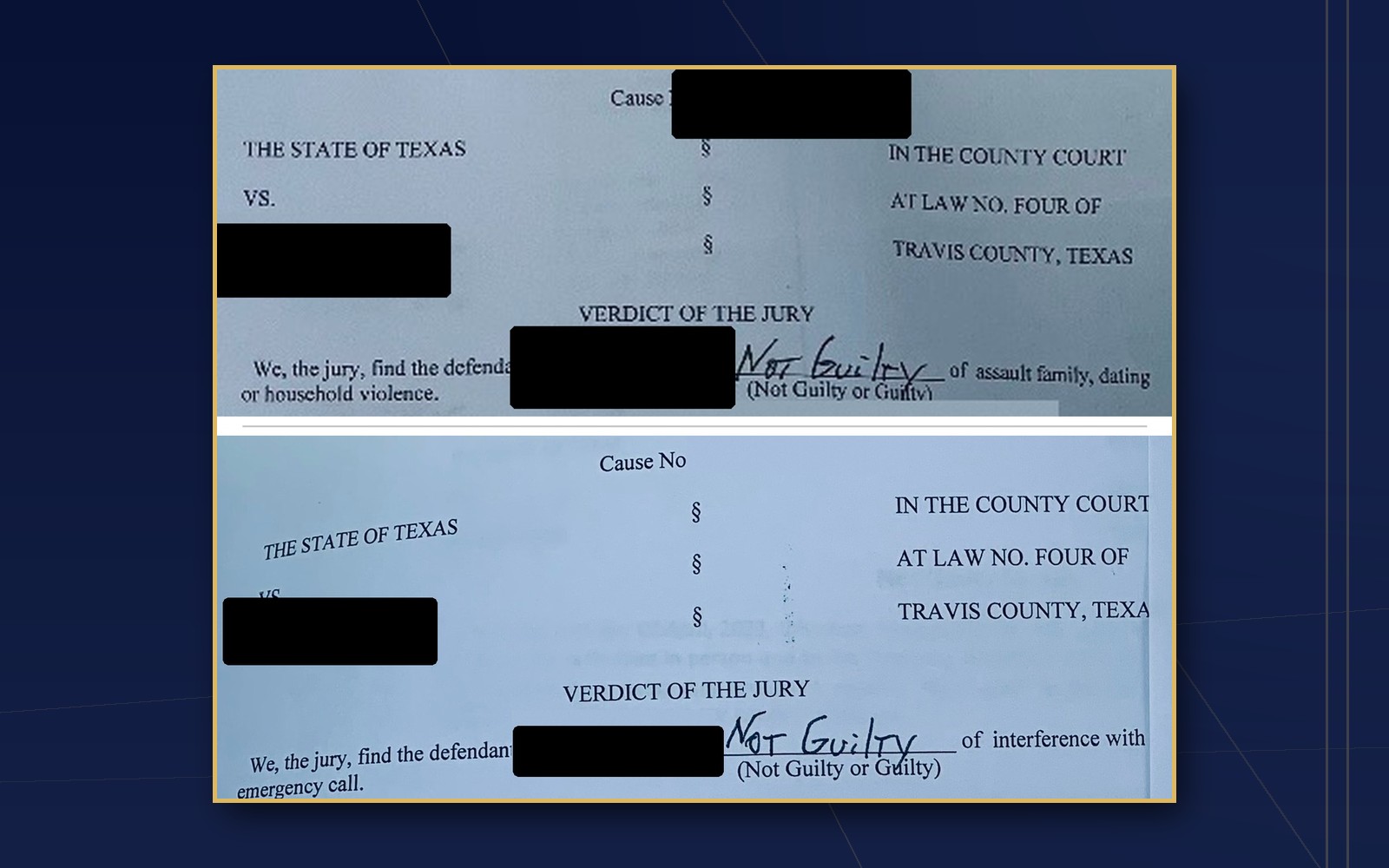
What Counts as Family Violence in Texas
Prosecutors charge family violence assault under the same statute as any other assault (Texas Penal Code § 22.01). What makes it “family violence” is the relationship between the accused and the alleged victim:
- Family: relatives by blood or marriage, former spouses, parents of the same child, and foster parents and children (Family Code § 71.003)
- Household: people who live together or used to live together, related or not (§§ 71.005, 71.006)
- Dating relationship: a current or former dating partner (§ 71.0021(b))
For a bodily injury assault, the State must prove the accused acted intentionally, knowingly, or recklessly. Because recklessness is enough, “it was an accident” is a fight about the facts, not a legal loophole. Self-defense is a separate defense, and when the evidence raises it, a reasonable doubt about it means not guilty.
Domestic Violence Charges and Penalties in Texas
The level of the charge depends on the injury alleged, how it happened, whether a weapon was involved, and whether there is a prior family violence case.
Misdemeanor Family Violence Charges
| Charge | Level | Punishment range |
|---|---|---|
| Assault causing bodily injury to a family or household member or dating partner (§ 22.01(a)(1)) | Class A misdemeanor | Up to 1 year in jail and a fine up to $4,000 |
| Threat of bodily injury, or offensive physical contact (§ 22.01(a)(2)–(3)) | Class C misdemeanor | Fine up to $500 |
| Violating a protective order or bond condition (§ 25.07) | Class A misdemeanor (a felony in some cases) | Up to 1 year in jail and a fine up to $4,000 |
Felony Family Violence Charges
| Charge | Level | Punishment range |
|---|---|---|
| Choking or strangulation: impeding breathing or blood flow (§ 22.01(b)(2)(B)) | Third-degree felony | 2 to 10 years in prison and a fine up to $10,000 |
| Bodily injury assault after a prior family violence conviction or deferred adjudication (§ 22.01(b)(2)(A), (f)) | Third-degree felony | 2 to 10 years in prison and a fine up to $10,000 |
| Strangulation after a prior family violence conviction or deferred adjudication (§ 22.01(b-3)) | Second-degree felony | 2 to 20 years in prison and a fine up to $10,000 |
| Continuous violence against the family: two or more bodily injury assaults within 12 months (§ 25.11) | Third-degree felony | 2 to 10 years in prison and a fine up to $10,000 |
| Aggravated assault: serious bodily injury, or using or showing a deadly weapon (§ 22.02) | Second-degree felony | 2 to 20 years in prison and a fine up to $10,000 |
| Aggravated assault where a deadly weapon is used and causes serious bodily injury to a family or household member or dating partner (§ 22.02(b)(1)) | First-degree felony | 5 to 99 years or life in prison and a fine up to $10,000 |
For misdemeanor charges, see our misdemeanor page; for felonies, see felony charges. For assaults outside the family, see our assault defense page.
Deferred Adjudication in a Family Violence Case
Prosecutors often offer deferred adjudication in family violence cases. If you complete it, you avoid a conviction. However, in a family violence case it carries costs that last:
- It counts as a prior. If you are later accused of a bodily injury assault of a family or household member or dating partner, prosecutors can use the earlier deferred adjudication to charge the new case as a felony (§ 22.01(f)).
- It can never be sealed. A person placed on deferred adjudication for a family violence offense cannot get an order of nondisclosure for that case, and it blocks nondisclosure for other cases on the person’s record too (Gov’t Code § 411.074(b)).
In some cases, completing a Family Violence Intervention Program (FVIP) can be part of a negotiated resolution. Whether that is possible, and what it leads to, depends on the facts, your record, and the prosecutor. Before you accept any plea offer, talk with a lawyer about what it will mean years from now.
Long-Term Consequences of a Domestic Violence Conviction
- Firearms: a family violence assault conviction can mean a lifetime federal ban on possessing firearms (18 U.S.C. § 922(g)(9)). Texas separately bars possession for five years after release from jail or community supervision (Penal Code § 46.04(b)).
- Future charges: prosecutors can charge a later bodily injury assault of a family or household member or dating partner as a felony.
- Your record: it cannot be sealed (see deferred adjudication above).
- Custody: a history of family violence weighs heavily in custody decisions (Family Code § 153.004).
- Immigration: for non-citizens, a domestic violence conviction can lead to removal (8 U.S.C. § 1227(a)(2)(E)(i)).
- Work and housing: background checks for jobs, professional licenses, and rentals.
Emergency Protective Orders and Bond Conditions
After an arrest for family violence, a magistrate can issue an emergency protective order at your first court appearance (Article 17.292). If the arrest involves serious bodily injury or a deadly weapon, the magistrate must issue one. The order can bar you from going to or near the protected person’s home, even if it is also your home, as well as their workplace or a child’s school. Magistrates can also bar contact with them and possession of a firearm. These orders last 61 to 91 days, or 91 to 121 days in deadly weapon cases, and violating one is a separate crime. Bond conditions often add similar no-contact rules. Learn more about protective orders.
Common Defenses in Domestic Violence Cases
Depending on the evidence, defenses can include:
- Self-defense (§ 9.31) and defense of others (§ 9.33)
- A false or exaggerated accusation, which we test by tracing how the story developed and comparing it to the 911 call, the video, and the physical evidence
- No bodily injury, or injuries that do not match the account
- No qualifying family, household, or dating relationship
- The State cannot prove the required mental state
- Violations of your constitutional rights during the arrest or questioning
- Insufficient evidence to prove the charge
For family violence assaults involving physical injury, see also our physical violence page.
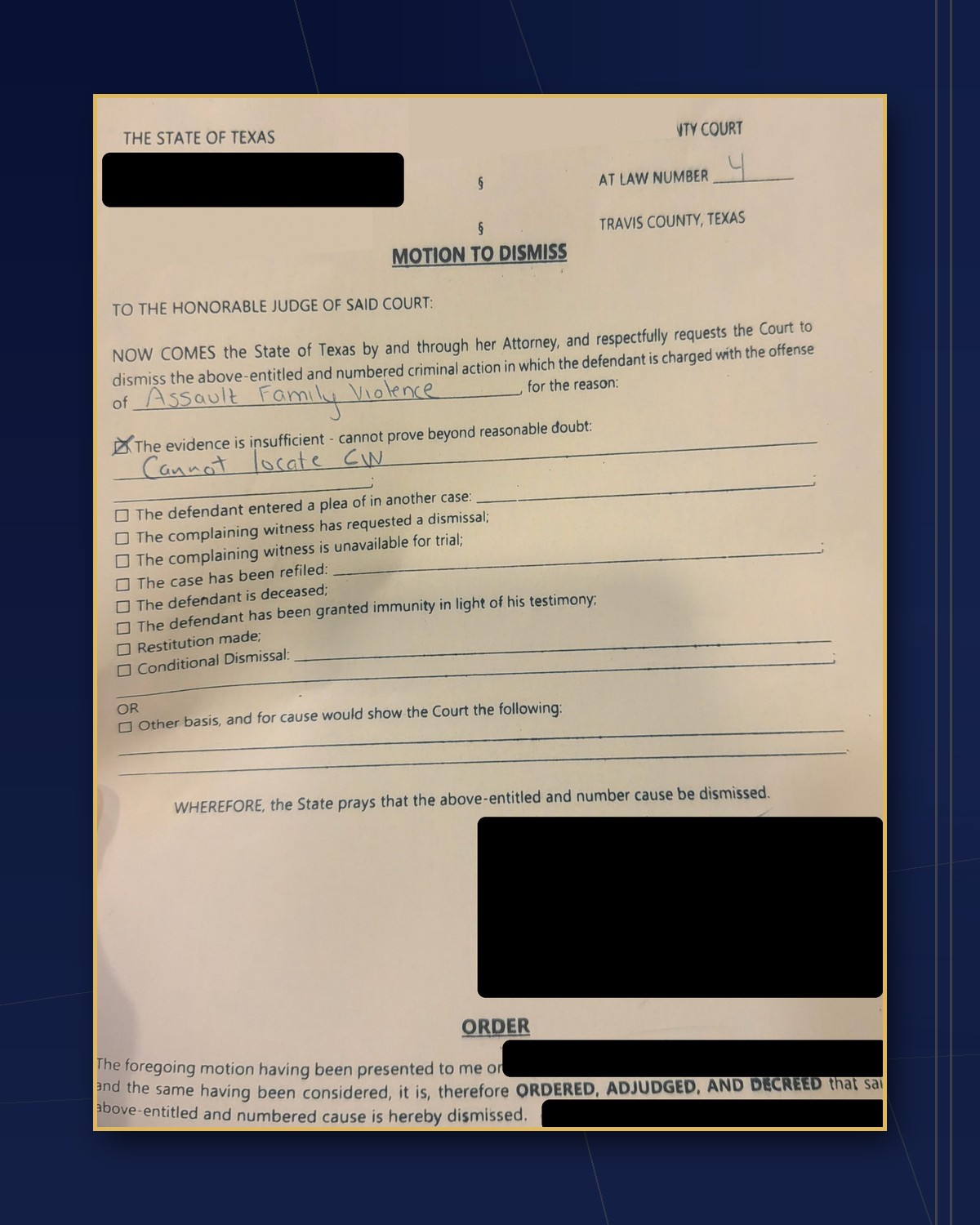
Why Choose CMK Defense, PLLC
We’re not a volume practice. CMK Defense, PLLC was founded by trial lawyers who refuse to accept “that’s just the way it is,” and our attorneys bring more than 30 years of combined courtroom experience to every case. You work directly with an experienced domestic violence lawyer, not a case manager.
Who Handles Your Case
Deniz Kadirhan, partner, has tried numerous felony and misdemeanor jury trials, including aggravated assault and murder cases, and has argued before the Fifth Circuit and the Texas Court of Appeals. She serves on the Board of Directors of the Texas Criminal Defense Lawyers Association.
Angelica Cogliano, partner, has tried cases to verdict in eight states and argued before the Texas Third Court of Appeals, the Fifth Circuit, and the Texas Court of Criminal Appeals. She teaches other defense lawyers how to challenge the State’s evidence; see her speaking and teaching.
FAQ: Domestic Violence Charges in Austin
Can the alleged victim drop domestic violence charges?
No. Once police are involved, prosecutors decide whether the case goes forward. In Travis County, the County Attorney prosecutes misdemeanor family violence cases and the District Attorney prosecutes felonies. The alleged victim can tell prosecutors they do not want the case to go forward, sometimes with an affidavit of non-prosecution, and that can matter. That should go through the defense team: contacting the alleged victim about the case can violate a protective order or bond condition and lead to a new charge.
Is deferred adjudication a good deal in a family violence case?
Sometimes, but it is not a clean exit. In a family violence case, it counts as a prior for a future felony and can never be sealed. Read more about deferred adjudication before accepting any plea offer.
Will I lose my gun rights after a domestic violence conviction?
A conviction for a family violence assault can mean a lifetime federal ban on possessing firearms. Texas law separately bars possession for five years after release from jail or community supervision. A magistrate’s emergency protective order can also bar you from having a firearm while it is in effect.
What is the statute of limitations for family violence assault in Texas?
Misdemeanor family violence assault must be charged within three years. Felony family violence assault, continuous violence against the family, and aggravated assault have five years.
What to Expect When You Call
You can call us before any charge is filed. People often reach out the night of an arrest, when a detective calls, or when they learn someone has made a report. Calling early gives us a chance to protect you before you make a statement and to preserve the 911 call and video.
Your first consultation is free and confidential, and you can reach us after hours. We will listen to what happened, explain the process and what you may be facing, and tell you what to do (and not do) in the meantime.
If you can, have these ready when you call:
- Any paperwork: bond papers, the magistrate’s emergency protective order, or a court date notice.
- The name of the officer or detective, and any report or case number.
- The county, and the cause number if charges have been filed.
- The names of any witnesses.
- Photos of any injuries you had, and a list of texts, calls, posts, or videos that may matter. Do not delete anything, and do not post about the incident.
Do not contact the alleged victim about the case, even to apologize or explain, especially if a protective order or bond condition is in place. Don’t worry if you don’t have everything on this list. Call anyway.
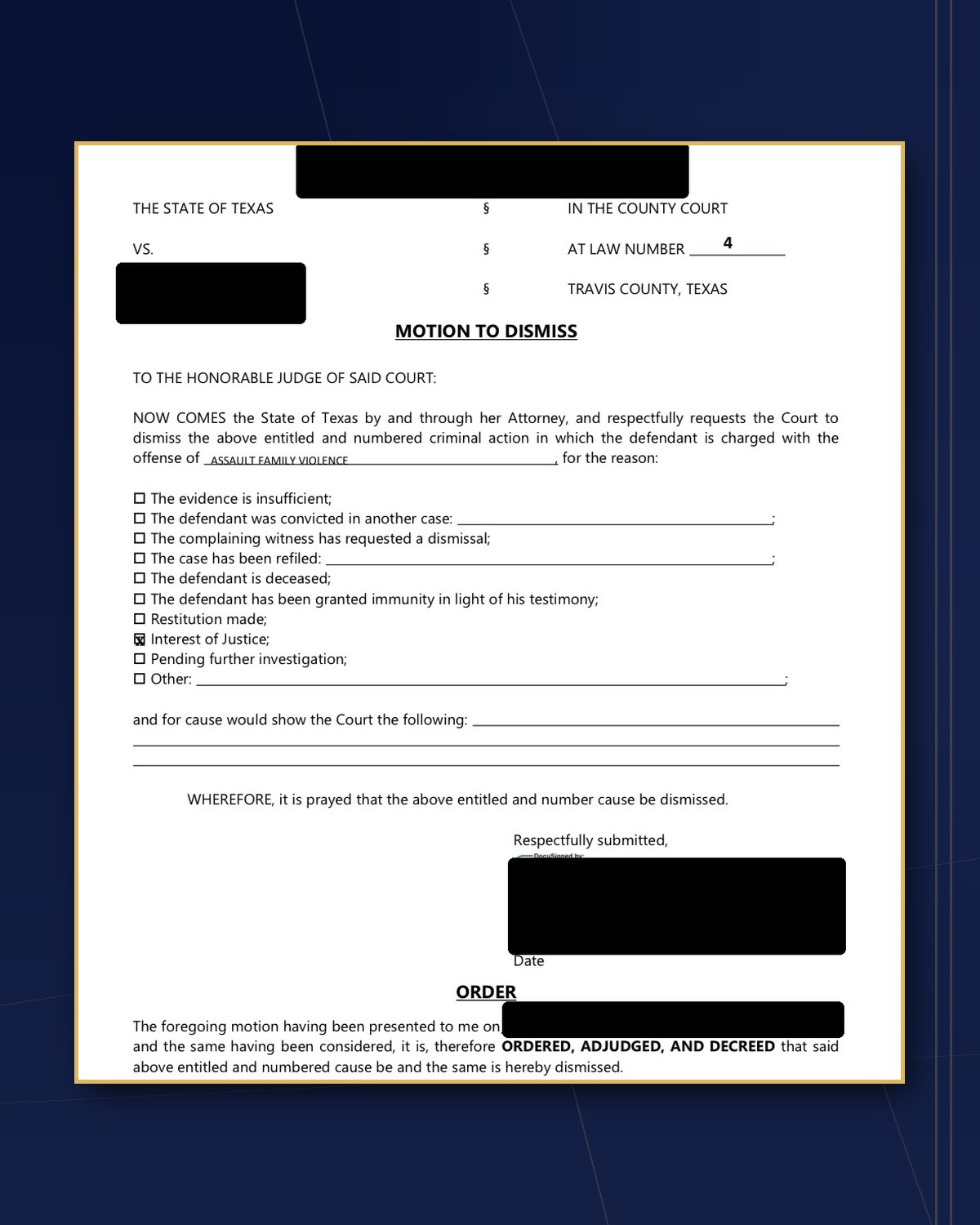
Contact Our Austin Domestic Violence Attorneys
The sooner you call, the more we can do. Call CMK Defense, PLLC at (512) 375-3303, including after hours, for a free and confidential consultation with an Austin domestic violence lawyer, or reach out through our contact page.
Reviewed by Angelica Cogliano, partner at CMK Defense, PLLC. Last reviewed October 2026.
Our Location
CMK Defense, PLLC
1304 West Ave, Austin, TX 78701
(512) 375-3303



Tell us what’s going on. We’ll help you figure out what to do next—starting today.

© Copyright 2026 CMK Defense, PLLC. All Rights Reserved.
