We’re Here to Help With Your Case (512) 375-3303

Austin Sex Crimes Lawyer
Accused of a sex crime in Austin, or told that a detective wants to talk to you? Call an Austin sex crimes lawyer before you say anything to anyone. Your first consultation is free and confidential, and you can reach us after hours. Call (512) 375-3303 or contact us online.
At CMK Defense, PLLC, we defend people accused of sexual assault, child sex offenses, and other sex crimes. We don’t judge, and we don’t assume the accusation is true. We test it.

How We Defend Sex Crime Cases
Sex crime cases often come down to one person’s word and a lab report. We challenge both:
- Our own investigation: We find and interview witnesses, gather messages and digital records, and build the timeline ourselves instead of relying on the police report.
- The forensic evidence: We read the lab’s underlying DNA data, not just its conclusions, and work with independent experts. See how we challenge DNA evidence.
- Trial preparation: We prepare every case as if it will go to a jury. That preparation protects you whether the case is tried, dismissed, or resolved another way.
Why Choose CMK Defense, PLLC?
 Sex crime cases are won on details: a text message the police never collected, a timeline that doesn’t fit, a lab result that doesn’t say what the State claims it says. Our attorneys bring more than 30 years of combined courtroom experience, and we focus on the places these cases are won or lost:
- Forensic science: We study the science behind DNA, digital, and medical evidence, and we teach it. Angelica Cogliano trains other defense lawyers on cross-examining forensic and medical experts; see her speaking and teaching.
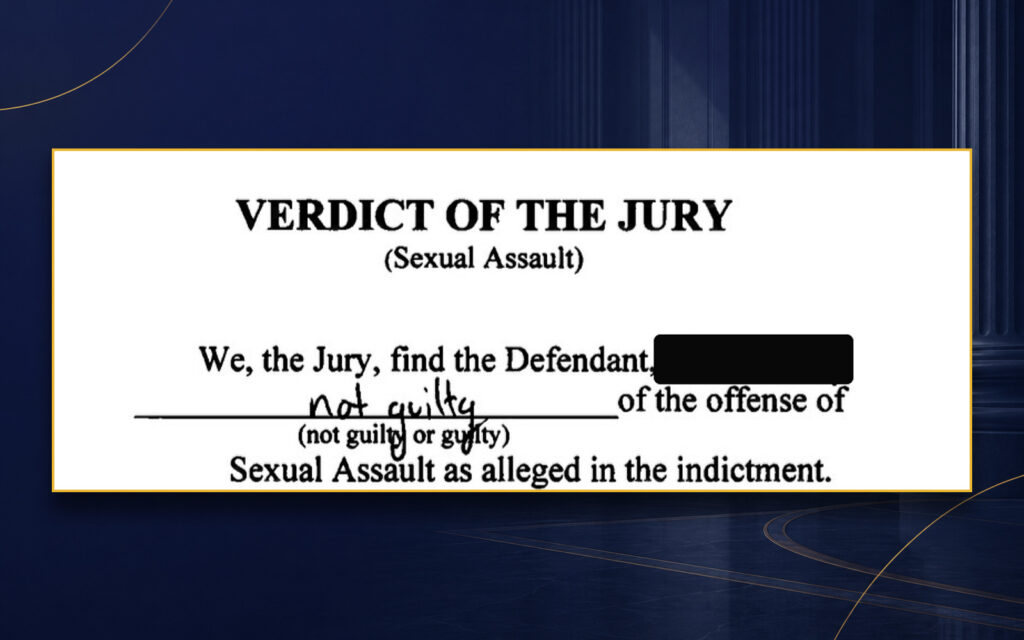
- Trial experience: We have tried sexual assault cases to a jury, including the not-guilty verdict shown below.
- Respect and discretion: An accusation does not define you. We treat every client with respect and keep what you tell us confidential.
We also defend the full range of serious misdemeanor and felony charges.
What Constitutes Sex Crimes in Texas?
Texas law defines sex crimes broadly, covering a wide range of conduct that carries severe legal consequences. CMK Defense, PLLC represents clients facing the following accusations:
- Sexual assault (Texas Penal Code § 22.011)
- Aggravated sexual assault (§ 22.021)
- Sexual assault of a child (§ 22.011(a)(2))
- Indecency with a child by contact (§ 21.11)
- Indecency with a child by exposure (§ 21.11)
- Online solicitation of a minor (§ 33.021)
- Possession or promotion of child pornography (§ 43.26)
- Prostitution (§ 43.02) and solicitation of prostitution (§ 43.021)
- Sexual coercion (§ 21.18)
- Indecent assault (§ 22.012)
- Voyeurism (§ 21.17)
- Indecent exposure (§ 21.08)
- Continuous sexual abuse of a child (§ 21.02)
- Continuous sexual abuse of two or more victims of any age (§ 21.03, for offenses on or after September 1, 2025)
Potential Penalties for Sex Crimes in Texas
The consequences of a sex crime conviction in Texas reach far beyond the courtroom and can permanently alter the course of your life. Penalties vary based on the specific offense, the age of the alleged victim, the date of the alleged offense, and any prior criminal history:
- Sexual Assault (Second-Degree Felony): Two to twenty years in prison, fines up to $10,000, and mandatory sex offender registration.
- Aggravated Sexual Assault (First-Degree Felony): Five to ninety-nine years or life in prison, fines up to $10,000, and lifetime sex offender registration. The minimum rises to 25 years if the child was younger than 10, or younger than 14 and the offense involved one of the aggravating factors in the statute, such as serious bodily injury or a deadly weapon (§ 22.021(f)). For offenses committed before September 1, 2025, the first age limit is younger than 6.
Penalties for Child Sex Offenses
- Indecency with a Child by Contact (Second-Degree Felony): Two to twenty years in prison and fines reaching $10,000.
- Indecency with a Child by Exposure (Third-Degree Felony): Two to ten years in prison and fines up to $10,000.
- Online Solicitation of a Minor (Second- or Third-Degree Felony): It is a third-degree felony (two to ten years) for a person 17 or older to communicate with a minor online in a sexually explicit way, or send a minor sexually explicit material, with the intent to commit certain sex offenses. It is a second-degree felony if the minor is under 14 (or the person believed the minor was under 14). Soliciting a minor online to meet for sex is a second-degree felony (two to twenty years). A conviction requires sex offender registration.
- Continuous Sexual Abuse of a Child (First-Degree Felony): Twenty-five to ninety-nine years or life in prison, with no possibility of parole.
- Continuous Sexual Abuse, Two or More Victims (First-Degree Felony): Five to ninety-nine years or life in prison, for offenses committed on or after September 1, 2025.
For offenses committed on or after September 1, 2025, a judge can order the sentences for more than one sexual assault or aggravated sexual assault conviction to be served one after another.
Common Defenses to Sex Crime Charges
An effective defense against sex crime allegations requires a meticulous review of every piece of evidence and every statement involved in the case. It includes an independent defense investigation to attack the State’s case. It often requires experts in different areas, like psychology, memory, and DNA. Our team builds each strategy around the unique facts of your situation. Here are some examples:
- Consent Defense: Presenting evidence that the alleged encounter was consensual through text messages, communications, witness accounts, or other documentation that supports your version of events.
- False Accusation Defense: Demonstrating that the claims are rooted in personal motives, not legitimate criminal activity.
- Constitutional Violations: Challenging evidence obtained through illegal searches, coerced confessions, or interrogations conducted without proper Miranda warnings.
- Insufficient Evidence: Pointing out flaws, contradictions, and gaps in the prosecution’s case that prevent it from meeting the standard of proof beyond a reasonable doubt.
- Alibi Defense: Providing verifiable proof that you were in a different location at the time the alleged offense occurred.
- Forensic Challenges: Questioning the reliability of DNA evidence, medical examinations, or digital forensic analysis based on collection errors or procedural failures. See DNA and forensic evidence below.
DNA and Forensic Evidence in Sex Crime Cases
DNA is often the centerpiece of the State’s case in a sexual assault prosecution, and jurors tend to treat it as the final word. It is not. A DNA result is only as reliable as the way the sample was collected, stored, tested, and interpreted, and every one of those steps can go wrong. Challenging forensic evidence is a core part of our practice: we read the lab’s underlying data, not just its report, and we work with independent forensic experts when the science is in dispute.
- Mixtures: Samples in sexual assault cases often contain DNA from more than one person. Sorting out who contributed what involves judgment calls and software models whose assumptions can be tested and challenged.
- Transfer: DNA can move from one person or object to another without any sexual contact. Finding someone’s DNA does not show how or when it got there.
- Y-STR testing: This male-only test cannot tell apart men in the same paternal line, such as brothers or a father and son, and its statistics are far weaker than standard DNA testing.
What We Check in the Lab’s Work
- The lab file: Under Texas’s discovery statute, Article 39.14 of the Code of Criminal Procedure, we request the lab’s complete case file, including bench notes, electronic data, and quality records. We also check the lab’s accreditation under Article 38.35 and any disclosures to the Texas Forensic Science Commission.
- The analyst: We examine the analyst’s training, forensic license, and track record, including any past problems with their testimony or casework.
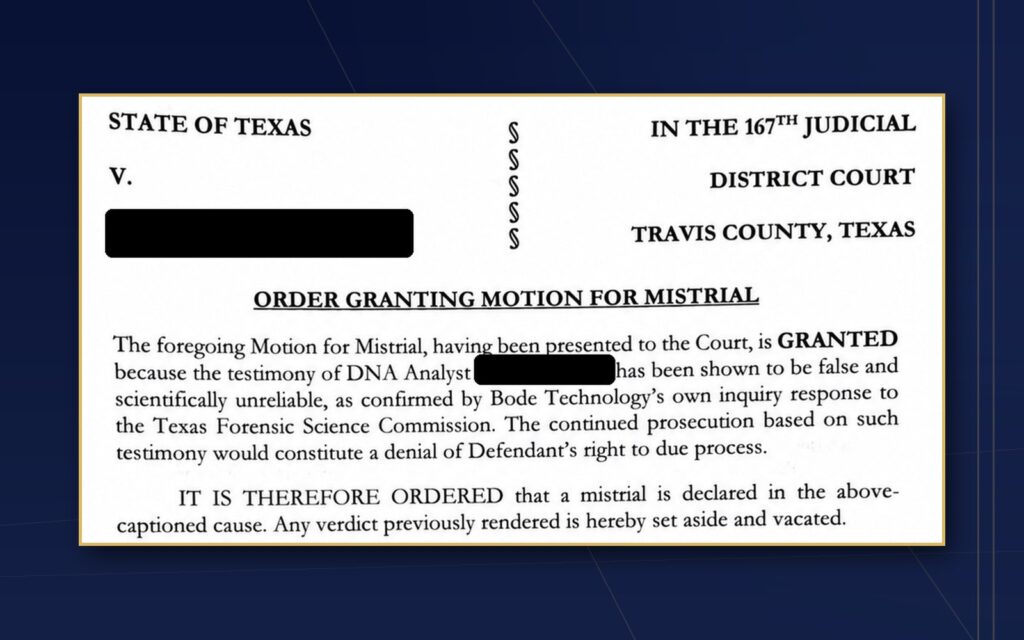
Angelica Cogliano has written about Y-STR DNA testing for Voice for the Defense, the journal of the Texas Criminal Defense Lawyers Association; see her speaking and teaching. The mistrial order near the top of this page is one example of what this scrutiny can uncover: the court found the State’s DNA testimony false and scientifically unreliable.
Protecting Your Rights During the Investigation
The investigation phase is often where cases are won or lost, and what you say or do during this period can dramatically affect the outcome. Protect yourself by following these guidelines from the very beginning:
- Exercise your right to remain silent during police questioning. Learn more about talking to police when you are not under arrest.
- Contact an Austin sex crimes lawyer from CMK Defense, PLLC before making any statements.
- Do not discuss the allegations with anyone other than your attorney.
- Preserve all communications, messages, and digital records related to the case.
- Avoid any contact with the accuser or potential witnesses.
- Do not consent to searches of your phone, computer, or home without a warrant.
- Document your whereabouts and activities relevant to the alleged timeframe.
FAQ: Answers After Being Charged With a Sex Crime
The Police Want to Talk to Me. What Should I Do?
Do not speak with law enforcement without an attorney present, no matter how friendly or casual the conversation seems. Even innocent people can be tricked into giving incriminating statements by seasoned detectives who are only seeking probable cause to arrest you. The Fifth Amendment to the United States Constitution gives you the right to remain silent, but you have to say so clearly. Simply staying quiet may not be enough: the U.S. Supreme Court has allowed prosecutors to use a person’s silence against them when the person never actually invoked the right. Never go alone to the police station to “clear your name.” Tell officers plainly that you will not answer questions without a lawyer, and then call one. For more, see our criminal defense FAQs.
Should I Take a Lie Detector Test?
You should not agree to a polygraph examination (lie detector test) without first consulting your attorney. Polygraph results are not admissible in Texas courts, and law enforcement uses them mainly as an interrogation tool to pressure you into making statements or admissions that can damage your defense later.
Can DNA Evidence Be Challenged?
Yes. A DNA result depends on how the evidence was collected, stored, tested, and interpreted. Mixed samples, DNA transfer, and analyst error can all be challenged using the lab’s underlying data and an independent expert. See DNA and forensic evidence above.
Will I Have to Be on the Sex Offender Registry if Found Guilty?
The Texas Sex Offender Registration Program requires individuals convicted of certain sex offenses to provide local law enforcement with their personal information, address, and photograph. Whether a person must register and for how long depends on the offense.
Some offenses require registration for ten years after the sentence ends, while others require registration for life. Texas law allows some people to ask a court to end the duty to register early, but many offenses are not eligible. Under Texas Code of Criminal Procedure Article 62.102, failing to comply with registration requirements may result in a felony charge and additional prison time.
What to Expect When You Call
You can call us before any charge is filed. People often reach out when a detective calls, when CPS opens an investigation, or when they learn someone has made an accusation. Calling early gives us a chance to protect you before you make a statement or agree to a search.
Your first consultation is free and confidential, and you can reach us after hours. We will listen to what happened, explain the process and what you may be facing, and tell you what to do (and not do) in the meantime.
If you can, have these ready when you call:
- Any paperwork: arrest or bond papers, a court date notice, a protective order, or a letter from CPS.
- The name and phone number of any detective or investigator who has contacted you.
- The county, and the case or cause number if charges have been filed.
- The names of the people involved and any possible witnesses.
- A list of messages, photos, social media posts, or other records that may matter. Do not delete anything, and do not share it with anyone but your lawyer.
Don’t worry if you don’t have all of this. Call anyway.
Talk to an Austin Sex Crimes Lawyer Now
The sooner you call, the more we can do. Call CMK Defense, PLLC at (512) 375-3303, including after hours, for a free and confidential consultation with an Austin sex crimes lawyer, or reach out through our contact page.
Reviewed by Angelica Cogliano, partner at CMK Defense, PLLC. Last reviewed October 2026.
What Our Clients Say

Read Luis’s review on Google. Every case is different, and past results do not guarantee a similar outcome.
Read all our Google reviews.
Our Location
CMK Defense, PLLC
1304 West Ave, Austin, TX 78701
(512) 375-3303



Tell us what’s going on. We’ll help you figure out what to do next—starting today.

© Copyright 2026 CMK Defense, PLLC. All Rights Reserved.
