We’re Here to Help With Your Case (512) 375-3303

Austin DWI & Alcohol Offense Lawyers
Arrested for DWI in Austin? Call an Austin DWI lawyer before you talk to anyone about what you drank or when. If you failed or refused a breath or blood test, you also have only 15 days after you receive notice to ask for a hearing to save your driver’s license. Your first consultation is free and confidential, and you can reach us after hours.

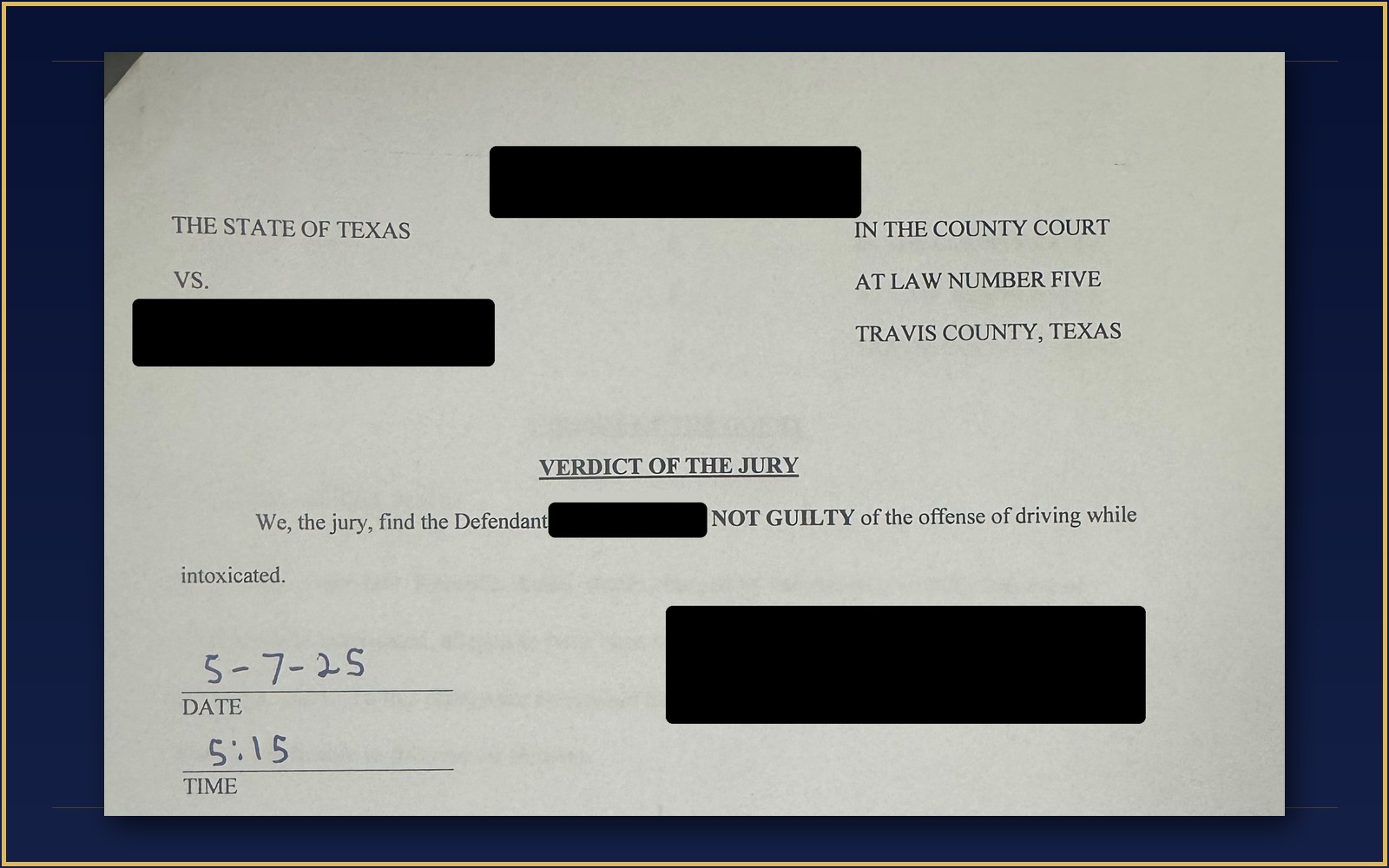
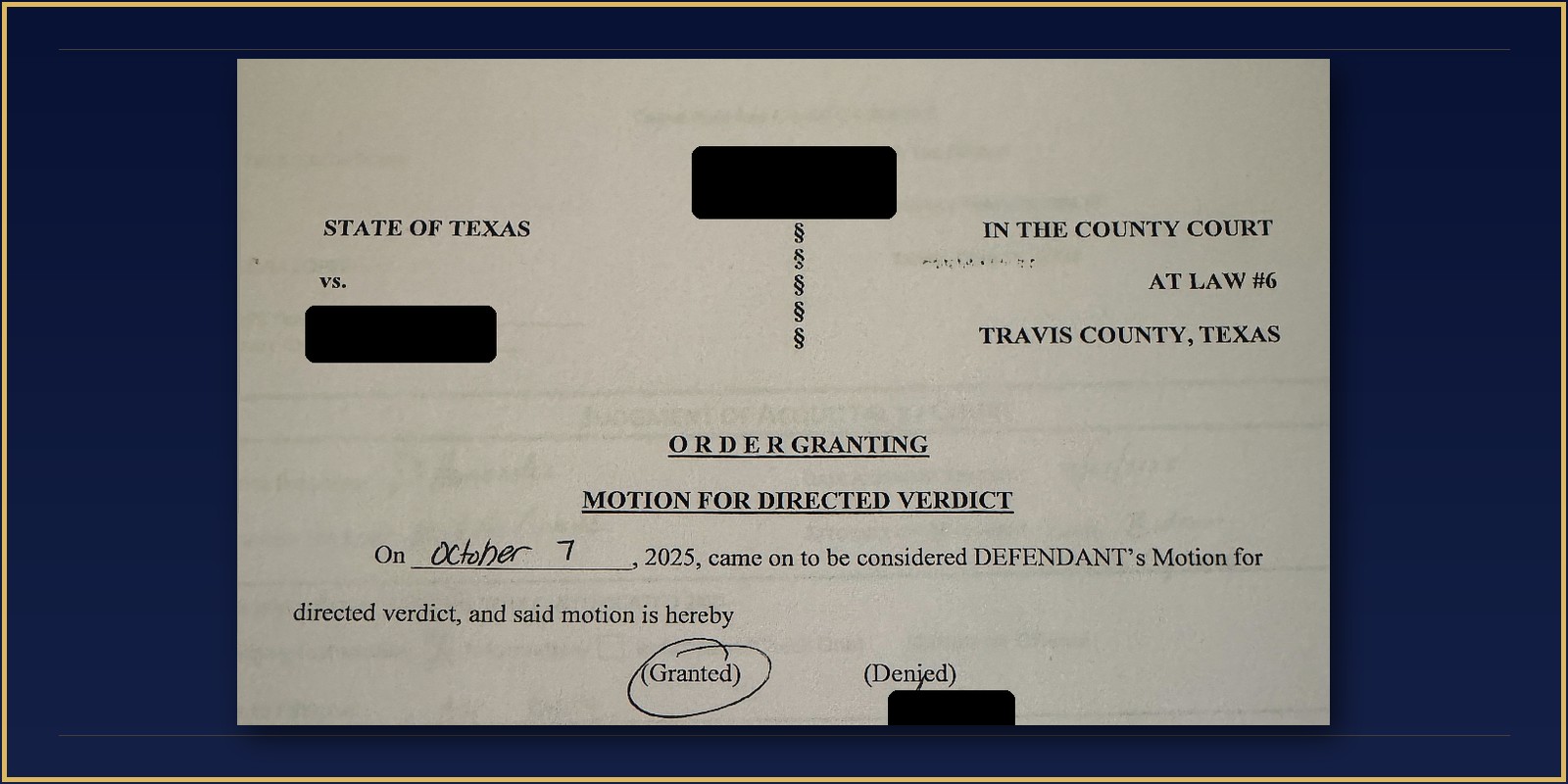
At CMK Defense, PLLC, we defend people charged with DWI, felony DWI, intoxication assault, intoxication manslaughter, and related alcohol offenses in Austin and across Central Texas. We get the video and the testing records early and test every piece. Recent Travis County DWI results include a jury verdict of not guilty (May 2025) and a directed verdict granted (October 2025). Past results do not guarantee a similar outcome.
What Happens After a DWI Arrest in Austin
Two cases start at the same time: the criminal case in court, and a separate civil case with the Texas Department of Public Safety over your driver’s license. They run on different deadlines, and the license deadline comes first.
- Getting out of jail. Bond comes first. Our posts on how CAFA affects getting out of jail in Travis County and on personal, surety, and cash bonds explain the process.
- The 15-day license deadline. If you failed a breath or blood test, or refused one, you receive a notice of suspension. The department must receive your written hearing request within 15 days after you receive that notice (Tex. Transp. Code § 524.031 for a failed test; § 724.041 for a refusal). The law treats notice mailed by the department as received on the fifth day after mailing. A timely request stays the suspension until the administrative law judge makes a final decision.
- The criminal charge. The prosecutor reviews the case and files formal charges. Until then, do not discuss the stop, your drinking, or your driving with anyone but your lawyer. Our post on whether you have to talk to police in Texas explains why.
- The evidence. We move quickly to secure the body camera and dash camera video, 911 and dispatch records, and the breath or blood testing records, because that evidence decides most DWI cases.
How Texas Proves a DWI Charge
Under Tex. Penal Code § 49.04(a), the State must prove you were intoxicated while operating a motor vehicle in a public place. “Intoxicated” has two definitions:
“Intoxicated” means: (A) not having the normal use of mental or physical faculties by reason of the introduction of alcohol, a controlled substance, a drug, a dangerous drug, a combination of two or more of those substances, or any other substance into the body; or (B) having an alcohol concentration of 0.08 or more. Tex. Penal Code § 49.01(2).
That means a DWI charge does not need a test result. An officer’s description of how you looked, spoke, and performed can be enough for the State to go to trial. It also means DWI is not limited to alcohol: prescription medication and other drugs can support the same charge.
The State must also prove you were operating the vehicle, and that it happened in a public place. Where you were, what the vehicle was doing, and who saw you driving are facts we check against the video and the witnesses.
DWI Charges and Penalties in Texas
These are the statutory ranges for a conviction. What happens in a particular case depends on the facts, the record, and the court.
The fine for the offense is only part of the cost. After a conviction, Transp. Code § 709.001(b) adds a separate traffic fine: $3,000 for a first conviction within 36 months, $4,500 for a second or later one within 36 months, and $6,000 if a test showed 0.15 or more. The court must waive it if it finds you indigent (§ 709.001(c)). Prior DWIs matter, too. A probated sentence is still a final conviction for enhancement. So is a deferred adjudication for DWI (§ 49.09(d), (g)).
Misdemeanor DWI
- First DWI (Class B misdemeanor): a minimum of 72 hours in jail and up to 180 days, a fine up to $2,000 (plus the additional traffic fine described above), and a license suspension of 90 days to one year (§ 49.04(b); Transp. Code § 521.344). Probation may be possible.
- DWI with an open container: still a Class B misdemeanor, but with a minimum of six days in jail (§ 49.04(c)).
- DWI with an alcohol concentration of 0.15 or more (Class A misdemeanor): up to one year in jail and a fine up to $4,000, if a blood, breath, or urine test shows 0.15 or more at the time of analysis (§ 49.04(d)).
- Second DWI (Class A misdemeanor): a minimum of 30 days and up to one year in jail, a fine up to $4,000, and a license suspension of 180 days to two years (§ 49.09(a)). A second offense within five years brings a mandatory ignition interlock order (§ 49.09(h)).
Felony DWI
- Third DWI (third-degree felony): two to ten years in prison and a fine up to $10,000. The same level applies after two prior qualifying intoxicated-operation convictions, or one prior intoxication manslaughter. Qualifying priors include DWI, intoxication assault or manslaughter involving a vehicle, flying or boating while intoxicated, and similar out-of-state offenses (§ 49.09(b), (c)).
- DWI with a child passenger (state jail felony): 180 days to two years in state jail and a fine up to $10,000, even on a first offense, when a passenger is younger than 15 (§ 49.045).
- DWI in a school crossing zone (state jail felony): 180 days to two years in state jail and a fine up to $10,000. It applies when the offense happens in a school crossing zone while the reduced speed limit is in effect, for offenses on or after September 1, 2025 (§ 49.04(e)).
Intoxication Assault and Intoxication Manslaughter
- Intoxication assault (third-degree felony): two to ten years in prison and a fine up to $10,000 when intoxicated driving causes serious bodily injury (§ 49.07). It rises to a second-degree felony if the injured person is a firefighter or emergency medical services worker on duty, or if the injury leaves the person in a persistent vegetative state. It is a first-degree felony if the injured person is a peace officer or judge on duty (§ 49.09(b-1), (b-4)).
- Intoxication manslaughter (second-degree felony): two to twenty years in prison and a fine up to $10,000 when intoxicated driving causes a death (§ 49.08). It is a first-degree felony if the person killed was a peace officer, judge, firefighter, or emergency medical services worker on duty. For offenses on or after September 1, 2025, it is also a first-degree felony if more than one person died in the same criminal transaction (§ 49.09(b-2)). The license suspension is 180 days to two years.
For how felony cases work, see our felony charges page. For misdemeanor DWI, see our misdemeanor page.
Minors and Other Alcohol Offenses
- Driving under the influence by a minor (Class C misdemeanor): for a driver under 21 with any detectable amount of alcohol, a fine up to $500 plus consequences for the driver’s license (Alco. Bev. Code § 106.041). A minor at 0.08 or higher can be charged with DWI instead.
- Other alcohol offenses (Class C misdemeanors): public intoxication, an open container in a vehicle, and minor in possession of alcohol.
How We Defend a DWI Charge
A strong defense starts with every detail of the arrest, from the reason for the stop to how the evidence was collected. No two cases look alike, and the right approach depends on the facts.
The Traffic Stop
An officer needs reasonable suspicion to pull you over. If the stop was not legal, we can file a motion to suppress the evidence gathered after it, which can end the prosecution’s case.
Field Sobriety Tests and Video
Field sobriety tests depend heavily on the officer’s interpretation of your performance. Uneven pavement, poor lighting, footwear, age, injuries, and nervousness can make a sober person look impaired. Dash camera and body camera video often shows something different from the police report, so we review all of it frame by frame.
Breath and Blood Tests
A test number is only as reliable as the way it was collected and analyzed. We examine the breath instrument’s maintenance records and the operator’s certification, and for blood we look at how the sample was drawn, stored, and tested, and at the lab’s accreditation and the analyst’s qualifications. A blood draw is a search, so we also ask whether you consented or the officer had a valid warrant.
The Gap Between Driving and Testing
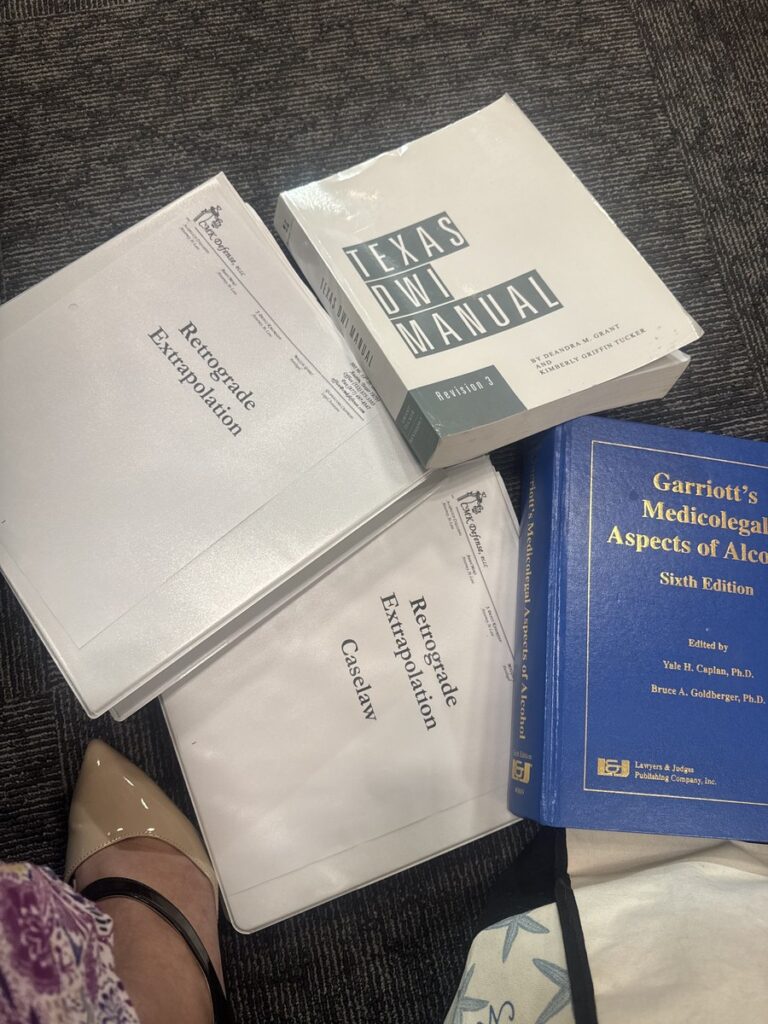
Your alcohol concentration does not peak the moment you take your last drink. The State must prove you were intoxicated while operating the vehicle (§ 49.04(a)), not later when the test was taken. The result of a test taken at an officer’s request is admissible (Transp. Code § 724.064), but a long delay between the stop and the test lets us challenge what the number says about the time you were driving. Your alcohol concentration may still have been rising and could have been under the limit while you were behind the wheel.
Medical Conditions and Other Explanations
Diabetes, neurological conditions, acid reflux, sleep disorders, and some medications can affect how you perform on roadside tests, and can affect test results. We look into whether any of them played a role in your case.
Statements and Police Procedure
We look at what you said and when you said it. A court may exclude a statement made during a custodial interrogation without proper warnings, but answers you give at the roadside before an arrest are usually treated differently and can still be used. We also check the police report for gaps and mistakes, and whether the officers followed required procedures.
Probation and Clearing a DWI From Your Record
A first DWI conviction can lead to community supervision (probation) instead of jail time served in full. Conditions can include fines, classes, reporting, and an ignition interlock device. Read more in our post on probation in Texas.
After a DWI conviction that ends in probation, Texas allows a petition for an order of nondisclosure in limited cases (Tex. Gov’t Code § 411.0731). It is not available if:
- the offense was punishable as a DWI with an alcohol concentration of 0.15 or more;
- you have any prior conviction or deferred adjudication, other than a fine-only traffic offense;
- you did not complete probation, or it was revoked; or
- the State shows the offense caused a collision involving another person.
Even then, the court must find that an order is in the best interest of justice. You can petition two years after finishing probation if you complied with an ignition interlock condition for at least six months. Otherwise, you must wait five years. A nondisclosure order is not an expunction: the record still exists, and certain agencies can still see it. If a DWI charge is dismissed or ends in a not guilty verdict, you may be able to clear the arrest through an expunction. See our expunctions page and our post on the expunction process.
Why Choose CMK Defense, PLLC for a DWI Charge
We keep our caseload limited on purpose. Fewer cases means more time for the video, the testing records, and the witnesses in each DWI, and every client works directly with the attorneys handling the case. We prepare each case as if it will go to a jury, and we explain what every offer would cost you before you decide.
DWI and Alcohol Offense FAQs
Can I refuse a breath or blood test in Texas?
Texas has an implied consent law: by driving, you are considered to have agreed to a breath or blood test after a DWI arrest. You can still refuse, but a refusal suspends your license for 180 days, or two years if your driving record shows an alcohol or drug enforcement contact in the previous ten years (Transp. Code § 724.035), and prosecutors can use the refusal as evidence at trial. Officers may also seek a warrant for your blood. You can request a hearing on the suspension, but only within 15 days after you receive notice, and if the criminal charge ends in an acquittal, the suspension may not be imposed or must be rescinded (§ 724.048(c); § 524.015(b)).
Can I refuse field sobriety tests in Texas?
The implied consent law does not cover field sobriety tests, so you can decline them without an automatic license suspension. Officers can still arrest you based on other observations, and your refusal can come up at trial.
How long do I have to request a hearing to protect my license?
If you failed or refused a breath or blood test, the department must receive your written request within 15 days after you receive the notice of suspension. A timely request stays the suspension until the administrative law judge decides. Because the deadline is short, call us as soon as you are out of custody.
Will I go to jail for a first DWI?
A first DWI conviction carries a minimum of 72 hours and up to 180 days in jail (§ 49.04(b)). Probation may be possible, and the terms matter, so have an attorney review any plea offer before you accept it.
Can a DWI be removed from my record?
Sometimes. A dismissal or not guilty verdict may qualify for an expunction. After a first DWI that ended in probation, a nondisclosure order may be possible if you meet the requirements described above.
Contact an Austin DWI Lawyer
The 15-day license deadline runs from the day you receive the notice of suspension, which is often handed to you at the arrest, and evidence like video is easiest to secure early. Call CMK Defense, PLLC at (512) 375-3303, including after hours, for a free and confidential consultation with an Austin DWI lawyer, or reach out through our contact page.
Reviewed by Angelica Cogliano, partner at CMK Defense, PLLC. Last reviewed October 2026.



Tell us what’s going on. We’ll help you figure out what to do next—starting today.

© Copyright 2026 CMK Defense, PLLC. All Rights Reserved.
