We’re Here to Help With Your Case (512) 375-3303

Austin Theft Crimes Lawyer
Charged with theft in Austin, or accused by a store, an employer, or someone you know? Do not talk to the police or the person accusing you about what happened until you have spoken with an Austin theft lawyer. Your first consultation is free and confidential, and you can reach us after hours. Call (512) 375-3303 or contact us online.

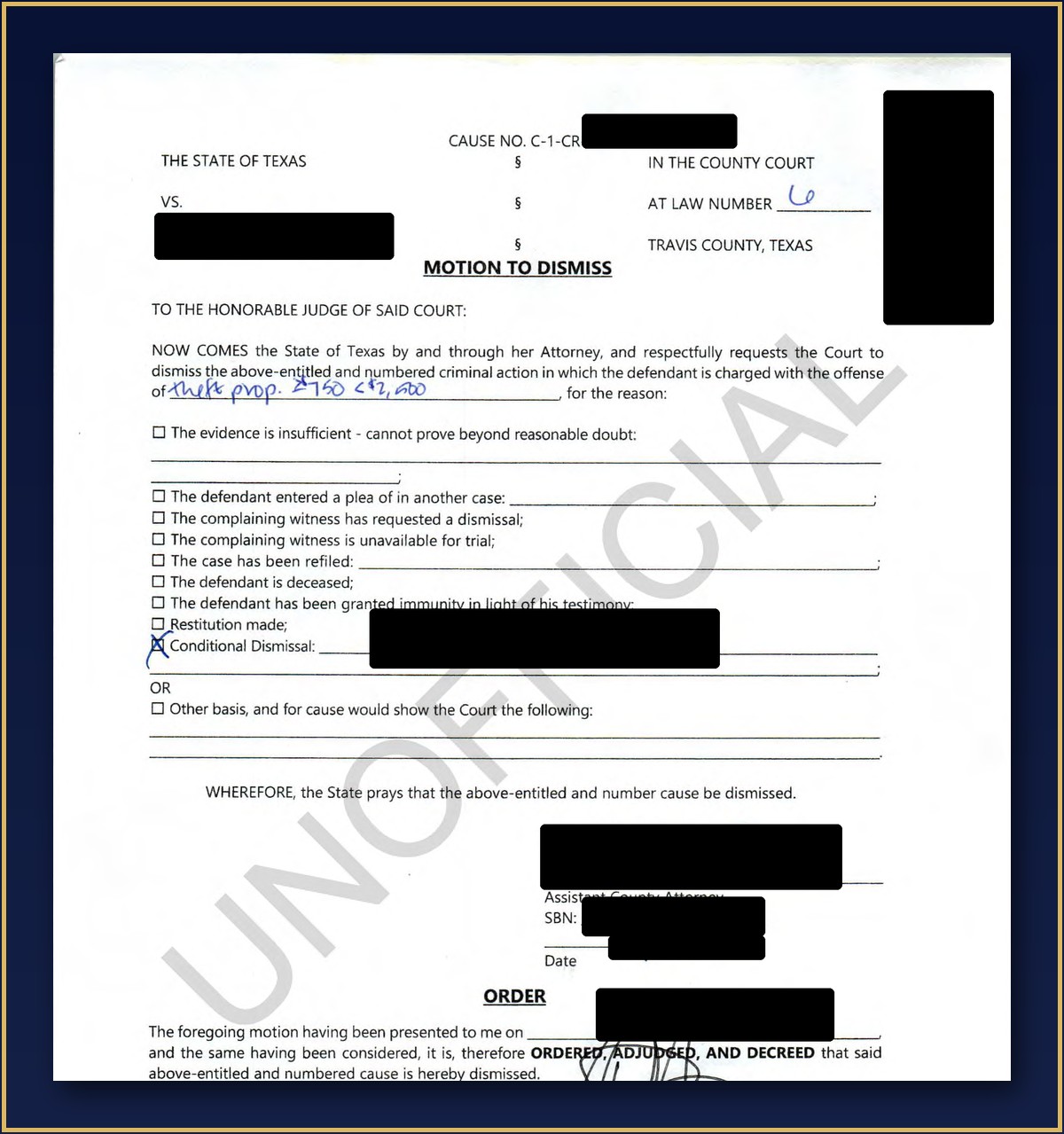
At CMK Defense, PLLC, we defend people charged with shoplifting, felony theft, theft of service, organized retail theft, and other property crimes in Austin and across Central Texas. A theft case often turns on three things: what the State can prove about intent, what the property was worth, and what the video actually shows. We look at all three early. A recent Travis County result is a conditional dismissal of a theft charge (July 2025). Past results do not guarantee a similar outcome.
What Texas Law Says Theft Is
Tex. Penal Code § 31.03 defines theft:
(a) A person commits an offense if he unlawfully appropriates property with intent to deprive the owner of property.
Appropriation is unlawful when the owner did not effectively consent, when the person knew someone else stole the property, or when police represented held property as stolen and the person believed it was (§ 31.03(b)).
So the State must prove more than that property is missing. It must prove three things. You took or controlled the property. The owner did not effectively consent. You meant to deprive the owner of it. Intent is where most theft cases are won or lost. It is about what someone was thinking at one moment.
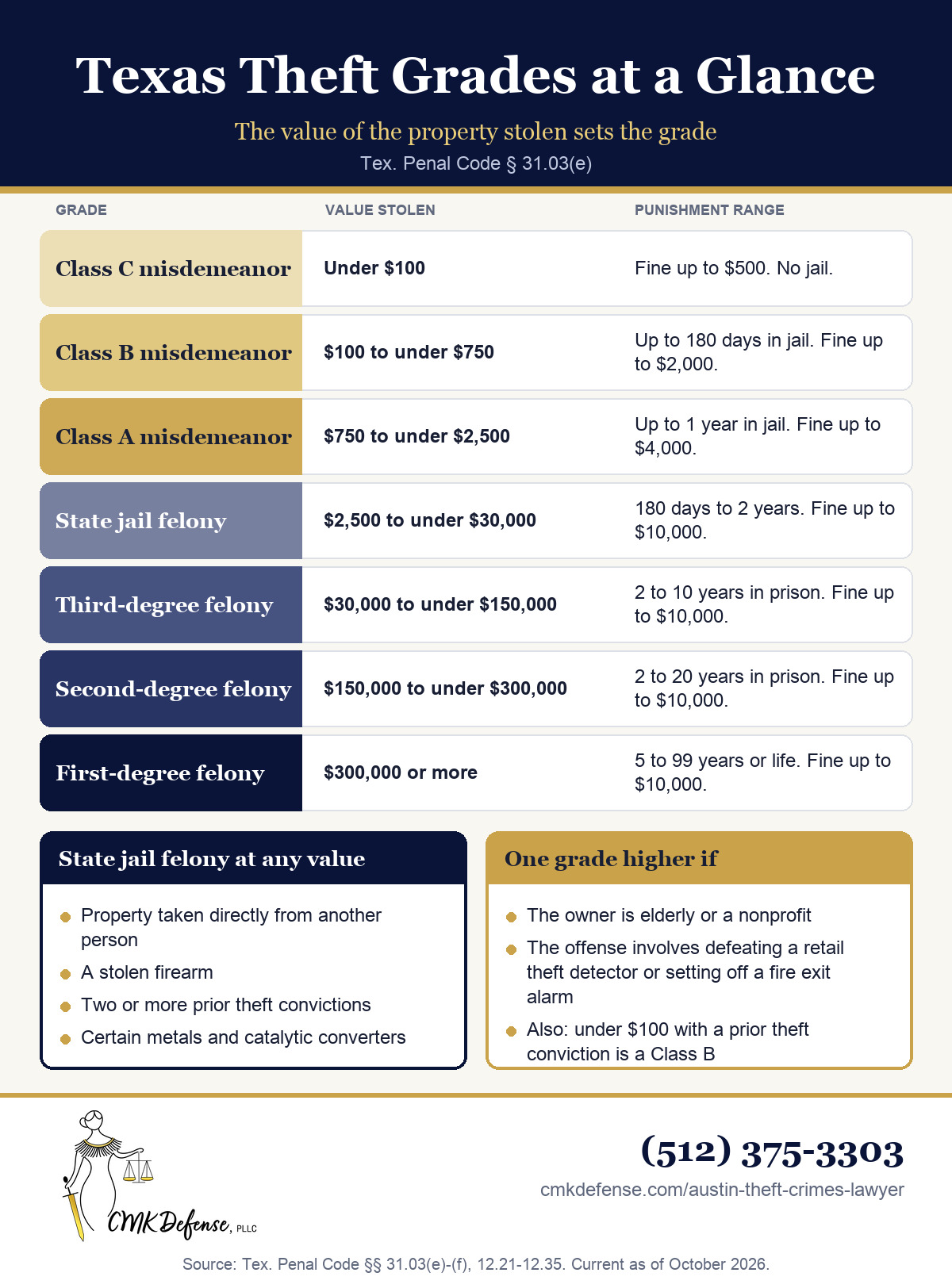
How Texas Grades Theft: Value and Other Factors
Value usually sets the grade. Under § 31.08, value means fair market value at the time and place of the offense. If that can’t be determined, it means the cost of replacing the property within a reasonable time. A conviction at any level creates a record that shows up on background checks.
Misdemeanor Theft
- Class C misdemeanor (under $100): a fine up to $500 and no jail (§ 12.23). It becomes a Class B if you have a prior theft conviction.
- Class B misdemeanor ($100 to under $750): up to 180 days in jail and a fine up to $2,000 (§ 12.22). Stealing a driver’s license or state ID is also a Class B, whatever it is worth.
- Class A misdemeanor ($750 to under $2,500): up to one year in jail and a fine up to $4,000 (§ 12.21).
For how these cases work, see our misdemeanor page.
Felony Theft
- State jail felony ($2,500 to under $30,000): 180 days to two years in state jail and a fine up to $10,000 (§ 12.35).
- Third-degree felony ($30,000 to under $150,000): two to ten years in prison and a fine up to $10,000 (§ 12.34).
- Second-degree felony ($150,000 to under $300,000): two to twenty years in prison and a fine up to $10,000 (§ 12.33).
- First-degree felony ($300,000 or more): five to ninety-nine years or life in prison and a fine up to $10,000 (§ 12.32).
Some thefts are felonies whatever the property is worth. Under § 31.03(e)(4), a state jail felony includes property taken directly from another person, a stolen firearm, a theft where you have two or more prior theft convictions, and certain metals and catalytic converters. For more on how felony cases work, see our felony charges page.
What Can Raise the Grade or the Charge
- The owner’s status: the offense moves up one category if the owner is an elderly individual or a nonprofit organization (§ 31.03(f)).
- Defeating store security: it also moves up one category if you set off or disabled a fire exit alarm or a retail theft detector, or used a shielding device (§ 31.03(f)).
- Adding thefts together: when amounts are taken under one scheme or continuing course of conduct, the State may add them together to set the grade (§ 31.09).
- Reducing a state jail felony: a court may punish a state jail felony with Class A misdemeanor confinement, and a prosecutor can ask to prosecute it as a Class A (§ 12.44).
Shoplifting, Organized Retail Theft, and Theft of Service
Shoplifting is theft from a merchant, and value sets the grade as with any theft. Two related charges are often more serious:
- Organized retail theft (§ 31.16) covers acting with others to take merchandise, or taking from a merchant on two or more occasions within 180 days. Total value sets the grade. It starts as a Class B misdemeanor under $100. It reaches a state jail felony at $750, a third-degree felony at $2,500, a second-degree felony at $30,000, and a first-degree felony at $150,000. The State values merchandise at the store’s posted price. Changing a label or moving an item into other packaging creates a presumption that you meant to take it.
- Theft of service (§ 31.04) covers things like leaving without paying for a service or not returning rented property, and uses the same value grades as theft.
How We Defend a Theft Charge
The right defense depends on the facts. These are the questions we start with:
Intent
Theft requires an intent to deprive the owner of property, not just to use or borrow it. A mistake, a misunderstanding about whether something was paid for, or a belief that the property was yours can defeat that intent.
Consent and Ownership
Taking property with the owner’s effective consent is not theft. Consent does not count if someone gained it by deception or coercion, so those details matter. Disputes about who owns something are common between partners, roommates, relatives, and business owners. An interest in the property is not a defense if someone else has the right to exclusive possession (§ 31.10). We look at who had the right to possess the property at the time.
Value
Value decides whether a case is a ticket, a misdemeanor, or a felony. We check the State’s number against fair market value at the time and place. We look at receipts, the age and condition of the property, and whether the State counted items that nobody took. A $2,600 allegation should not stay a felony when the real value is under $2,500.
Identity and Video
Store and doorbell video can help or hurt. It is often unclear, and it may not show the whole event. We get the full footage and check who it actually shows. We also test any identification, especially when a witness, a coworker, or a loss-prevention employee named someone.
Procedure, Statements, and Duress
We examine how officers handled a stop, a search, or a statement, and whether the court should exclude anything you said without a lawyer. In rare cases a person took part because of a threat, and we raise duress when the facts support it.
What Happens After a Theft Arrest in Austin
- Do not discuss the case. The State can use statements to officers, store security, or an employer against you. Our post on whether you have to talk to police in Texas explains why.
- Bond comes first. Read how it works in our posts on getting out of jail in Travis County and on personal, surety, and cash bonds.
- Keep your own evidence. Save receipts, texts, emails, account records, and the names of witnesses, and write down what happened while you remember it.
- Do not contact the accuser. If you want to reach out about the property or about paying it back, let your lawyer do it so it does not become a new charge or an admission.
Possible Outcomes of a Theft Charge
A theft charge does not automatically mean a conviction, jail, or a permanent record. Depending on the facts, your history, and the strength of the defense, outcomes can include:
- Dismissal: if the State cannot prove the case or the evidence is weak or officers got it improperly.
- Diversion: some cases qualify for a pretrial diversion program that can end in dismissal after you meet conditions like community service or restitution.
- A reduced charge: a lower grade, or a lesser offense, can change the penalties significantly.
- Acquittal: a not guilty verdict when the State cannot prove its case beyond a reasonable doubt.
- Probation: straight probation results in a conviction, while deferred adjudication does not. See our post on probation in Texas.
Clearing a Theft Charge From Your Record
An expunction removes the arrest records, but the rules are narrow. Under Tex. Code Crim. Proc. art. 55A.051, the arrest must not have led to a final conviction, and no charge can still be pending. There must also have been no court-ordered community supervision, other than for a Class C misdemeanor. If no one filed a charge, you can ask after a waiting period: 180 days for a Class C, one year for a Class A or B, and three years for a felony. A dismissal or acquittal can also qualify.
If an expunction is not available, an order of nondisclosure may be, including after some deferred adjudications, though waiting periods and exclusions apply. See our expunctions and record sealing page and our post on the expunction process.
Why Choose CMK Defense, PLLC for a Theft Charge
We keep our caseload limited on purpose. Fewer cases means more time for the video, the records, and the witnesses in each theft case, and every client works directly with the attorneys handling it. We prepare each case as if it will go to a jury, and we explain what every offer would cost you before you decide.
Theft Charge FAQs
Can I be charged with theft if I did not steal anything?
Yes. A charge can start with a store employee’s report, an employer’s accusation, or a witness’s mistake. Being charged is not proof of guilt. The State must still prove every element of theft beyond a reasonable doubt, including that you meant to deprive the owner of the property.
What should I do if I am falsely accused of theft?
Do not talk to the police or the accuser, and call a lawyer. False accusations are common in workplace and relationship disputes. Save texts, receipts, account records, and witness names, because that evidence is easiest to lose early.
Is shoplifting a felony in Texas?
Usually not for a first offense. Under $2,500 it is a misdemeanor. But it can be a felony if the value is $2,500 or more, if you have two or more prior theft convictions, or if the charge is organized retail theft, which becomes a state jail felony at $750.
Does a theft conviction affect a professional license?
It can. A theft conviction, even a misdemeanor, can lead a licensing board to review your license and may lead to suspension, denial, or revocation, depending on the board and the license.
Can a theft arrest be expunged?
Sometimes. If the case was dismissed or ended in an acquittal, or no charge was filed after the waiting period, you may qualify. A conviction or court-ordered community supervision, other than for a Class C, generally rules out an expunction. A nondisclosure order may still be possible.
Contact an Austin Theft Lawyer
The sooner a lawyer is involved, the sooner we can secure the video and records, and the fewer statements you make without advice. Call CMK Defense, PLLC at (512) 375-3303, including after hours, for a free and confidential consultation with an Austin theft lawyer, or reach out through our contact page.
Reviewed by Angelica Cogliano, partner at CMK Defense, PLLC. Last reviewed October 2026.



Tell us what’s going on. We’ll help you figure out what to do next—starting today.

© Copyright 2026 CMK Defense, PLLC. All Rights Reserved.
