

By Angelica Cogliano | CMK Defense, PLLC | Austin, Texas
Reviewed and updated July 2026
If someone you love was just arrested in Austin, the next 48 hours decide whether they get out, and getting out of jail quickly is often what lets them keep their job, their home, and their kids. CMK Defense, PLLC worked the very first Counsel at First Appearance (CAFA) shift in Travis County, and we have been on that docket ever since. We know the room, the people in it, and the moves that get someone out sooner. Here is how that first appearance works, and what changes when we are the ones standing in it for you.
If someone was just arrested in Central Texas, do this right now:
- Do not let them answer questions or explain their side. Anything they say can be used against them, and the right to stay silent starts at arrest.
- Write down their full name, date of birth, and where they are being held (County Jail, a city lockup, or a substation).
- Call an attorney before you call a bondsman. Paying a bond first can waste money if there is a hold or if a personal bond is possible.
Magistration in Austin and Travis County changed in February 2025 when the Counsel at First Appearance (CAFA) program launched. CMK Defense, PLLC was there from the beginning. We participated in the pilot program and continue working shifts today as defense counsel through the Capital Area Private Defender Service (CAPDS). We’ve seen what counsel actually accomplishes when present from the first appearance. For anyone arrested in Austin or Travis County, the system looks meaningfully different than it did prior to CAFA. At magistration, the judge determines if probable cause exists, sets the bail amount, and establishes the conditions of bond.
Why We Work CAFA Shifts
At CMK, we believe in giving back to the community. We also believe in staying at the forefront of what’s changing in our jurisdiction. When CAFA launched, working those shifts made sense for both reasons.
What we found was more important than either: a functioning collaborative system.
It also gave us something we use for every client we represent: firsthand knowledge of how this docket actually moves, who to talk to, and where the delays happen. That is the difference between a lawyer who has read about CAFA and one who has stood in that room since day one.
The CAFA Ecosystem: Everyone Has a Role
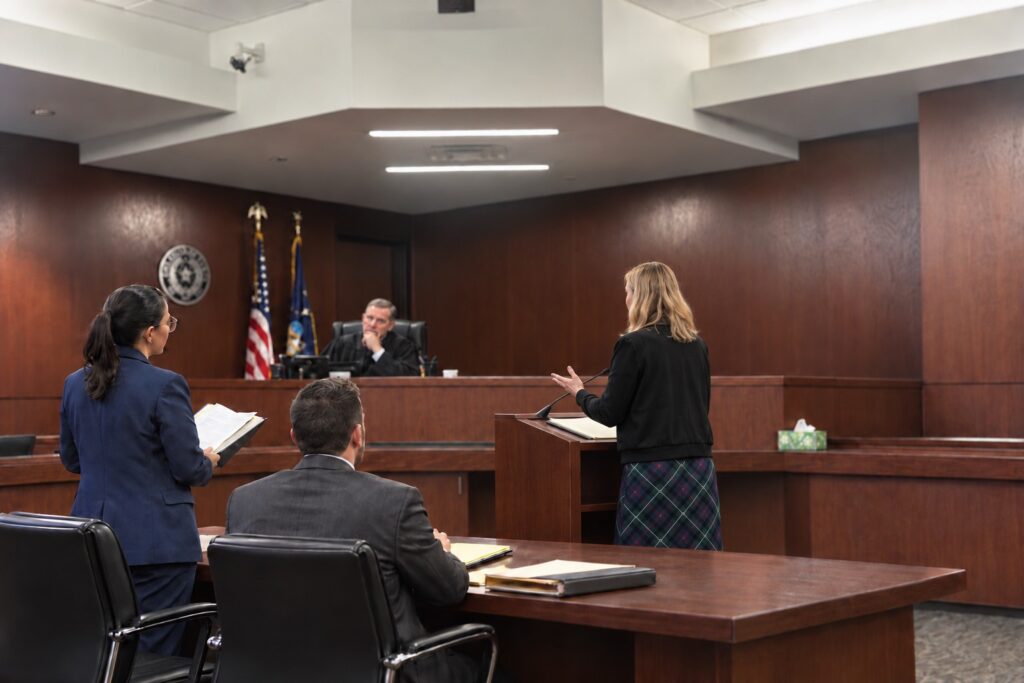
Magistration is the first court appearance after arrest. The magistrate reads the arrestee their rights under Article 15.17 of the Texas Code of Criminal Procedure, including the right to remain silent, the right to retain counsel, the right to have an attorney present during any interview, and the right to an examining trial.
From there, the magistrate determines if probable cause exists for the charges, sets bail, both the amount and the conditions of release, and may also issue emergency protective orders.
Most people think of magistration as adversarial: a person accused and a judge, maybe an attorney. In Travis County’s CAFA operation, it’s more like choreography with multiple dancers.
At a CAFA shift, you have:
- The magistrate (Criminal Associate Judge)
- Defense attorneys from the Office of First Defense (OFD)
- Attorneys from the Capital Area Private Defender Service (CAPDS) who take shifts
- Defense attorneys from the Travis County Public Defender’s Office
- Prosecutors from the District Attorney’s and County Attorney’s offices
- A representative from Pretrial Services
- Social workers
- A clerk managing filings
- A court interpreter
- A representative from court administration
- The bailiff
The arrestees flow through as they make it onto the CAFA docket. If you represent a private client not yet on docket, you can work with the system to expedite release. In my experience, if the docket shows that an arrestee already has a lawyer, CAFA attorneys will attempt to make contact with that attorney before proceeding.
CAFA runs as a coordinated operation. Magistrate, prosecution, defense, Pretrial Services, administration: each agency has a defined role. The system works to get accurate information in front of the judge so bail gets set fairly.
What Appointed CAFA Counsel Covers (And What It Doesn’t)
When working a CAFA shift for the county, the county appoints attorneys for one job: represent whoever the docket assigns to them at magistration. That role covers magistration only, and it shapes how they work in those few minutes.
The defense attorney meets with the client assigned to them after reviewing two critical documents: the probable cause affidavit and the Pretrial Services report. That meeting is short. There’s no time for a full client interview or investigation. An advantage of the program is that the defense attorney has the ability to call family members and references that can help.
In that meeting, the attorney does targeted work to obtain:
- Financial information: income, assets, debts, ability to pay
- Work information: employer name, position, how long employed, likelihood of keeping the job if released
- Family obligations: dependents, childcare, medical care the client provides
- Mitigating circumstances: ties to the community, no prior failures to appear, medication or treatment needs, immigration status considerations
That meeting determines what the magistrate hears. The difference between a magistrate seeing a name on a probable cause affidavit and actually understanding who this person is happens in those minutes.
After the meeting, the defense attorney talks to the prosecutor. This conversation often accomplishes more than people realize.
Killing a Weak Case at Magistration
We have seen people arrested where there was no probable cause to do so. A weak case can die right here at magistration, and it can die two ways.
The first is the prosecutor. Because CAFA gives counsel time to review the affidavit and talk to the client first, we can walk the prosecutor through exactly where the evidence falls short before charges ever move forward. Sometimes, once we lay it out, the prosecutor agrees the case is not backed by evidence and says so.
The second is the magistrate. That judge decides whether probable cause exists based on the four corners of the affidavit itself, under well-established Texas case law, nothing outside that document counts. The magistrate may draw reasonable inferences but cannot consider outside evidence, and magistration is not the place to present witnesses. So even when the prosecutor believes probable cause exists, the magistrate can disagree. After hearing counsel’s argument about what the affidavit says and what it does not, the magistrate may conclude the evidence is insufficient.
Either way, the case gets rejected then and there. Not later. Not after months in the system. At magistration.
Fighting for Release: Bail, Bond, and Getting Out
Most cases aren’t rejected, and even a strong probable cause challenge doesn’t always land. When the case moves forward, the fight becomes bail.
A good defense attorney advocates for a personal bond where the law allows it. Under Article 17.03 of the Texas Code of Criminal Procedure, a magistrate may release a defendant on personal bond without sureties or other security on certain charges. A personal bond means release without money: just a promise to appear. For arrestees without resources, this is everything.
If a personal bond is not viable under the law, the attorney advocates for the lowest possible bond that serves the legitimate purposes of bail: ensuring appearance in court and protecting public safety. Not ensuring the arrestee stays detained. Not punishing poverty. Under Article 17.15 of the Texas Code of Criminal Procedure, the magistrate must consider factors including the nature of the offense, ability to pay, criminal history, and ties to the community.
Then the magistrate decides. Our Travis County magistrates are knowledgeable and fair. They listen.
After the Magistrate Rules: Paperwork Before Release
Once the magistrate rules, the case moves to paperwork. The clerk checks the file to make sure everything is accurate, and that step matters more than it sounds, because a small error here can hold up a release that should be routine. What happens next depends on the type of bond. On a surety bond, a bondsman posts it. On a cash bond, someone pays the full amount to the court. On a personal bond, there’s no money to post, so the signed paperwork simply moves forward. From there, the release order goes to the jail for processing.
One more thing worth knowing: counsel can waive magistration, fully or partially, and there’s sometimes a strategic reason to do it. If the court has already approved a personal bond before someone reaches the docket, waiving magistration can speed release up considerably. Knowing when to waive and when to appear before the magistrate is part of working this system well.
The Jail Release Question Everyone Asks
“When will I (or my family member) get out of jail?”
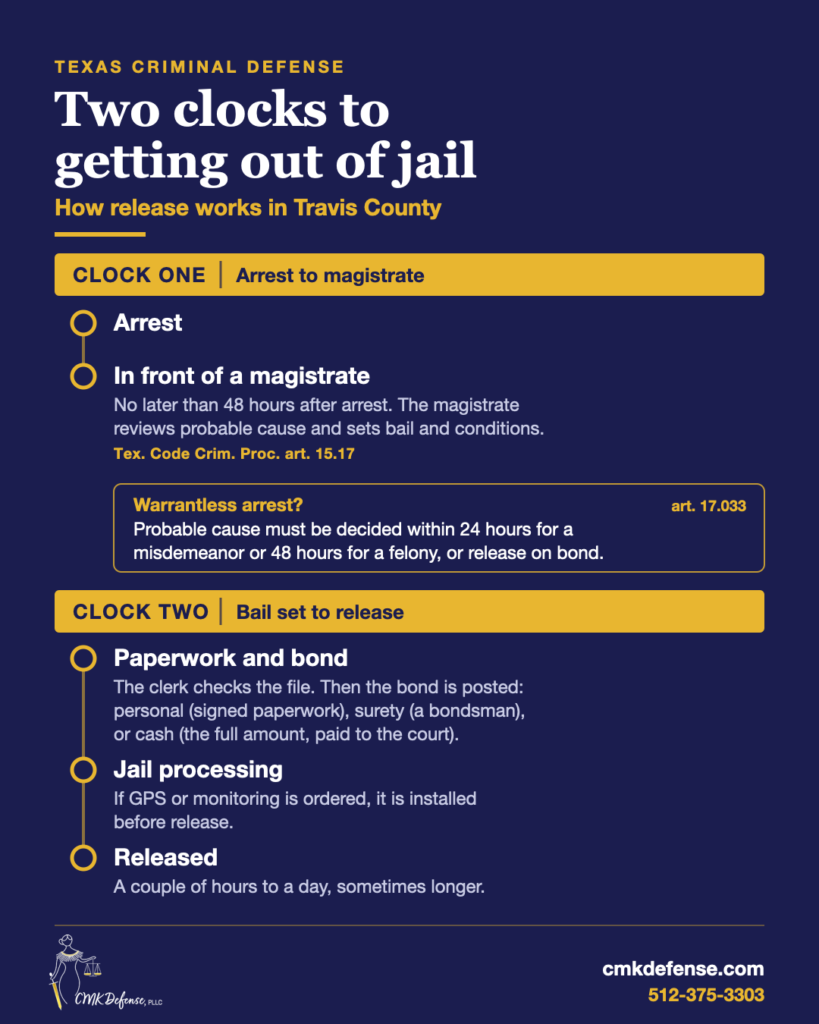
The honest answer is that it depends. It helps to think of it as two clocks.
Clock One: Getting in Front of a Magistrate
The first clock is getting in front of a magistrate. Under Article 15.17 of the Texas Code of Criminal Procedure, a person must be taken before a magistrate without unnecessary delay and no later than 48 hours after arrest. For warrantless arrests, Article 17.033 adds a tighter rule: a magistrate must determine probable cause within 24 hours for a misdemeanor and within 48 hours for a felony. If that deadline is missed, the person must be released on bond. So the law sets an outer limit on how long someone can sit before the case even gets looked at.
Clock Two: From Bail to Release
The second clock starts once the magistrate sets bail. From there, release depends on how fast the paperwork gets entered into the system and how backed up the jail is. Sometimes it’s a couple of hours. Sometimes it’s most of a day, or longer. And if the magistrate orders GPS or electronic monitoring as a condition, the jail won’t release the person until staff install the device while they’re still in custody, which can add real time.
In our experience, releases take longer now than they did before CAFA launched, and CAFA isn’t the only reason. Bail reform added steps. The safety report requirement, among other new laws, added bureaucracy. Staffing shortages during and after the pandemic ended what used to be a 24/7 jail release operation, so the hours an attorney can actually get someone out are now limited. Before the pandemic, a lawyer could show up at the jail at 3 a.m. and walk a client out. That is no longer an option.
So we don’t wait and hope. We track every release, follow up with the jail, and stay the squeaky wheel until our client is out, because that’s how you keep someone from getting lost in a slower system.
How We Move Your Case Faster
Working the shifts taught us where time gets lost in this system. Here is what that means for you when we are on the case:
- We know when to waive magistration. If a personal bond is already approved before your loved one hits the docket, waiving can shave real time off the wait. Knowing when to waive and when to appear is a judgment call we make every shift.
- We put a full picture in front of the magistrate. Employment, family obligations, community ties, treatment needs. We call family and references in real time so the judge sees a person, not a name on an affidavit. That is what moves bail down.
- We know the room. Magistrate, prosecutors, Pretrial Services, the clerk. We know who to talk to and how to get accurate information in front of the judge without delay.
- We track every release and follow up relentlessly, so paperwork does not sit and no one gets lost in the queue.
- We explain holds early. If there is an out-of-county warrant or an ICE detainer, we tell you before you spend money on a bond that will not produce a release, and we plan around it.
- When the magistrate’s number is too high, we do not wait. Full representation begins after magistration, and we can move quickly on a writ of habeas corpus to ask the district court to lower the bond or change the conditions.
We cannot promise an outcome, and any lawyer who does is not being straight with you. What we can promise is that we know this process cold and we work it hard, from the first hour.
When Jail Release Isn’t Immediate
Not everyone gets released, and sometimes the reason is legal, not financial. A hold from somewhere else can stop a release cold: a warrant out of another county, a parole or probation violation, or an immigration detainer.
An ICE detainer, often called an ICE hold, is one of the hardest. When one is in place, the sheriff notifies ICE once bond is posted, and ICE then has the chance to take the person into federal custody. Posting bond, in other words, doesn’t always mean walking out the door.
This is where having a defense attorney early adds value that never shows up in the statistics, whether it’s appointed CAFA counsel or a lawyer the family hires. A lawyer can tell the client and the family the truth about what’s happening: why release isn’t coming today, why paying a bondsman won’t fix a hold, and what the real strategy looks like for this person’s situation. That honesty saves families money they would otherwise throw away, and it spares them the second heartbreak of expecting a release that was never going to happen. It also lays the groundwork for the rest of the case.
Remember, the bail fight doesn’t end at magistration. The CAFA appointment covers only the first appearance. After that, the lawyer who will carry out full case representation must be either appointed or retained. Whatever the reason for continued detention, that attorney can file a writ of habeas corpus asking the trial court judge who will hear the case to review the magistrate’s decision and reduce the bail or amend the conditions.
Having a Lawyer at Magistration is a Game Changer
After working multiple shifts, here is what we’ve seen change.
Bail is fairer. When a lawyer is standing there as the magistrate sets the amount, the magistrate hears what actually matters: steady work, family who depend on the person, roots in the community, no history of skipping court. Putting those facts on the record instead of leaving silence generally results in a lower bail amount.
Weak cases get caught sooner. With defense counsel in the room to test the affidavit, and a prosecutor there to talk to, the facts get questioned before the case builds momentum. Some cases stop at magistration that used to roll forward for months.
Counsel protects rights from the start. This is the quiet change, and maybe the most important one. When a lawyer is present at the first appearance, the person isn’t facing it alone. Someone makes sure they understand their rights, don’t unknowingly waive them, and aren’t left to handle the hearing without advice. That matters for everyone, and it matters most for the people least equipped to protect themselves in that moment: immigrants, people in a mental health crisis, and people struggling with active addiction.
Why the First Appearance Matters
When counsel is present at magistration, when facts are presented instead of assumed, when rights are protected instead of waived, outcomes change.
And when everyone in the system, magistrate, prosecutor, defense, administration, and Pretrial Services, understands their role and does it well, you get fairer bail decisions and cases that get reviewed before they proceed instead of after.
CAFA proves this. Travis County has the data: when people have counsel at first appearance, bail amounts go down. Jail time goes down. Lives stay intact while the case proceeds.
Talk to CMK Defense, PLLC about jail release
The clock starts at arrest. The sooner we are in the case, the more we can do at magistration and the harder we can push on release.
If you or someone you love is in custody in Austin or elsewhere in Central Texas, call CMK Defense, PLLC now, day or night, at 512-375-3303. Do not wait for the next business day, and do not wait for the State to make the first move. We can be in that courtroom with you. We know how it works.
Frequently Asked Questions
What is CAFA in Travis County?
Counsel at First Appearance (CAFA) is a Travis County program that provides defense attorneys to people at magistration, the first court appearance after arrest, regardless of ability to pay. Launched in February 2025, it is one of only a handful of such programs in Texas.
What happens at magistration in Austin?
At magistration, a Criminal Associate Judge reads the arrestee their rights, reviews the probable cause affidavit, determines whether probable cause exists, sets the bail amount, and establishes conditions of release. The magistrate may also issue emergency protective orders. With CAFA fully operational, defense counsel is present at most Travis County magistrations.
How long after arrest does magistration happen in Texas?
Under Article 15.17 of the Texas Code of Criminal Procedure, a person must be taken before a magistrate without unnecessary delay and no later than 48 hours after arrest. For warrantless arrests, Article 17.033 requires a probable cause determination within 24 hours for a misdemeanor and 48 hours for a felony. If the deadline is missed, the person must be released on bond.
Can a lawyer get my charge rejected at magistration?
In some cases, yes. The magistrate’s probable cause determination is limited to the four corners of the probable cause affidavit. If the affidavit does not support probable cause, the magistrate may decline to hold the person. Prosecutors may also reject charges they believe are not supported by the evidence. CAFA has created space for exactly this kind of early review.
What is a personal bond in Texas?
A personal bond, sometimes called a PR bond, is a release without money. The defendant promises to appear in court without posting cash or using a bondsman. Under Article 17.03 of the Texas Code of Criminal Procedure, a magistrate may grant a personal bond on certain charges. Having counsel at magistration significantly increases the likelihood of the magistrate granting a personal bond.
What is an ICE detainer and how does it affect bail in Texas?
An ICE detainer is a request by the federal government to be notified when a person is released from local custody. When ICE (Immigration and Customs Enforcement) issues a detainer, the sheriff is required to notify ICE that bond has been posted, giving ICE the opportunity to take the person into federal custody. Posting bond does not guarantee release when an ICE detainer exists. An attorney can help the family understand the situation and plan a realistic strategy.
How long does it take to get out of jail after bond is posted in Austin?
Once bond is posted, release depends on how quickly the jail processes the paperwork and how busy they are. It can take a couple of hours or up to a day, sometimes longer. If the magistrate set GPS or electronic monitoring as a condition of release, the jail holds the person until staff install the device while still in custody. CMK tracks all releases and follows up to make sure no one is overlooked.
What can a lawyer do if my bail is too high?
If bail is set too high, your hired or appointed defense attorney can file a writ of habeas corpus asking the trial court judge who will hear the case to review and reduce the bail amount or amend bond conditions set at magistration. The bail fight does not end at magistration.
If CAFA gives me a free lawyer at magistration, why would I hire my own?
The county appoints the CAFA attorney for one thing: your first appearance. That representation ends when magistration does. Hiring your own lawyer means someone carries the case from the very start, keeps fighting on bail, can file a writ of habeas corpus if the bond is too high, and begins building your defense right away instead of waiting for counsel to be appointed later.