

By Deniz Kadirhan, CMK Defense, PLLC | Austin, Texas
Reviewed October 13, 2026
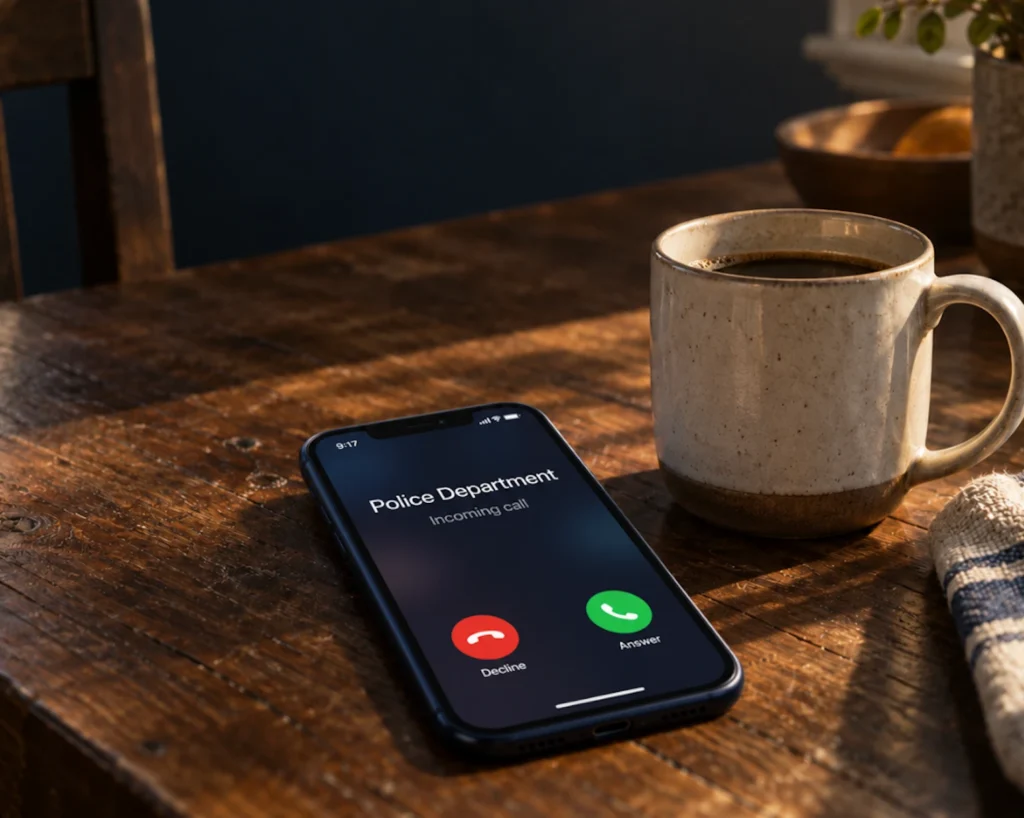
Maybe it was a voicemail. Maybe it was a business card stuck in your door with “please call me” written on the back. A detective wants to “clear a few things up” and says you are not under arrest. Do you have to talk? Generally, no. You do not have to agree to a voluntary interview, and you should speak with a lawyer before answering questions about the investigation.
The detective may say they just want your side of the story. It is understandable to want to explain, especially if the accusation is false. But you may not know what police are investigating, what evidence they have, or whether they consider you a witness or a suspect. What you say can become evidence against you, even when you are trying to clear things up.
If you are not in custody, police generally do not have to read you your rights before asking questions. Before you agree to talk, understand what “you are free to go” actually means, how handing over your phone can lead to a search, and what to say if you choose to decline the interview.
Talk with a lawyer to decide whether a statement would help or hurt.
A Voluntary Interview Is Your Choice
A police officer can walk up to anyone and ask questions. He does not need a reason. But you are just as free to say no. An invitation to speak with a detective is not, by itself, a legal requirement to do so.
The Texas Court of Criminal Appeals describes three kinds of police contact: a consensual encounter, a detention, and an arrest. During a consensual encounter, you can end the conversation and leave whenever you want. If a detective calls you and asks you to come in, you can decline. Declining is not a crime, and it is not a confession.
A subpoena or court order is different. Show it to your lawyer before deciding how to respond.
What Texas law may require: Identifying Information
Declining an interview is different from failing to provide identifying information. Texas Penal Code § 38.02 distinguishes between refusing to identify yourself and giving false information:
- A person commits an offense if he intentionally refuses to give his name, residence address, or date of birth to a peace officer who has lawfully arrested the person and requested the information.
- A person commits an offense if he intentionally gives a false or fictitious name, residence address, or date of birth to a peace officer who has:
- lawfully arrested the person;
- lawfully detained the person; or
- requested the information from a person that the peace officer has good cause to believe is a witness to a criminal offense.
The distinction between sections matters. Refusing to give your name, address, and date of birth is an offense only after a lawful arrest. Lying about them is an offense much earlier: once you are detained, or if the officer believes you witnessed a crime.
Drivers have an additional rule. If you are a driver lawfully detained for an alleged violation of law and fail to provide or display your license when asked, you must provide your name, driver’s license number, residence address, or date of birth when the officer requests that information. Intentionally refusing to do so is an offense under § 38.02(b-1).
However, these identification requirements do not require you to answer questions about what happened.
What Can Happen During a Voluntary Interview
An arrest makes the stakes obvious. A friendly conversation with a detective can make them easy to miss. What you say during a voluntary interview can become evidence against you before you are arrested or charged. Two rules matter here: when police must warn you of your rights, and how to make clear that you are invoking your right to remain silent.
Police generally do not have to give Miranda Warnings if you are not in custody
Miranda warnings (and the corollary Texas warnings in article 38.22 of the Code of Criminal Procedure) generally apply to custodial interrogation. Whether an interview is custodial depends on the circumstances: whether a reasonable person in your position would believe their freedom was restricted to the degree associated with an arrest. California v. Beheler, 463 U.S. 1121, 1125 (1983).
If you voluntarily go to the station, sit down, and talk, police generally do not have to warn you of anything. Your answers can still become evidence against you, even if no one read you your rights. Article 38.22, § 5 does not preclude admission of statements that do not stem from custodial interrogation.
However, going to the station voluntarily does not settle whether you are in custody for the entire interview. The circumstances can change while you are there.
Don’t just go quiet: Invoke your right to remain silent
This is the part almost no one explains. In Salinas v. Texas, a Houston man voluntarily went to the police station and answered questions about a double murder. When an officer asked whether his shotgun would match shell casings found at the scene, he stopped answering. Prosecutors used that silence against him at trial, and the Supreme Court upheld his conviction.
The decision was divided. Three justices reasoned that he had not expressly invoked the Fifth Amendment. They said a person who wants the protection of the Fifth Amendment “must claim it,” and that a person does not do that “by standing mute.” Two others would have rejected his claim even if he had. 570 U.S. 178, 181–83, 191–93 (2013).
What that means for you? Make your position clear. If you begin a voluntary interview and then decide to stop, say so out loud: “I am invoking my Fifth Amendment right to remain silent. I will not answer questions. I want to speak to a lawyer.”
Asking for a lawyer during a noncustodial interview does not, by itself, require police to stop questioning you. See McNeil v. Wisconsin, 501 U.S. 171, 182 n.3 (1991). If you are free to leave, you can end the interview. You do not have to keep answering while you wait for the detective to agree
The police can lie to you. You cannot lie to the police.
Police can use some forms of deception during an interview. In Frazier v. Cupp, an officer falsely told a suspect that his companion had already confessed. The Supreme Court held that the lie did not, by itself, make the confession inadmissible. 394 U.S. 731, 739 (1969). A detective who claims they have video, messages, or a confession from someone else may be telling the truth. Or he may not be.
That rule does not run both ways. Knowingly making a false statement to an officer conducting a criminal investigation, with intent to deceive, about something material to that investigation is a Class B misdemeanor. Tex. Penal Code § 37.08(a)(1), (c). An honest mistake is different from an intentional lie. Still, guessing about a date or detail can create an inconsistency that investigators may interpret as dishonesty. Do not fill in gaps in your memory just to give the detective an answer.
Before you give your side of the story.
When a detective asks for “your side,” you may not know what they have already heard or seen. They may have a statement from the other person, messages, photos, or other records. Investigators can compare your answers with that evidence. A detail you get wrong can become an issue, even if you were trying to be accurate.
Sometimes, giving a statement may help. Whether it would help you is a decision to make with your lawyer after discussing the allegation, the available information, and the risks.
Before making a statement, ask what it would accomplish. If you want to show where you were, could messages, receipts, or witnesses establish that without a broad interview? If you are being asked for an exact timeline, have you checked it against your records? Work through those questions with your lawyer before committing to an account or deciding how to present it.
What Does “You Are Free to Go” Actually Mean?
If the police tell you that “you’re free to go,” they are likely saying that for a specific legal reason, not for your comfort. It is one of the things that separates a voluntary conversation from a custodial interview. The question is whether a reasonable person in your position would believe their freedom was restricted to the degree associated with an arrest.
The Texas Court of Criminal Appeals has identified four general situations in which custody may arise:
- Your freedom of movement is significantly restricted by physical restraint.
- An officer tells you that you cannot leave.
- Officers create circumstances that would make a reasonable person believe their freedom of movement is significantly restricted.
- Officers have probable cause to arrest you and do not tell you that you are free to leave.
In real life, the line can blur. If you are not sure where you stand, ask. “Am I being detained, or am I free to leave?” If you are free to leave, you can go. If you are being detained, do not physically resist. You can still decline to answer questions about the investigation.
Does Handing Over Your Phone Mean You Consented to a Search?
It can. But handing over your phone does not automatically settle the question. What the officer asked, what you agreed to, and whether your consent was voluntary all matter.
Phones get special protections under the 4th Amendment. Police generally need a warrant to search the data on a phone, including one taken during an arrest. Riley v. California, 573 U.S. 373, 403 (2014). Consent is one of the most common ways around that requirement. If an officer asks to look through your phone and you unlock it and hand it over, or say “sure, go ahead,” the State may argue that you consented to a search.
If you do not agree to a search, say so clearly: “I do not consent to a search of my phone.” Refusing consent does not prevent police from searching under a warrant or another lawful exception. It makes your position clear. Under Texas law, the State must prove voluntary consent by clear and convincing evidence. State v. Ibarra, 953 S.W.2d 242, 245 (Tex. Crim. App. 1997).
What to Say
If you choose to end a voluntary interview, be clear. You do not need to explain or defend that decision.
- “I am invoking my Fifth Amendment right to remain silent. I will not answer questions about the investigation. I want to speak with a lawyer.” Say it out loud.
- If you have a lawyer, provide their name and number. If you do not, say: “I want to speak with a lawyer before deciding whether to give a statement.”
- “I do not consent to any searches.” Make your position clear about your phone, car, home, or other property. Police may still search under a warrant or another lawful exception.
- “Am I being detained, or am I free to leave?” If you are free to leave, leave.
- Do not lie or guess. You do not need to fill the silence with an explanation. Guessing about dates, times, or details can create inconsistencies in your account.
- Do not argue or physically resist, even if you believe the officer is wrong. That fight happens later, in court, with a lawyer.
What a Lawyer Can Do Before Charges Are Filed

You can hire a defense lawyer while an investigation is still underway. You do not have to wait for an arrest.
Before charges are filed, your lawyer may be able to get some information about the investigation. Article 39.14(a) provides a discovery mechanism for defendants; but it does not guarantee access to the investigative file before charges. Investigators or prosecutors may share information voluntarily. But you and your lawyer may have to decide whether you give an interview without knowing everything.
A lawyer can:
- Contact the detective and ask that further communications go through counsel.
- Ask what the allegation is, whether investigators consider you a witness or a suspect, and what information they are willing to share.
- Advise you whether a statement would help and, if appropriate, discuss the interview’s timing and conditions with investigators.
- Help preserve messages and records, identify witnesses, and investigate before evidence becomes harder to find.
In some cases, your lawyer may submit information for a prosecutor or grand jury to consider before an indictment. Whether to do that and what to submit are decisions to make with your lawyer. See What a Grand Jury Does.
If you are arrested, see how to get out of jail in Austin and personal, surety, and cash bonds in Austin.
Talking to Police When You Are Not Under Arrest in Texas: FAQ
Does refusing to talk to the police make me look guilty?
Declining a voluntary interview is not an admission of guilt. You cannot control what an officer thinks, but you do not have to give a statement just to avoid looking uncooperative. If you decline, make your position clear: “I am invoking my Fifth Amendment right to remain silent. I want to speak with a lawyer.” Do not rely on silence alone, especially if you have already started answering questions.
Can the police arrest me for not answering questions in Texas?
Not simply because you decline a voluntary interview. Refusing to answer questions about the investigation does not, by itself, provide a lawful basis for arrest. Police may still arrest you if they have another lawful basis.
Identification requirements are separate. Texas law requires certain identifying information after a lawful arrest and in some driver detentions, as explained above.
A detective left a card at my house. Do I have to call back?
You generally do not have to call back if the detective is requesting a voluntary conversation. You can decline or have a lawyer contact the detective instead. A subpoena or court order is different: show it to your lawyer before deciding how to respond.
Can police lie to you during questioning in Texas?
Yes, police can use some forms of deception. A detective’s claim about “what we already have” may be true, or it may be an interview tactic. Talk to a lawyer before deciding how to respond.
Is it a crime to lie to the police in Texas?
It can be. Knowingly making a false statement to an officer conducting a criminal investigation, with intent to deceive, is a Class B misdemeanor if the statement is material to the investigation. Tex. Penal Code Ann. § 37.08(a)(1), (c).
Intentionally giving a false name, residence address, or date of birth is a separate offense during a lawful arrest or detention. It can also be an offense when an officer requests that information and has good cause to believe you witnessed a crime. Tex. Penal Code Ann. § 38.02(b). An honest mistake is different from a knowing or intentional lie
Do police have to read me my rights if I am not under arrest?
It depends on whether you are in custody. Miranda warnings and the Texas warnings under article 38.22 generally apply to custodial interrogation. You can be in custody before an officer announces an arrest. An interview that remains noncustodial generally does not require those warnings. See what “free to go” means above.
Can police come to my work to ask me questions?
Yes. Officers can approach you at work in areas where they are lawfully allowed to be, including areas open to the public. That does not mean you have to agree to an interview. You can decline a voluntary conversation and, if you are free to leave, walk away. You can also provide your lawyer’s contact information and ask that further communications go through counsel.
I already talked to the detective. Is it too late to get a lawyer?
No. You can get a lawyer before answering any more questions. Tell the lawyer what the detective asked, what you said, when and where the conversation happened, and whether you know it was recorded. Preserve relevant messages and records.
A detective called my son. Can I talk to them for him?
You can speak with the detective, but you do not have to give a statement on your son’s behalf. If your son is an adult, you generally cannot invoke his right to remain silent for him. You can help him contact a lawyer.
If the detective asks you questions, you can decline a voluntary interview. What you say can become evidence, and you could later be called as a witness. Tell the lawyer your son’s age, because different rules may apply to juvenile questioning.
Can we hire a lawyer before anyone is charged?
Yes. You do not have to wait for an arrest or a charge. A defense lawyer can contact the detective, advise the person being investigated about any proposed interview, and begin preserving and investigating evidence. Access to the State’s evidence may be limited before charges are filed. Investigators or prosecutors may share information voluntarily, but hiring a lawyer does not guarantee access to the full investigative file.
What to Do Now
If a detective wants to interview you, talk to a defense lawyer before deciding whether to participate. If you decline, say so clearly. Preserve relevant messages and records. Do not lie, guess, destroy evidence, or physically resist.
CMK Defense is a criminal defense firm in Austin, Texas. If a detective has contacted you or someone in your family, call 512-375-3303 to talk through the situation and your next steps.