We’re Here to Help With Your Case (512) 375-3303

Austin Self-Defense Lawyer
Arrested or under investigation after defending yourself or someone else in Austin? We defend people facing assault, aggravated assault, and murder charges. Contact CMK Defense, PLLC before giving a statement so we can evaluate the facts and begin preserving evidence. Your first consultation is free and confidential.
At CMK Defense, PLLC, we defend self-defense and defense-of-others cases in Travis, Williamson, Hays, and Bastrop counties, from misdemeanor assault to murder. These cases turn on a few facts: who started it and what each person did next. The video, the 911 call, and the injuries usually tell that story. We go after that evidence early, before it disappears.
Results: Not-guilty verdicts on murder charges in self defense trials in Travis, Caldwell, and Comal counties. See the results. Past results do not guarantee a similar outcome.

What Texas Law Says About Self-Defense
Self-defense is a defense to prosecution under § 9.02. Under § 9.31, you may use force against another person when you reasonably believe it is immediately necessary to protect yourself against that person’s use or attempted use of unlawful force. Three parts matter most:
- Reasonable belief: The question is whether you reasonably believed force was needed, not whether it looks different in hindsight.
- Immediately necessary: The threat has to be happening or about to happen. Force after the danger has passed is not self-defense.
- Degree of force: The force has to fit the threat. A response far greater than the danger can lose the defense.
Once the evidence raises self-defense, the court must instruct the jury, and a reasonable doubt about it requires a not-guilty verdict (§ 2.03(c)-(d)).
When the Law Does Not Allow It
Section 9.31(b) lists situations where force is not justified:
- In response to verbal provocation alone.
- To resist an arrest or search by someone you know is a peace officer or is acting at an officer’s direction, even if the arrest or search is unlawful. The exception: before you resisted, the officer used or tried to use greater force than necessary. Even then, you may resist only with force you reasonably believe is immediately necessary to protect yourself against that excessive force (§ 9.31(c)).
- If you consented to the exact force the other person used or attempted.
- If you provoked the other person’s use or attempted use of unlawful force. The exception: you abandoned the encounter, or clearly communicated your intent to, because you reasonably believed you could not safely abandon it, and the other person kept using or attempting to use unlawful force.
- If you sought an explanation from or discussion with the other person about your differences while unlawfully carrying a weapon (§ 46.02) or unlawfully possessing or transporting one (§ 46.05).
Who started it is often the main fight in the case. Many self-defense cases come down to the provocation rule.
How We Defend Self-Defense Cases
Self-defense cases are won on evidence, so we build the record early:
- Video and 911 records: We go after body camera and dash camera footage, surveillance and phone video, and 911 recordings before they disappear.
- The scene and the injuries: We document the scene and review medical records and photographs. We compare the injuries and any wound patterns to what the State says happened.
- Witnesses the police skipped: We interview people who saw what happened before, during, and after the confrontation.
- Your first statements: What you said at the scene or to a detective can shape the whole case. We review every statement and how you gave it, and we advise you before you say anything else.
- Getting the defense in front of the jury: The jury hears about a defense only if the evidence supports it. We make sure that evidence comes in so the jury gets the self-defense instruction.
When You May Use Deadly Force
Deadly force is force you intend or know will cause death or serious bodily injury, or force that can cause either in the way you use it (§ 9.01(3)). Under § 9.32, you may use deadly force only if § 9.31 would let you use force. You must also reasonably believe deadly force is immediately necessary for one of two reasons. The first is to protect yourself against the other person’s use or attempted use of unlawful deadly force. The second is to prevent the other person’s imminent commission of aggravated kidnapping, murder, sexual assault, aggravated sexual assault, robbery, or aggravated robbery.
The parties can dispute whether force was deadly force. A fist, a vehicle, or a pocketknife may or may not be deadly force, depending on how you used it.
Home, Vehicle, and Workplace: The Presumption of Reasonableness
Sections 9.31(a) and 9.32(b) presume that your belief that force (or deadly force) was immediately necessary was reasonable if you knew or had reason to believe the other person:
- unlawfully and with force entered, or was trying to enter unlawfully and with force, your occupied habitation, vehicle, or place of business or employment;
- unlawfully and with force removed, or was trying to remove, you from your habitation, vehicle, or place of business or employment; or
- was committing or attempting to commit aggravated kidnapping, murder, sexual assault, aggravated sexual assault, robbery, or aggravated robbery.
The presumption applies only if you did not provoke the other person. You also cannot have been engaged in other criminal activity, apart from a Class C traffic violation. If the presumption does not apply, you can still claim self-defense under the general rules. That is why what you were doing in the minutes before the confrontation matters.
No Duty to Retreat
Texas does not require you to retreat if you meet three conditions (§ 9.31(e); § 9.32(c)). You have a right to be where you are. You did not provoke the other person. You were not engaged in criminal activity when you used force. If you meet them, the jury may not consider whether you failed to retreat when it decides if your belief that force was necessary was reasonable (§§ 9.31(f), 9.32(d)). If one condition is missing, the prosecutor can argue you could have walked away.
Defending Someone Else and Property
Under § 9.33, you may use force or deadly force to protect another person. Two things must be true. First, judge the situation as you reasonably believe it to be: § 9.31 or § 9.32 must have let you use that force to protect yourself from the unlawful force or unlawful deadly force you reasonably believe threatens that person. Second, you reasonably believe your intervention is immediately necessary.
Property is different. § 9.41 lets you use force, but not deadly force, to prevent or end a trespass or an unlawful interference with your property. § 9.42 allows deadly force to protect property only in limited situations. The FAQ below covers them.
If a justified act also recklessly injures or kills an innocent bystander, you cannot use the justification against a charge for that reckless injury or killing (§ 9.05).
Showing a Weapon or Making a Threat
You may threaten force when you could lawfully use it (§ 9.04). Producing a weapon is not itself the use of deadly force if your purpose is limited to making the other person fear you will use deadly force if necessary. Prosecutors still bring these cases, often as aggravated assault or deadly conduct. We cover both in the FAQ below.
Charges a Self-Defense Claim Can Apply To
Self-defense is a justification, not a separate charge. It can apply to many accusations of violence:
- Simple and aggravated assault
- family violence assault
- Deadly conduct
- Threat offenses
- murder and manslaughter
Where the accusation lands sets the stakes. A bar scuffle might stay a misdemeanor case. A shooting can become one of the most serious felony charges in the Penal Code, with years in prison in play.
Results in Self-Defense Cases
Self-defense was the defense in each of these murder trials. Past results do not guarantee a similar outcome.
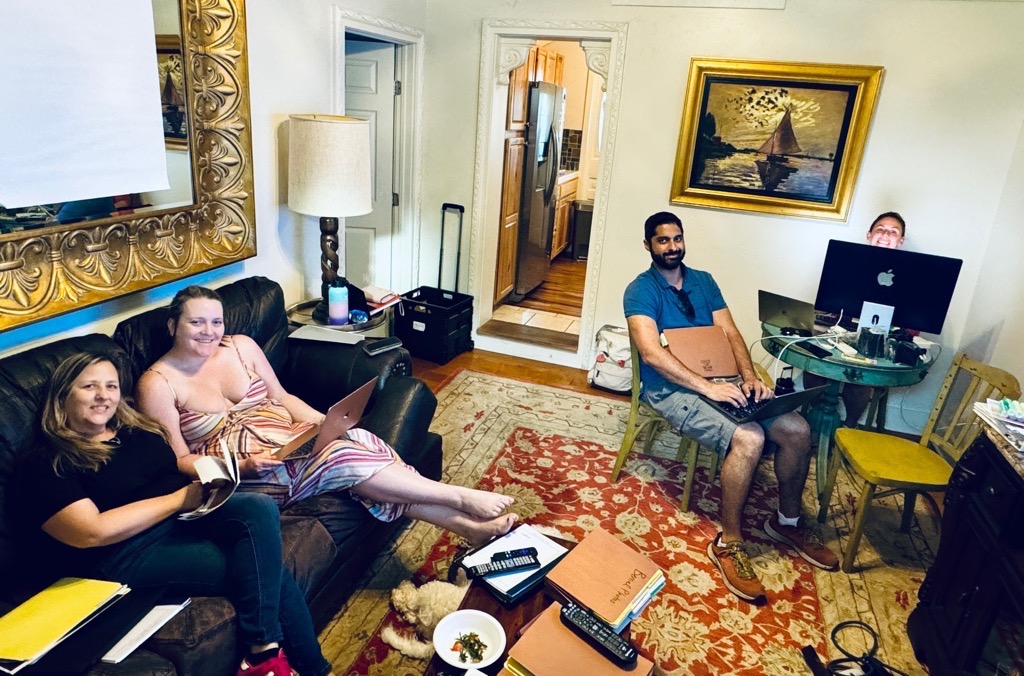
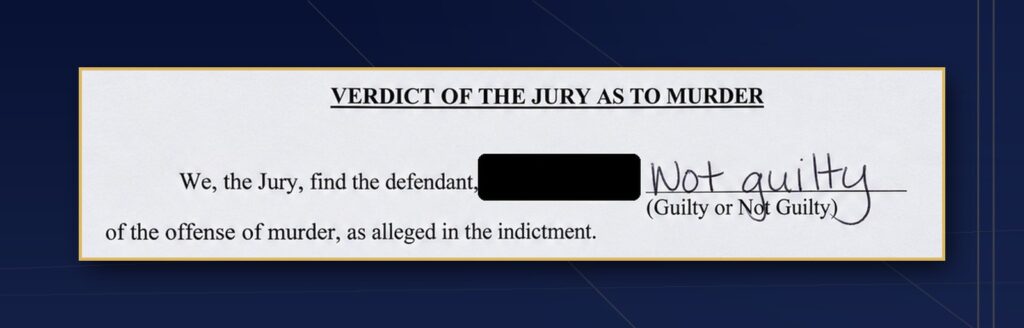
Not Guilty: Murder, Travis County
A Travis County jury found the client not guilty of murder in a trial where self-defense was the defense. See the verdict form.
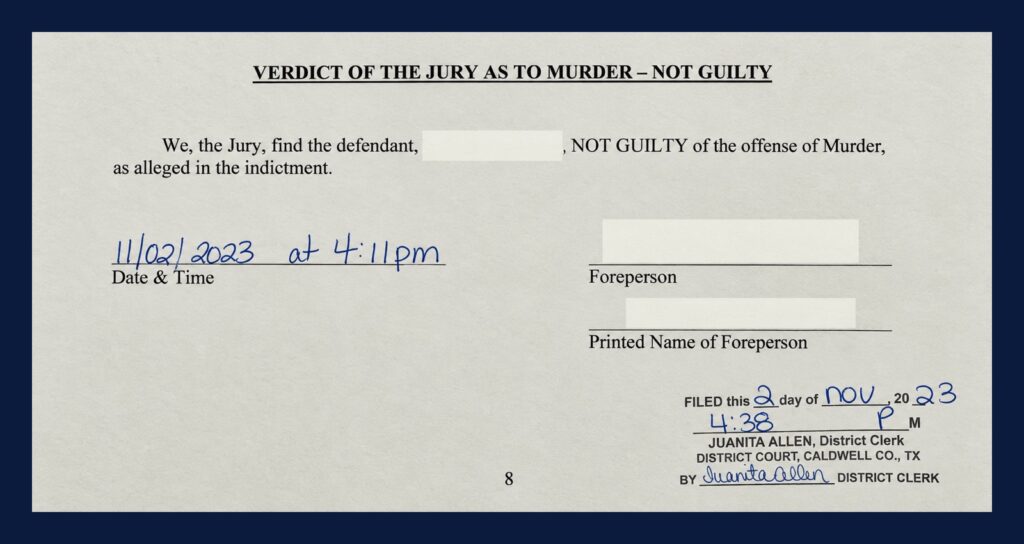
Not Guilty: Murder, Caldwell County
A Caldwell County jury returned a not-guilty verdict on a murder charge on November 2, 2023, in a trial where self-defense was the defense. See the verdict form.
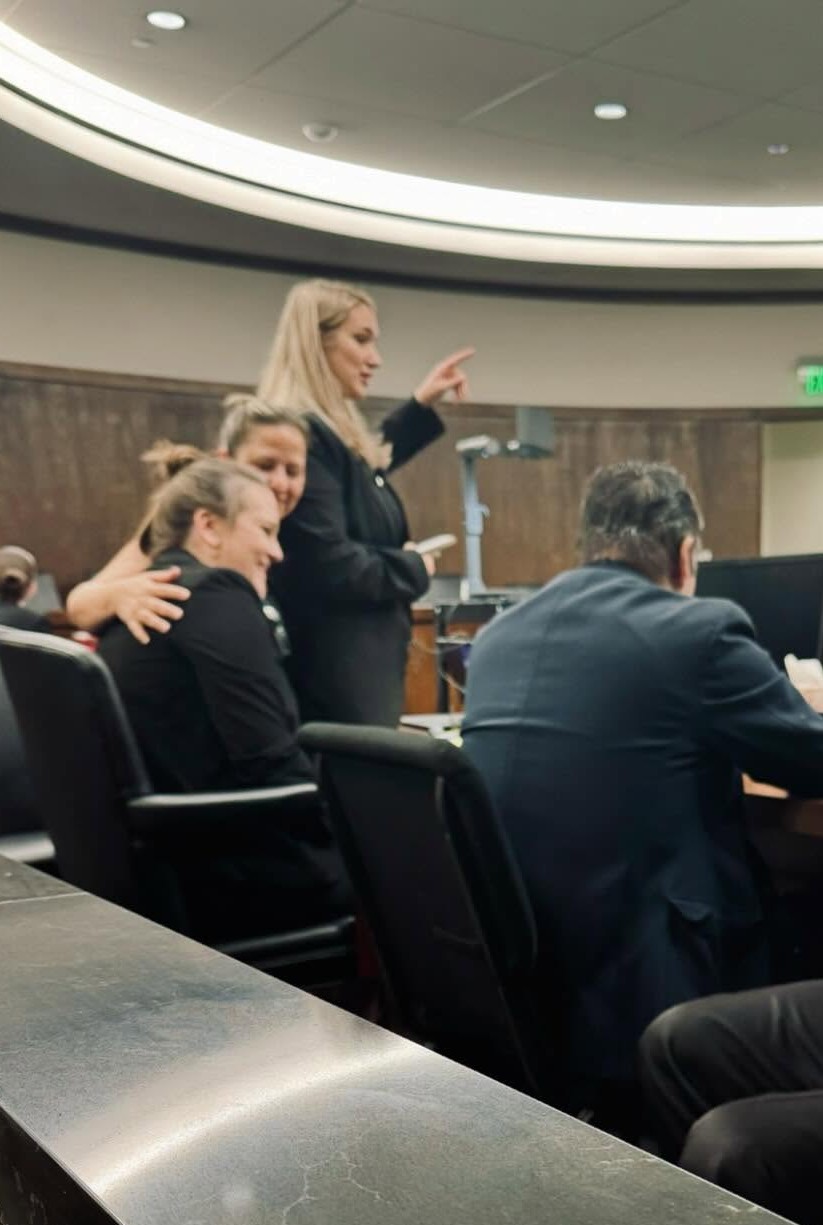
Not Guilty: Murder, Comal County
A murder trial in Comal County ended in a not-guilty verdict. Self-defense was the defense. See the courtroom photo.
Separate Result: Sudden Passion Finding and a Five-Year Sentence, Travis County
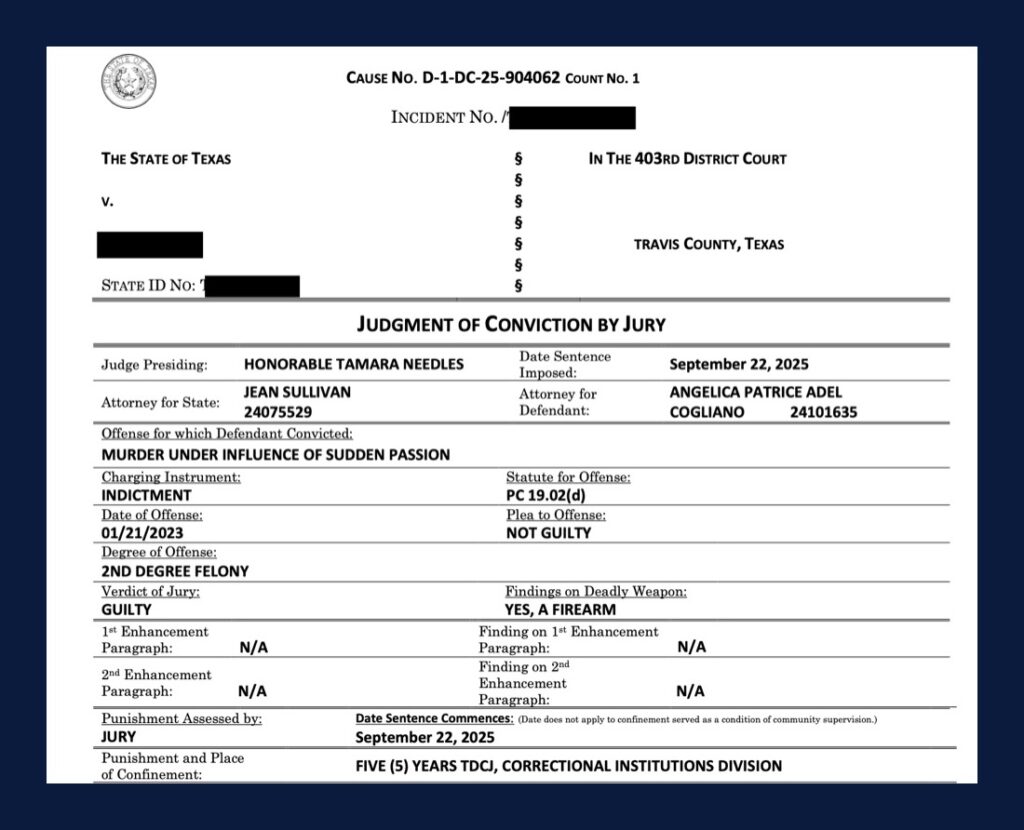
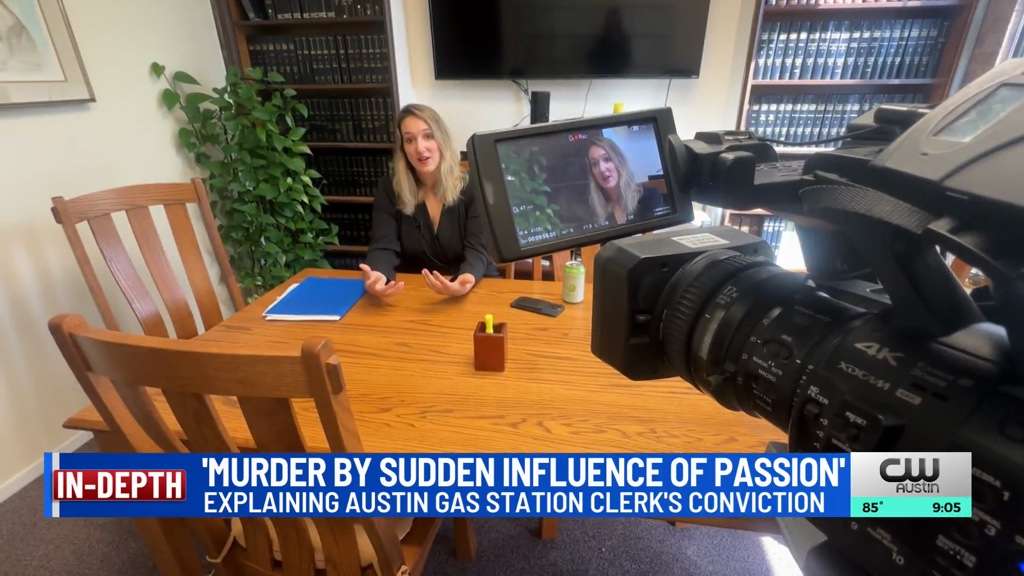
This result was not an acquittal. In this Travis County murder trial, self-defense was the primary argument, and the jury found the client guilty. At punishment, it found that the client acted under the immediate influence of sudden passion. That makes murder a second-degree felony instead of a first-degree felony (§ 19.02(d)). That reduced the punishment range from 5 to 99 years or life (§ 12.32) to 2 to 20 years (§ 12.33). The jury assessed five years. KXAN reported on the verdict.
Who Handles Your Case
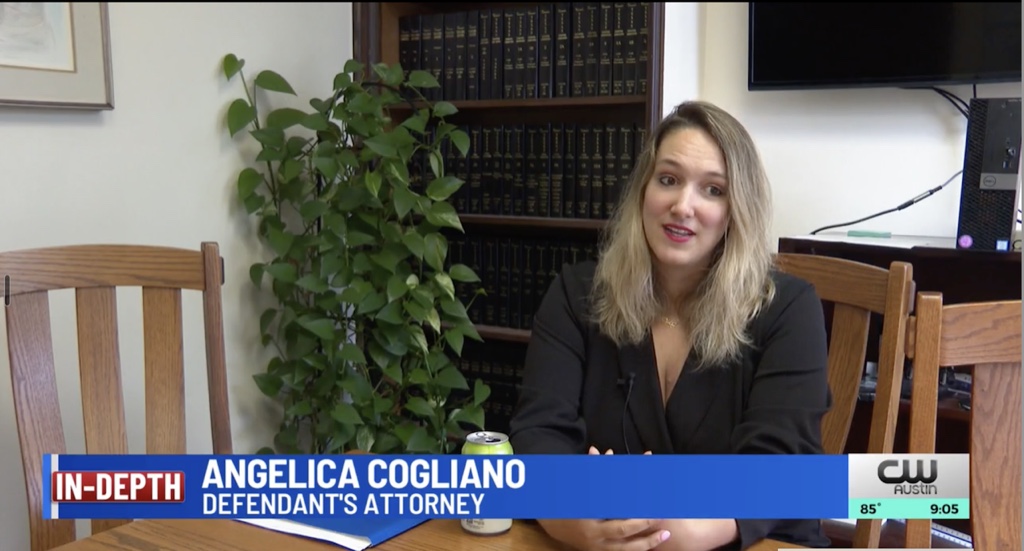
You work directly with an experienced trial lawyer, not a case manager. Deniz Kadirhan, partner, has tried numerous felony and misdemeanor jury trials, including aggravated assault and murder cases, and has argued before the Fifth Circuit and the Texas Court of Appeals. She serves on the Board of Directors of the Texas Criminal Defense Lawyers Association. Angelica Cogliano, partner, has tried cases to verdict in eight states and argued before the Texas Third Court of Appeals, the Fifth Circuit, and the Texas Court of Criminal Appeals. She has kept the State’s experts off the stand in multiple cases and teaches other defense lawyers how to challenge expert testimony.
FAQ: What to Know After a Self-Defense Arrest in Austin
Will I be arrested even if I acted in self-defense?
Often, yes. Officers who arrive at a chaotic scene frequently arrest one or both people and leave justification for later. An arrest does not mean the law has decided you were wrong. After an arrest, officers must take you before a magistrate within 48 hours (art. 15.17). What you say before then can become the center of the case, so do not give a statement until you have talked to a lawyer.
Do I have to retreat before using force in Texas?
Not if you meet three conditions. You have a right to be where you are, you did not provoke the other person, and you were not engaged in criminal activity when you used force (§ 9.31(e); § 9.32(c)). If you meet them, a jury may not consider whether you failed to retreat when it decides if your belief that force was necessary was reasonable. If one condition is missing, the prosecutor can argue that you could have walked away.
Can I use force to protect someone else?
Yes, if you meet two conditions. First, the circumstances as you reasonably believe them to be would have justified you in using the same force to protect yourself. Second, you reasonably believe your intervention is immediately necessary to protect that person (§ 9.33). The question is what you reasonably believed when you acted, not what turned out to be true.
What if I only showed my gun and never fired it?
A threat of force is justified when the force itself would be justified (§ 9.04). Producing a weapon is not itself deadly force if your purpose is limited to making the other person fear you will use deadly force if necessary. Prosecutors can still charge it. They often charge aggravated assault, which includes exhibiting a deadly weapon during an assault (§ 22.02(a)(2)). They may also charge deadly conduct, where the law presumes recklessness and danger if you knowingly pointed a firearm at or toward another person (§ 22.05(c)). Whether it was a justified threat or a crime depends on what the other person was doing at that moment.
Can I use deadly force to protect my property?
Only in limited situations. First, you must be justified in using force to protect the property (§ 9.41). Second, you must reasonably believe deadly force is immediately necessary, to the degree you use it, to prevent imminent arson, burglary, robbery, aggravated robbery, theft during the nighttime, or criminal mischief during the nighttime, or to stop someone who is fleeing immediately after burglary, robbery, aggravated robbery, or nighttime theft with your property. Third, you must reasonably believe you cannot protect or recover the property any other way, or that non-deadly force would expose you or someone else to a substantial risk of death or serious bodily injury (§ 9.42).
Can I still be sued if my force was justified?
You can still face a civil lawsuit. Texas law provides immunity from civil liability for personal injury or death resulting from force that is justified under Chapter 9 of the Penal Code (§ 83.001), but whether your force was justified can itself be disputed. Being sued is not the same as being held liable, and the criminal case and the civil case are separate. Talk to a lawyer before you say anything in either one.
Will a self-defense case stay on my record?
If a trial court acquits you, you generally qualify for an expunction, subject to statutory exceptions such as an acquittal from a criminal episode in which you were convicted of, or still face, another offense (art. 55A.002; art. 55A.151). A dismissal can also qualify, depending on why the prosecutor or court dismissed the case (art. 55A.053). Some successfully completed deferred-adjudication cases may qualify for an order of nondisclosure. Eligibility depends on the offense, your criminal history, and other statutory requirements, and murder and offenses involving family violence are generally excluded (Gov’t Code § 411.074). See our expunction page for the details.
What to Expect When You Call
You can call us before prosecutors file any charge. People often reach out after a fight, when a detective calls, or when they learn someone has made a report. Calling early gives us a chance to protect you before you make a statement and to preserve video before it disappears.
Your first consultation is free and confidential, and you can reach us after hours. We will listen to what happened, explain the process and what you may be facing, and tell you what to do (and not do) in the meantime.
If you can, have these ready when you call:
- Any paperwork: bond papers, a magistrate’s protective order, or a court date notice.
- The name of the officer or detective, and any report or case number.
- The county, and the cause number if prosecutors have filed charges.
- The names of any witnesses.
- Photos of any injuries you had, and a list of videos, messages, or posts that may matter. Do not delete anything, and do not post about the incident.
Do not contact the other person if a bond condition or protective order forbids it. Don’t worry if you don’t have everything on this list. Call anyway.
Call an Austin Self-Defense Lawyer Today
An arrest starts the clock, and the State begins building its case right away. The sooner we start, the more we can do. Call CMK Defense, PLLC at (512) 375-3303, including after hours, for a free and confidential consultation, or reach out through our contact page.
Reviewed by Angelica Cogliano, partner at CMK Defense, PLLC. Last reviewed October 2026.



Tell us what’s going on. We’ll help you figure out what to do next—starting today.

© Copyright 2026 CMK Defense, PLLC. All Rights Reserved.
