We’re Here to Help With Your Case (512) 375-3303

Austin Sexual Assault Lawyer
Charged with sexual assault in Austin? These cases usually turn on a few questions: whether the State can prove the act was without consent, what the DNA and the phone records actually show, what the complainant said and when, and whether the account holds together against the rest of the evidence. We get that evidence early and test it. In Texas, sexual assault is a second-degree felony (2 to 20 years in prison), and aggravated sexual assault is a first-degree felony (5 to 99 years or life). A conviction also means sex-offender registration, generally for life. Do not give a statement or contact the complainant before you talk to a lawyer. Call an Austin sexual assault lawyer at CMK Defense, PLLC for a free and confidential consultation.
We defend sexual assault charges in Travis, Williamson, Hays, and Bastrop counties. We read the lab’s underlying DNA data, not just its conclusions, and we get the phone extractions, interview recordings, and medical records before building the case. See our pages on sex crimes, child sexual abuse, and felony charges for related charges.
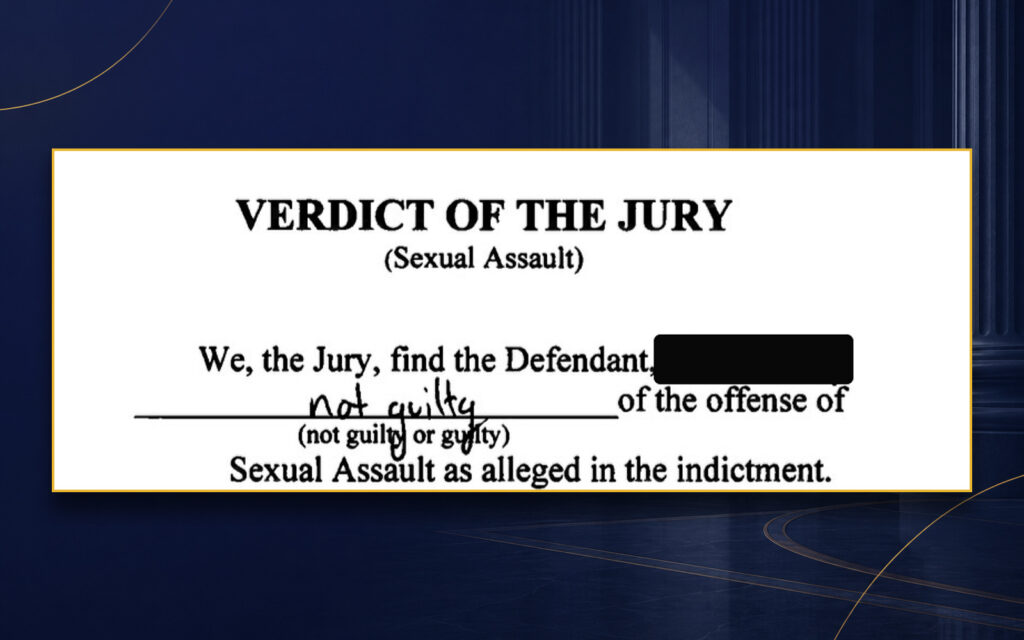
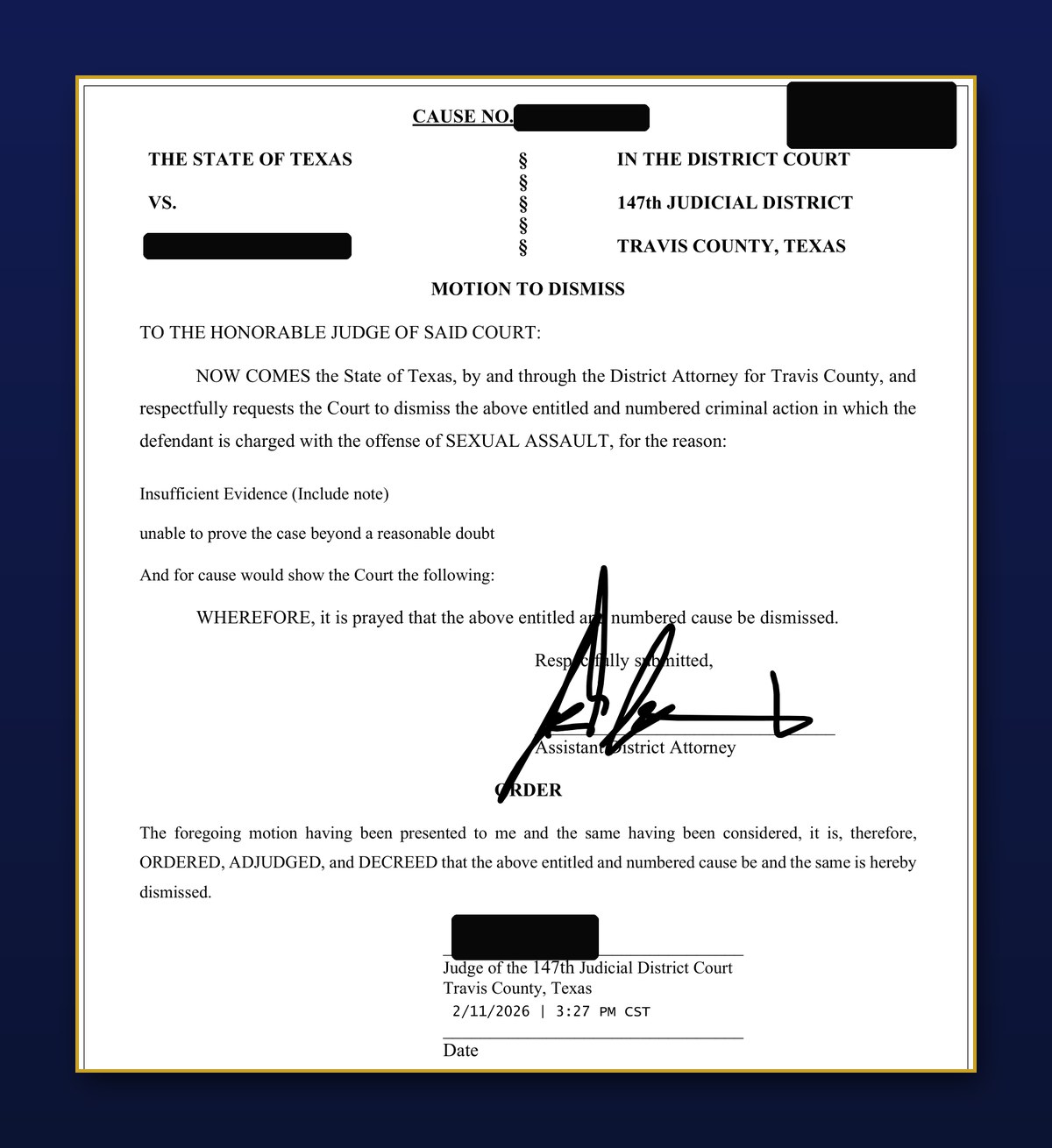
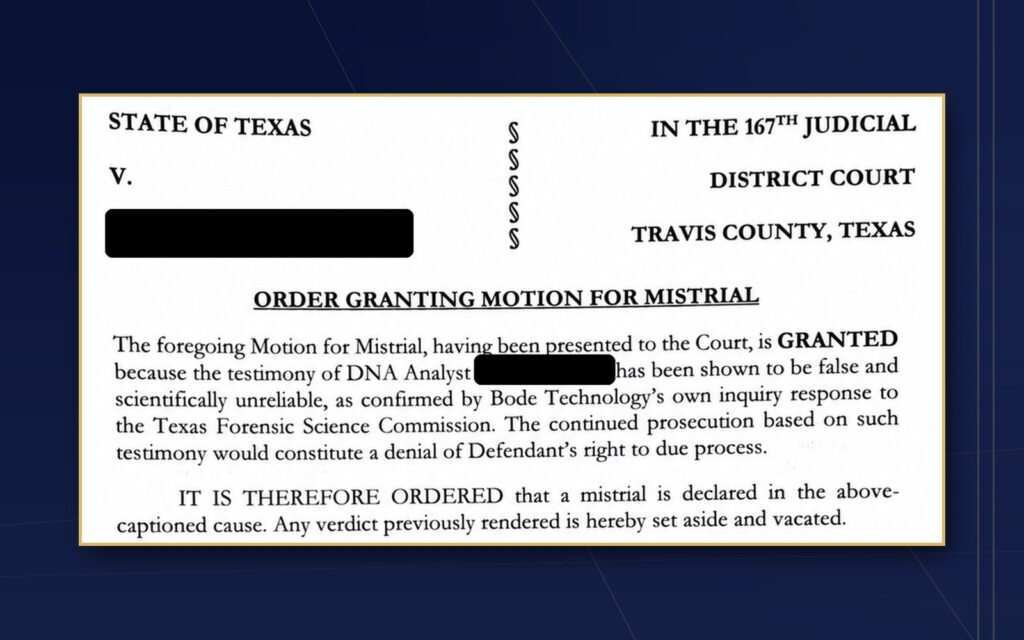
Results: A not-guilty Travis County jury verdict in a sexual assault case, a sexual assault charge dismissed in Travis County because the State was unable to prove the case beyond a reasonable doubt, and a mistrial after the court found the State’s DNA testimony false and scientifically unreliable. See the results. Past results do not guarantee a similar outcome.

What Texas Law Means by Sexual Assault
Texas does not use the word “rape” in its Penal Code. Section 22.011 defines sexual assault in two ways.
Sexual assault of an adult
A person commits sexual assault by intentionally or knowingly doing one of these things without the other person’s consent (§ 22.011(a)(1)):
- penetrating the other person’s anus or sexual organ by any means;
- penetrating the other person’s mouth with the actor’s sexual organ; or
- causing the other person’s sexual organ to contact or penetrate the mouth, anus, or sexual organ of another person, including the actor.
The statute lists when conduct is “without consent” (§ 22.011(b)). The main situations are:
- The person was compelled by physical force, violence, or coercion, or by a threat of force or violence.
- The person had not consented and the actor knew the person was unconscious, physically unable to resist, or unaware that the assault was happening.
- The actor knew the person was intoxicated or impaired by any substance to the extent the person was incapable of consenting.
- The actor knew the person was incapable, because of mental disease or defect, of understanding the act or resisting it.
- The actor held a position of trust or authority and exploited it, such as a public servant, a health care or mental health provider, a clergy member, a coach or tutor, a caregiver, or an employee of a facility where the person lives.
“Consent” means assent in fact, whether express or apparent (§ 1.07(a)(11)). The State carries the burden of proving the lack of consent, and in many of these situations it must also prove what the accused knew.
Sexual assault of a child
It is also sexual assault to do the listed acts to a child, meaning anyone younger than 17, regardless of whether the person knew the child’s age (§ 22.011(a)(2), (c)(1)). Consent is not an issue in these cases, but the statute provides defenses. It is an affirmative defense that the person was the child’s spouse. It is also an affirmative defense that the person was not more than three years older, the child was 14 or older, the person was not required to register for life as a sex offender, and the two were not related in a way that makes marriage or sexual contact unlawful (§ 22.011(e)). See our child sexual abuse page for charges involving young children.
When it is aggravated sexual assault
Sexual assault becomes aggravated sexual assault under § 22.021 when any of these is alleged:
- The person caused serious bodily injury or attempted to cause death.
- The person, by acts or words, placed the victim in fear of death, serious bodily injury, or kidnapping, or made such a threat in the victim’s presence.
- The person used or exhibited a deadly weapon.
- The person acted in concert with another person against the same victim.
- The person gave the victim a substance meant to impair the victim’s ability to understand or resist the act.
- The victim was younger than 14, or was an elderly or disabled individual.
How We Defend Sexual Assault Cases
Every case depends on the evidence. These cases often come down to one person’s word against another’s, which makes the surrounding evidence the whole case. We look at:
- Consent. When the State alleges the act was without consent, it must prove that. We look at the messages, the timeline, and what each person did before and after.
- What the accused knew. Several of the “without consent” situations, such as intoxication, require that the accused knew the other person could not consent. Whether that knowledge can be proved is often contested.
- Identity and DNA. A DNA result can be explained, challenged, or misread. We review the lab’s raw data, not only its report, and work with independent experts on mixtures, touch DNA, and Y-STR testing. See how we challenge DNA evidence.
- The complainant’s account. We compare every statement: the 911 call, the first account to a friend or officer, the forensic interview, and the testimony. Gaps, changes, motive to fabricate, and evidence that contradicts the account all matter.
- Corroboration. A sexual assault conviction can rest on the complainant’s testimony alone if the complainant told someone other than the accused within a year of the alleged offense, with exceptions for victims 17 or younger and certain others (art. 38.07). When that requirement is not met, the State needs more than the complainant’s word.
- Digital and medical evidence. Phone extractions, location data, texts, video, and the medical or forensic nurse exam often show something different from what the police report summarizes.
- Your rights. We look for violations of your constitutional rights, from unlawful searches of your phone to statements taken without proper warnings, and we use article 39.14 to demand the State’s file.
Penalties and Consequences of a Conviction
Sexual assault is a second-degree felony: 2 to 20 years in prison and a fine up to $10,000 (§ 12.33). It is a first-degree felony if the victim was a person the accused was prohibited from marrying or living with as if married, such as a close relative (§ 22.011(f)).
Aggravated sexual assault is a first-degree felony: 5 to 99 years or life and a fine up to $10,000 (§ 12.32). The minimum rises to 25 years if the victim was younger than 10, or younger than 14 and the aggravating conduct involved injury, threats, a weapon, or similar circumstances (§ 22.021(f)).
Probation and deferred adjudication
A judge cannot order probation (community supervision) after a conviction for sexual assault or aggravated sexual assault (art. 42A.054(a)). A jury can recommend it if you have no prior felony conviction and the sentence is 10 years or less, but not if the victim was younger than 14 (art. 42A.055, art. 42A.056). A judge may offer deferred adjudication only after finding in open court that it is in the best interest of the victim (art. 42A.102(a)).
Parole
A person serving a sentence for sexual assault or aggravated sexual assault is not eligible for parole until the actual time served, without good-conduct credit, equals half the sentence or 30 years, whichever is less, and never before two years (Gov’t Code § 508.145(d)). A person serving a sentence for aggravated sexual assault that carries the 25-year minimum is not eligible for parole at all (§ 508.145(a)).
Sex-offender registration
Both offenses are “sexually violent offenses” under the registration law when committed by a person 17 or older (art. 62.001(6)), and the duty to register generally lasts for life (art. 62.101(a)). Registration can limit where you live and work.
Other consequences
A felony conviction also takes away firearm rights (18 U.S.C. § 922(g)(1), Penal Code § 46.04). It can affect work, housing, professional licenses, and, for a noncitizen, immigration status. See our page on immigration consequences.
How long the State has to charge
There is often no deadline. A sexual assault indictment may be presented at any time if the victim was a child, if biological matter collected in the investigation was never DNA tested or does not match the victim or anyone else readily identified, or if probable cause exists that the accused committed the same or a similar offense against five or more victims (art. 12.01(1)(B)-(C)). Otherwise the limit is 10 years from the date of the offense (art. 12.01(2)(E)). An old allegation can still be charged.
What to Do If You Are Charged or Under Investigation
- Do not talk to police or investigators without a lawyer, even to explain or to “clear it up.”
- Do not contact the complainant, directly or through friends. A bond condition or a protective order may forbid it, and any message can be used against you.
- Keep everything: texts, call logs, photos, social media, receipts, and the names of anyone who saw you that day. Do not delete anything, even if it seems unhelpful.
- Do not post about the case or discuss it with friends.
- Do not agree to a phone search or a DNA sample without talking to us first.
- Call us before your first court date.
Results in Sexual Assault Cases
Every case is different, and past results do not guarantee a similar outcome.
- Sexual Assault, Travis County: Not guilty (jury verdict, 2024)
- Sexual Assault, Travis County: Dismissed (February 2026). The State moved to dismiss for insufficient evidence.
- Sexual Assault, Travis County: Mistrial granted after the court found the State’s DNA testimony false and scientifically unreliable (March 2026)
- Indecent Assault (a misdemeanor), Travis County: Not guilty (jury verdict, August 2022)
Teaching Other Lawyers to Defend These Cases
Angelica Cogliano teaches criminal defense lawyers across the country how to defend sexual assault cases and challenge the forensic evidence in them. See her full speaking and teaching page.
- “Combating Y-STR DNA Analysis in Sexual Assault Cases.” Voice for the Defense (Texas Criminal Defense Lawyers Association), March 2021.
- “Sexual Assault.” Fiesta 2023 Advanced Criminal Defense (San Antonio Criminal Defense Lawyers Association and TCDLA), San Antonio, April 2023. Speaker.
- “The Fallibility of DNA.” 49th Annual Advanced Criminal Law Course (State Bar of Texas), Houston, July 2023. Speaker and course book author.
- “Creative Pretrial Litigation: Motions in Limine and More!” 14th Annual Defending Sex Cases (NACDL), Las Vegas, November 2023. Faculty.
- Roundtable on Sexual Assault & Discovery (TCDLA), online, November 2025. Co-leader.
- “DNA: The Dangers of Relatedness.” Friday CLE (Austin Criminal Defense Lawyers Association), online, July 2026. Speaker.
- Sexual & Family Violence Offenses (TCDLA), Round Rock, December 10–11, 2026. Speaker.
What Clients Say

Every case is different, and past results do not guarantee a similar outcome.
Who Handles Your Case
Deniz Kadirhan, partner, has tried numerous felony and misdemeanor jury trials and has argued before the Fifth Circuit and the Texas Court of Appeals. She serves on the Board of Directors of the Texas Criminal Defense Lawyers Association. Angelica Cogliano, partner, has tried cases to verdict in eight states, argued before the Texas Third Court of Appeals, the Fifth Circuit, and the Texas Court of Criminal Appeals, and serves as course director of TCDLA’s annual Forensics seminar.
Frequently Asked Questions About Sexual Assault in Texas
Is sexual assault a felony in Texas?
Yes. Sexual assault is a second-degree felony, with 2 to 20 years in prison and a fine up to $10,000 (§ 22.011(f), § 12.33). It is a first-degree felony in the situations the statute lists, such as when the victim is a close relative. Aggravated sexual assault is always a first-degree felony.
What is the difference between sexual assault and aggravated sexual assault?
Aggravated sexual assault adds an aggravating circumstance to the same conduct: serious bodily injury, a threat of death or kidnapping, a deadly weapon, acting with another person, a drugging allegation, or a victim younger than 14 or an elderly or disabled individual (§ 22.021).
Can someone be convicted on the complainant’s word alone?
Sometimes. A conviction is supportable on the complainant’s testimony alone if the complainant told someone other than the accused about the offense within one year after it allegedly happened. That requirement does not apply if the complainant was 17 or younger, 65 or older, or substantially unable to meet their own needs because of age or disability (art. 38.07).
Can I get probation for sexual assault?
A judge cannot order probation after a conviction. A jury can recommend it if you have no prior felony and the sentence is 10 years or less, unless the victim was younger than 14. Deferred adjudication requires a finding that it is in the victim’s best interest (art. 42A.054, art. 42A.056, art. 42A.102).
Will I have to register as a sex offender?
A conviction for sexual assault or aggravated sexual assault is a reportable conviction, and the duty to register generally lasts for life (art. 62.101(a)). Registration rules for deferred adjudication and for out-of-state cases differ, so talk to a lawyer about your situation.
Can the complainant drop the charges?
No. The decision to prosecute belongs to the State, not the complainant. A complainant can tell the prosecutor they do not want to go forward, and that can affect how the case is handled, but the prosecutor decides whether to dismiss. Do not contact the complainant yourself.
How long does the State have to file a sexual assault charge?
Often there is no deadline, for example when the victim was a child or when biological evidence was never tested. Otherwise the limit is generally 10 years from the offense (art. 12.01). A lawyer can tell you which rule applies to the dates in your case.
Can a sexual assault charge be dismissed or reduced?
Sometimes. A charge can be dismissed, reduced to a lesser offense, or end in a not-guilty verdict. We have obtained dismissals and not-guilty verdicts in sexual assault cases, and you can see them in our results. Every case depends on its own evidence, and past results do not guarantee a similar outcome.
Talk to an Austin Sexual Assault Lawyer
A sexual assault allegation moves fast, and what you do in the first days matters. Call CMK Defense, PLLC at (512) 375-3303, including after hours, for a free and confidential consultation, or reach out through our contact page. Do not contact the complainant, and do not talk to investigators until we have spoken.
Reviewed by Angelica Cogliano, partner at CMK Defense, PLLC. Last reviewed October 2026.



Tell us what’s going on. We’ll help you figure out what to do next—starting today.

© Copyright 2026 CMK Defense, PLLC. All Rights Reserved.
