We’re Here to Help With Your Case (512) 375-3303

Austin Felony DWI Lawyer
Charged with a felony DWI in Austin? A DWI becomes a felony when the person has two earlier DWI-type convictions or one earlier intoxication manslaughter, when a child under 15 is in the car, or when the person was driving in a school crossing zone while the reduced speed limit applies. The State has to prove every part of the charge beyond a reasonable doubt, including any earlier conviction it relies on. Do not talk about the arrest or your history before you speak with a lawyer. Call an Austin felony DWI lawyer at CMK Defense, PLLC for a free and confidential consultation.
We defend felony DWI in Travis, Williamson, Hays, and Bastrop counties. Our attorneys teach other lawyers how to challenge forensic evidence, and we bring that work to every breath and blood case. See our pages on DWI and alcohol offenses, intoxication manslaughter and intoxication assault, and felony charges for related charges.
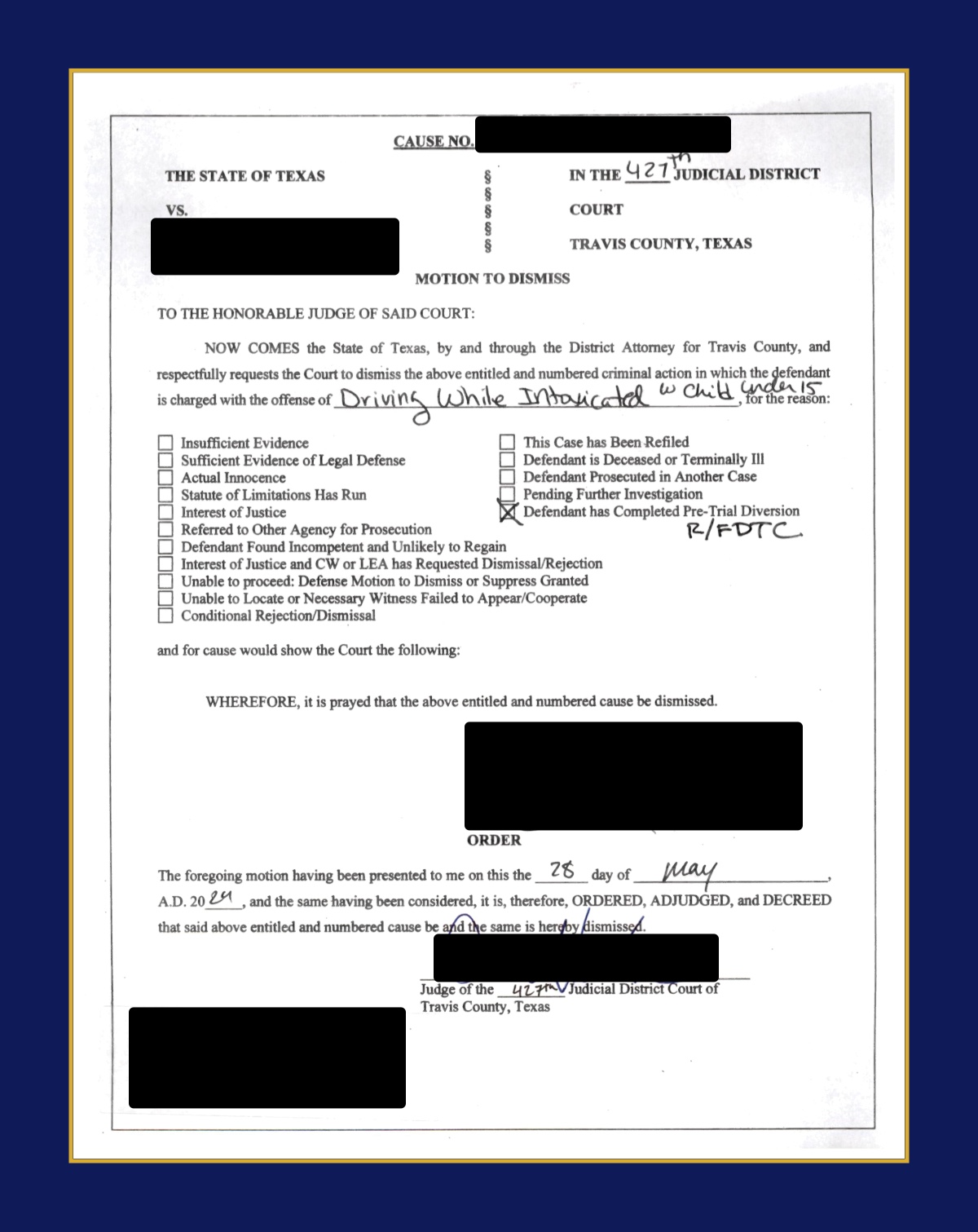
Results: A Travis County felony DWI with a child passenger dismissed after the client completed the felony DWI treatment court program. See the result. Past results do not guarantee a similar outcome.
- What makes it a felony: two earlier DWI-type convictions, an earlier intoxication manslaughter, a passenger under 15, or a school crossing zone while the reduced speed limit applies.
- What we investigate: the stop, the video, the breath or blood testing records, and, when the State relies on earlier convictions, the actual judgments and whether they are yours and can be used.
- Possible outcomes: depending on the evidence and your history, a case may end in a dismissal, a reduction to a misdemeanor, treatment court or pretrial diversion, probation, or a not-guilty verdict. Past results do not guarantee a similar outcome.
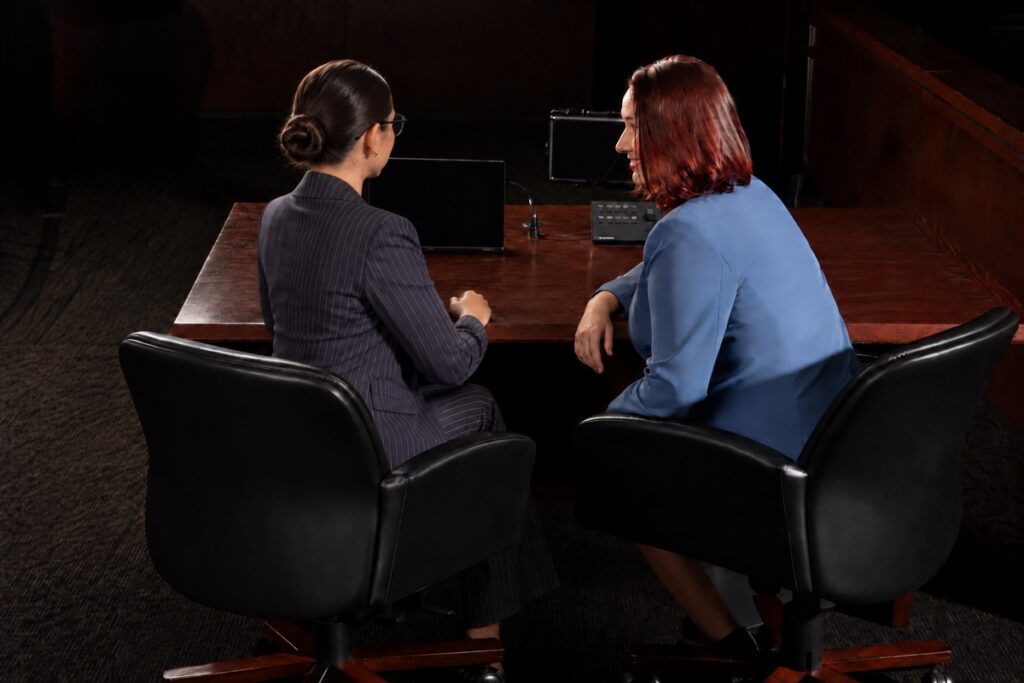
What Makes a DWI a Felony in Texas
A first or second DWI is usually a misdemeanor. The charge moves into felony territory in four situations.
Two prior DWI-type convictions
A DWI is a third-degree felony if it is shown at trial that the person has two earlier convictions for an offense relating to operating a motor vehicle, aircraft, or watercraft, or assembling or operating an amusement ride, while intoxicated (§ 49.09(b)(2)). The earlier convictions can include DWI, DWI with a child passenger, intoxication assault, and intoxication manslaughter involving a motor vehicle, as well as boating and flying while intoxicated and comparable offenses from other states (§ 49.09(c)).
A prior intoxication manslaughter
One earlier conviction for intoxication manslaughter, or for a substantially similar offense in another state, is enough to make a new DWI a third-degree felony (§ 49.09(b)(1)).
A child passenger
Driving while intoxicated with a passenger younger than 15 in the vehicle is a state jail felony, even for a first offense (§ 49.045).
A school crossing zone
Since September 1, 2025, a DWI is a state jail felony if the person was driving in a school crossing zone during the time the reduced speed limit applies (§ 49.04(e)).
What “intoxicated” means
The State can prove “intoxicated” either by showing the person did not have the normal use of mental or physical faculties because of alcohol, a drug, or another substance, or by showing an alcohol concentration of 0.08 or more (§ 49.01(2)). A felony DWI is still a DWI. The State has to prove that the person was operating a motor vehicle in a public place and was intoxicated, and then it has to prove the felony facts on top of that.
How the earlier convictions are counted
- A conviction on or after September 1, 1994 counts as final whether the sentence was imposed or probated (§ 49.09(d)).
- A DWI that ended in deferred adjudication counts as a conviction for this purpose (§ 49.09(g)).
- The State can use a conviction either to make the case a felony under § 49.09 or to enhance punishment under the repeat-offender statute, but not both (§ 49.09(g)).
How We Defend Felony DWI Cases
When the felony depends on earlier convictions, the case has two parts: the night of the arrest and the record of the past. We work on both. In a child passenger or school zone case, the State also has to prove that fact beyond a reasonable doubt.
The earlier convictions
To use a prior conviction, the State has to prove beyond a reasonable doubt that the conviction exists and that you are the person who was convicted. Flowers v. State, 220 S.W.3d 919, 921 (Tex. Crim. App. 2007). We look at:
- Whether each prior exists and is final. We get the actual judgments, not summaries. Missing, incomplete, or inconsistent records are a problem for the State.
- Whether it is your conviction. Names, dates of birth, and fingerprints have to link the record to you. Common names and old records cause mistakes.
- Whether it can be used. We check whether each prior was entered with a lawyer or a valid waiver of counsel, and whether it counts under the statute.
- Out-of-state cases. The State has to show that the other state’s offense fits the Texas definition (§ 49.09(c)(1)(F)).
- The number. If the State cannot prove both priors, a felony can fall back to a misdemeanor.
The stop and the arrest
The State also has to prove today’s offense. We look at the reason for the stop, the officer’s observations, the body camera and dash camera video, the field sobriety tests, and what was said before and after warnings. When the case involves a warrant for blood, we review the affidavit and the timeline. See our DWI page for how we challenge each type of evidence.
The breath or blood result
A result is only as good as how the sample was taken, stored, and tested. We review the chain of custody, the lab’s own data and calibration records, and the uncertainty of measurement. When the State has to estimate the alcohol level at the time of driving, we challenge the science behind that estimate.
Operating and public place
In a crash, a parking lot case, or a case where the person was found in a parked car, the State must still prove that the person was operating the vehicle in a public place.
Your rights
We look for violations of your constitutional rights, from the stop to the questioning, and we use article 39.14 to demand the State’s file.
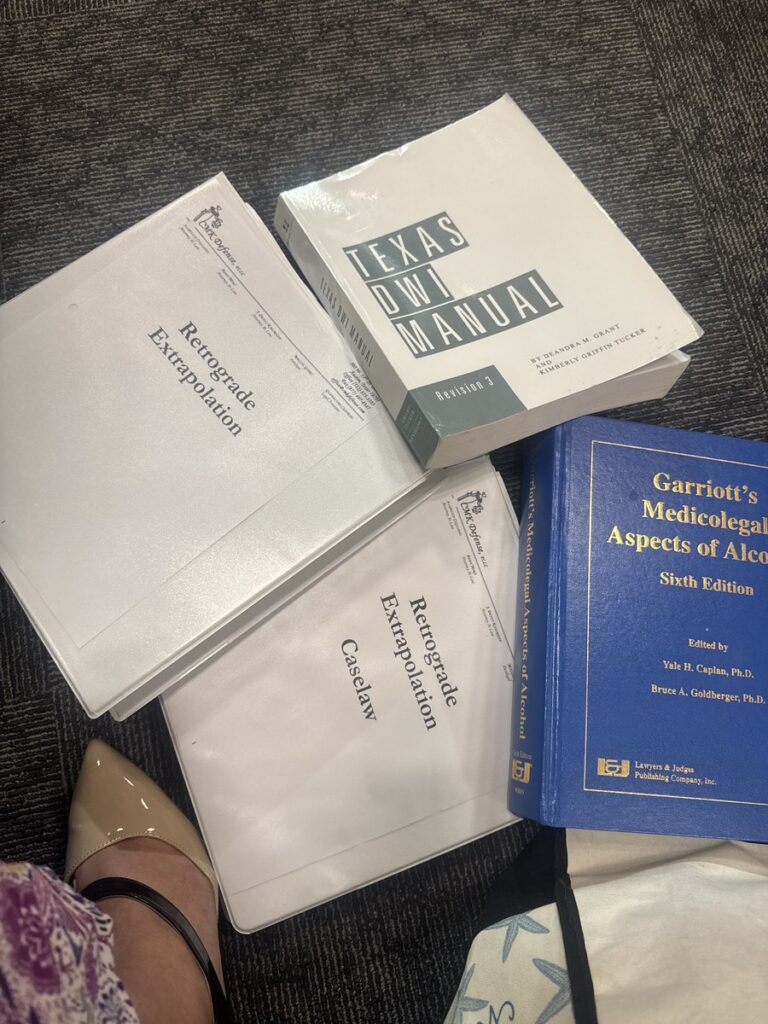
Penalties and Consequences of a Felony DWI Conviction
- Third DWI, or one prior intoxication manslaughter (third-degree felony): 2 to 10 years in prison and a fine up to $10,000 (§ 49.09(b), § 12.34).
- DWI with a child passenger, or DWI in a school crossing zone (state jail felony): 180 days to 2 years in a state jail and a fine up to $10,000 (§ 49.045, § 49.04(e), § 12.35(a), (b)). With two earlier DWI-type convictions or one earlier intoxication manslaughter, either one is a third-degree felony instead (§ 49.09(b)).
When a prior felony raises the range
If the State also proves that you were finally convicted of an earlier felony (other than a state jail felony punishable under § 12.35(a)), a third-degree felony is punished as a second-degree felony, which carries 2 to 20 years (§ 12.42(a), § 12.33). With two earlier felony convictions in sequence (the second offense committed after the first conviction became final), the range is 25 to 99 years or life (§ 12.42(d)). Earlier felony convictions can also raise a state jail felony DWI to a third- or second-degree range (§ 12.425). The State can use an earlier conviction either under § 49.09 or under that statute, but not both (§ 49.09(g)).
Probation and deferred adjudication
Deferred adjudication is not available for DWI with a child passenger or for any DWI that can be enhanced with an earlier conviction under § 49.09 (art. 42A.102(b)(1)(A), (C)). A first DWI in a school crossing zone is not on that list, so deferred adjudication may be available unless the alcohol concentration was 0.15 or more or the person held a commercial driver’s license (art. 42A.102(b)(1)(B)). After a conviction, a judge may order probation for a third-degree felony if the sentence is 10 years or less (art. 42A.053(c)), and for a state jail felony (art. 42A.551(d)). A jury can recommend probation only if the person has never been convicted of a felony (art. 42A.055(b)). When the DWI is a felony because of earlier convictions (§ 49.09(b)), the judge must require at least 10 days in county jail as a condition of probation (art. 42A.401(a)(3)). That article sets no minimum jail term for an unenhanced child passenger or school zone case. Every DWI probation includes an alcohol evaluation and any treatment it calls for (art. 42A.402). If probation is revoked, the jail time already served as a condition does not count toward the sentence (art. 42A.401(b)).
Ignition interlock
For a second or subsequent DWI committed within five years of the most recent earlier offense, the court must order a deep-lung breath device on every vehicle the person owns or operates (§ 49.09(h)).
Other consequences
A felony conviction also takes away firearm rights (Penal Code § 46.04, 18 U.S.C. § 922(g)(1)), and it can affect work, housing, professional licenses, and, for a noncitizen, immigration status. See our page on immigration consequences. A felony DWI conviction can also be a prior if you are ever charged again.
What to Do If You Are Charged With a Felony DWI
- Do not discuss the arrest or your driving history with anyone but your lawyer. Be polite, give your name, and say you want a lawyer.
- Gather what you can about every earlier case: the county, the year, and any paperwork or lawyer names. Do not guess about it with the police.
- Watch your license deadline. If you failed or refused a breath or blood test, the department must receive your hearing request within 15 days after you receive the notice of suspension (Tex. Transp. Code § 524.031; § 724.041). A notice mailed after a blood test result counts as received five days after it is mailed (§ 524.013(b)). Call us right away.
- Do not post about the arrest or discuss it with friends.
- Do not miss court. A bond condition violation can put you back in jail.
- Call us before your first court date.
Result in a Felony DWI Case
Every case is different, and past results do not guarantee a similar outcome.
Teaching Other Lawyers About Forensic Evidence
Angelica Cogliano teaches criminal defense lawyers across the country how to challenge the State’s forensic evidence and its experts. She has been course director of the Texas Criminal Defense Lawyers Association’s annual Forensics seminar every year since 2022 and program co-chair of the National Association of Criminal Defense Lawyers’ annual forensic science seminar since 2024. See her speaking and teaching page.
- “Junk Science: Learning from It & Preventing It.” 37th Annual Rusty Duncan Advanced Criminal Law Course (TCDLA), San Antonio, June 2024. Course Director and Speaker.
- “Special Teams: Experts & Witnesses.” TCDLA seminars, 2021 and 2022. Speaker.
- “Cajun Crossfire: Attacking the State’s Forensic Case & Handling Experts.” Gumbo Advanced Trial Tactics (TCDLA), New Orleans, February 2025. Speaker.
Who Handles Your Case
Deniz Kadirhan, partner, has tried numerous felony and misdemeanor jury trials and has argued before the Fifth Circuit and the Texas Court of Appeals. She serves on the Board of Directors of the Texas Criminal Defense Lawyers Association. Angelica Cogliano, partner, has tried cases to verdict in eight states, argued before the Texas Third Court of Appeals, the Fifth Circuit, and the Texas Court of Criminal Appeals, and serves as course director of TCDLA’s annual Forensics seminar.
Frequently Asked Questions About Felony DWI in Texas
What makes a DWI a felony in Texas?
A DWI is a felony when the person has two prior DWI-type convictions, or one prior intoxication manslaughter conviction (§ 49.09(b)). It is also a felony when a child under 15 is in the vehicle (§ 49.045) or, since September 1, 2025, when the offense happens in a school crossing zone while the reduced speed limit applies (§ 49.04(e)).
What is the punishment for a third DWI in Texas?
A third DWI is a third-degree felony: 2 to 10 years in prison and a fine up to $10,000 (§ 49.09(b), § 12.34). A judge can order probation after a conviction if the sentence is 10 years or less, and a jail term of at least 10 days is then a condition (art. 42A.053(c), art. 42A.401(a)(3)).
Do old DWIs count as priors?
Yes. The current statute has no time limit on how old a prior can be; the time limits it used to have were repealed in 2005 (§ 49.09(e), (f)). A conviction on or after September 1, 1994 counts as final whether the sentence was imposed or probated (§ 49.09(d)). That is why we check every prior: whether it exists, whether it is final, whether it is the client’s, and whether it can legally be used.
Does a DWI from another state count?
It can. The statute counts an offense under the laws of another state that prohibit operating a motor vehicle while intoxicated (§ 49.09(c)(1)(F)). Whether the other state’s offense actually fits is something we examine, because the State has to prove it.
Does a DWI that ended in deferred adjudication count?
Yes. For purposes of the enhancement statute, a person is considered convicted of a DWI or boating while intoxicated offense if the person was placed on deferred adjudication for it (§ 49.09(g)).
Can I get deferred adjudication or probation for a felony DWI?
Deferred adjudication is not available for DWI with a child passenger or for any DWI that can be enhanced with an earlier conviction under § 49.09 (art. 42A.102(b)(1)(A), (C)). A first DWI in a school crossing zone may be eligible unless the alcohol concentration was 0.15 or more or the person held a commercial driver’s license (art. 42A.102(b)(1)(B)). Probation after a conviction may be available from the judge, or from a jury if the person has never been convicted of a felony (art. 42A.053(c), art. 42A.055(b)). If the DWI is a felony because of earlier convictions, at least 10 days in county jail is a required condition (art. 42A.401(a)(3)). Every DWI probation includes an alcohol evaluation and any treatment it calls for (art. 42A.402).
Can a felony DWI be reduced to a misdemeanor?
Sometimes. If a prior cannot be proved or cannot be used, the charge may fall back to a misdemeanor, and a case can also end in a dismissal or a not-guilty verdict. Every case depends on its own evidence, and past results do not guarantee a similar outcome.
What happens to my license and my car?
A conviction can bring a license suspension, and a second or later DWI committed within five years of the most recent earlier offense requires an ignition interlock device on every vehicle the person owns or operates (§ 49.09(h)). If you failed or refused a breath or blood test, the department must receive your hearing request within 15 days after you receive the notice of suspension (Tex. Transp. Code § 524.031; § 724.041), so call us right away. See our DWI page for the license process.
Talk to an Austin Felony DWI Lawyer
Early work matters in a felony DWI case. The license deadline is short, and the sooner we see the State’s evidence, the sooner we can start testing it. Call CMK Defense, PLLC at (512) 375-3303, including after hours, for a free and confidential consultation, or reach out through our contact page.
Reviewed by Angelica Cogliano, partner at CMK Defense, PLLC. Last reviewed October 2026.


Tell us what happened. If you know where the case is pending or when your next court date is, include that too. We’ll explain your options and the next step.
Relentlessly Yours.

© Copyright 2026 CMK Defense, PLLC. All Rights Reserved.
