

By Deniz Kadirhan, CMK Defense, PLLC | Austin, Texas
Reviewed November 14, 2026
The short answer
In a Texas child abuse case, the outcry witness is generally the first adult (18 or older, and not the person accused) to whom the child described the alleged offense in some discernible manner, meaning more than a vague hint. Article 38.072 of the Code of Criminal Procedure lets that adult repeat the child’s statement in court, an exception to the usual ban on hearsay. Before a jury hears it, the State must give notice and a written summary at least 14 days before the proceeding begins, the judge must find the statement reliable at a hearing outside the jury’s presence, and the child must testify or be available to testify. Tex. Code Crim. Proc. art. 38.072, § 2.
A child in your family has told someone that you abused them. Maybe it came out years later. Maybe it came out to a school counselor, a grandparent, or your own spouse. Now a lawyer or a detective has used a phrase you had never heard before: outcry witness.
This post explains who counts as the outcry witness in a Texas child abuse case, what the State has to do before that person testifies, what changed in 2025, and how the defense can challenge outcry testimony before a jury hears it.
This post covers Texas state law. Federal cases follow different rules.
What Is an Outcry Witness in a Texas Child Abuse Case?
Courts usually do not let a witness repeat what someone else said outside the courtroom to prove that it is true. That is hearsay, and under Texas Rule of Evidence 802, hearsay is not admissible unless a statute or a court rule makes an exception. Tex. R. Evid. 802.
The outcry rule is one of those statutes. Article 38.072 of the Texas Code of Criminal Procedure creates a narrow exception for a child’s statement describing the alleged abuse, made to the first adult who heard it. The statute covers statements that:
“(3) were made to the first person, 18 years of age or older, other than the defendant, to whom the child or person with a disability made a statement about the offense or extraneous crime, wrong, or act.”
Tex. Code Crim. Proc. art. 38.072, § 2(a)(3).
The adult who repeats that statement in court is the outcry witness. What they repeat is the outcry statement. (The words “extraneous crime, wrong, or act” cover a narrower use at the punishment stage, explained below.)
Why Texas makes an exception here
The Court of Criminal Appeals has explained that the rule balances two things: the general ban on hearsay and the State’s interest in prosecuting child sexual abuse. Garcia v. State, 792 S.W.2d 88, 91 (Tex. Crim. App. 1990). The point to hold onto is that this is an exception to the general rule against hearsay. Because it is an exception, the statement comes in under it only if every one of the statute’s requirements is met, and the defense can hold the State to each of them.
Which cases the rule covers
The rule applies in prosecutions for listed offenses against a child younger than 18 or a person with a disability, as the Penal Code defines that term. Tex. Code Crim. Proc. art. 38.072, §§ 1, 3. The list includes the sexual offenses in Chapter 21 of the Penal Code (such as indecency with a child and continuous sexual abuse of a young child), the assaultive offenses in Chapter 22 (including aggravated sexual assault of a child), prohibited sexual conduct, sexual performance by a child, compelling prostitution, certain trafficking offenses, and attempts to commit any of them.
At the punishment stage, the rule can also cover a child’s statement about certain other alleged acts by the defendant, but only if that conduct is otherwise admissible and the statement meets the statute’s other requirements. Tex. Code Crim. Proc. art. 38.072, § 2(a)(1)(B). This post focuses on the guilt stage of trial. If a conviction would require registration, our post on what requires sex offender registration in Texas explains which offenses do and for how long.
Who Counts as the “First” Adult the Child Told?
The answer decides who gets to repeat the child’s words in front of a jury. “First adult” sounds simple. When the child disclosed late, it rarely is.
A hint is not an outcry
The child has to have described the offense to the adult “in some discernible manner.” Lopez v. State, 343 S.W.3d 137, 140 (Tex. Crim. App. 2011). The statement must be more than a general allusion that something in the area of child abuse was going on. Garcia, 792 S.W.2d at 91. A child saying “he makes me uncomfortable” or “I don’t like going over there” is usually not enough. Courts generally look for some account of what happened, not only that something happened.
That cuts in an unexpected direction. Take a hypothetical: a child made a vague comment to a parent two years ago and gave details to a school counselor last month. The counselor may be the outcry witness, not the parent. The State does not get to pick whichever adult makes the best impression on the stand. The question is who the child first described the offense to, and the trial judge decides it. Garcia, 792 S.W.2d at 91–92.
In a late disclosure, the outcry witness is often not the first person the child talked to
Children in these cases often talk to several people before any adult hears details. Some of those conversations do not count under the statute.
| Who heard it | Can that person be the outcry witness? |
|---|---|
| A friend, sibling, or cousin who was under 18 when the child told them | No. The statute requires a person 18 or older. |
| The person accused | No. The statute excludes the defendant. |
| An adult who heard only a vague hint | Usually not. A general allusion is not a description of the offense. |
| The first adult the child described the offense to | Yes, if the notice, reliability, and availability requirements are also met. |
| An earlier adult who cannot remember or relate what the child said | A later adult may qualify, depending on what the evidence shows about the earlier conversation. |
| Anyone, if the first description came after the person turned 18 | No. The statement has to be made while the person is still a child. |
Two of those rows come from case law. Courts have held that the proper outcry witness is the first adult who can remember and relate the child’s statement, so if an earlier adult cannot, a later adult may qualify. Carty v. State, 178 S.W.3d 297, 305–06 (Tex. App.–Houston [1st Dist.] 2005, pet. ref’d). What the evidence actually shows about the earlier conversation matters. And a description first given at 18 or older is not a child’s outcry under this statute. Harvey v. State, 123 S.W.3d 623, 629 (Tex. App.–Texarkana 2003, pet. ref’d).
The conversations that do not count still matter. They are part of the history of how the account developed: who heard it first, what was asked, what was said back, and how the details changed. That history can be defense material even when it is not outcry testimony.
When the outcry witness is a forensic interviewer
Sometimes the first time a child gives details to anyone is during a recorded interview at a Children’s Advocacy Center. If the interviewer was the first adult to hear a qualifying description, the interviewer can be the outcry witness. The outcry rule allows the interviewer’s live testimony; it does not, by itself, let the State play the recording. Bays v. State, 396 S.W.3d 580, 581–82 (Tex. Crim. App. 2013). Our child sexual abuse defense page explains how these interviews work and why the questions asked matter.
One Outcry Witness per Event, and What Changed in 2025
Outcry is “event-specific,” not person-specific. Lopez, 343 S.W.3d at 140. Different adults can be outcry witnesses for different alleged incidents, and one adult can be the first adult told about more than one incident. But two adults do not both become outcry witnesses for the same incident just because the child told both of them about it.
In 2025, the Legislature added a new subsection:
“(a-1) The trial court shall admit more than one statement under this article at a proceeding if each statement:
(1) meets the requirements of Subsection (a); and
(2) describes different conduct by the defendant.”
Tex. Code Crim. Proc. art. 38.072, § 2(a-1) (added by Acts 2025, 89th Leg., R.S., ch. 250 (H.B. 1778), § 4.03).
The new subsection is about statements, not witnesses. When two or more qualifying statements describe different conduct by the defendant, the court must admit them, whether they came through one adult or several. The subsection refers only to the requirements of Subsection (a), so it should be read alongside the notice, reliability, and availability requirements discussed below. No Texas appellate court has interpreted it yet.
The change applies to a criminal proceeding that commences on or after September 1, 2025. A proceeding that commenced before that date stays under the old law. H.B. 1778, § 4.08. The bill does not say when a proceeding “commences” for this purpose, and that may matter in a case that began around that date.
The same bill made two smaller changes. It raised the age, from under 14 to under 18, for the other children whose alleged mistreatment a punishment-stage outcry can describe, and it tied the definition of a person with a disability to Penal Code § 22.04. H.B. 1778, §§ 4.02, 4.04.
The Three Conditions Before a Jury Hears an Outcry Statement
Even when the adult and the statement qualify, the State has to clear three more steps before the hearsay rule stops being a barrier: timely notice, a reliability finding outside the jury’s presence, and a child who testifies or is available to testify.
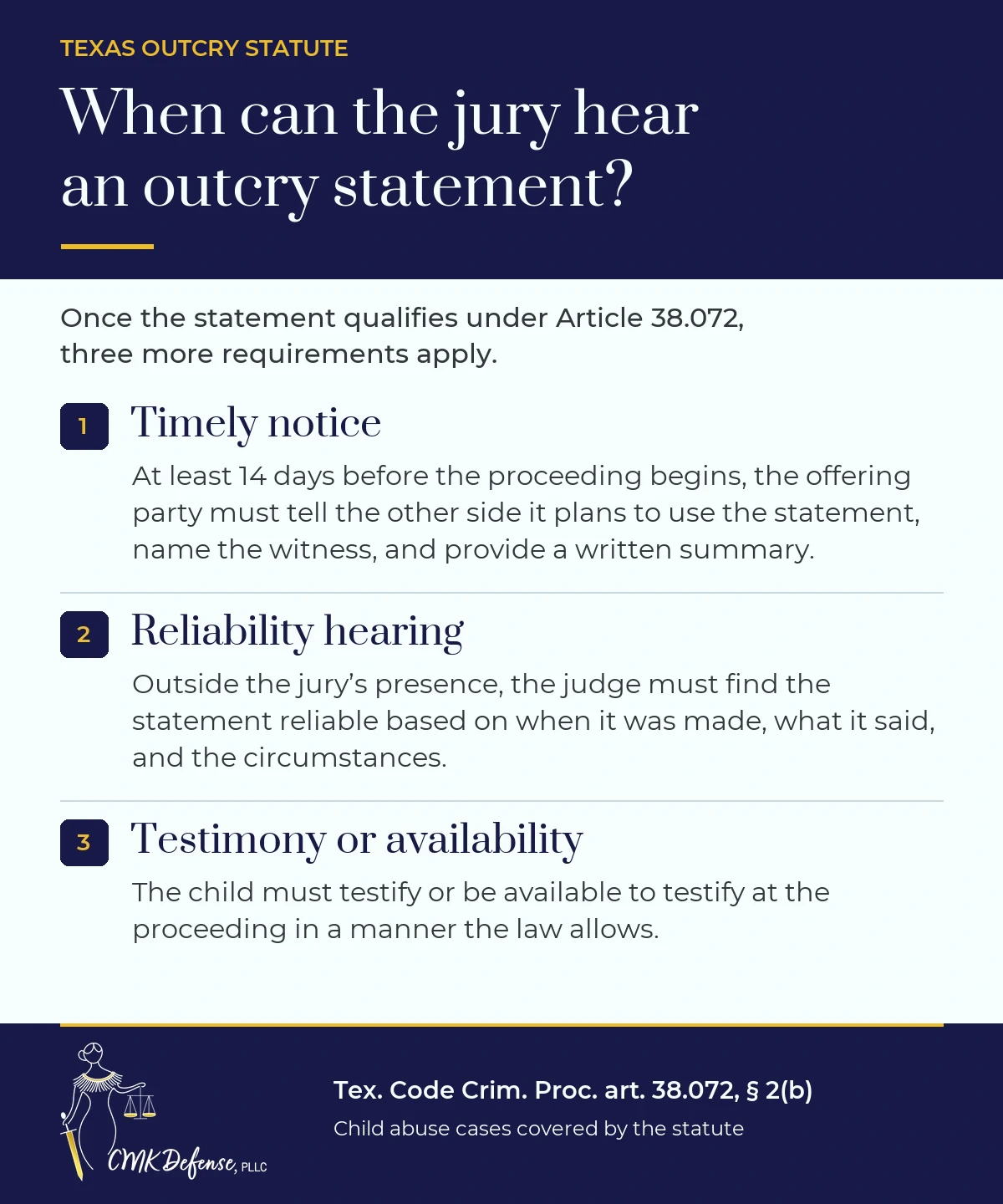
The statute reads:
“(b) A statement that meets the requirements of Subsection (a) is not inadmissible because of the hearsay rule if:
(1) on or before the 14th day before the date the proceeding begins, the party intending to offer the statement:
(A) notifies the adverse party of its intention to do so;
(B) provides the adverse party with the name of the witness through whom it intends to offer the statement; and
(C) provides the adverse party with a written summary of the statement;
(2) the trial court finds, in a hearing conducted outside the presence of the jury, that the statement is reliable based on the time, content, and circumstances of the statement; and
(3) the child or person with a disability testifies or is available to testify at the proceeding in court or in any other manner provided by law.”
Tex. Code Crim. Proc. art. 38.072, § 2(b).
1. Notice at least 14 days before the proceeding begins
At least 14 days before the proceeding begins, the side offering the statement must tell the other side it intends to use it, give the name of the witness who will repeat it, and provide a written summary of the statement. Tex. Code Crim. Proc. art. 38.072, § 2(b)(1). The Court of Criminal Appeals has held that the notice and hearing requirements are mandatory and must be met for the statement to come in over a hearsay objection. Long v. State, 800 S.W.2d 545, 547 (Tex. Crim. App. 1990).
That written summary is often the first time the defense sees, in writing, what the State says the child told the adult. It gives the defense a written account to test. Everything else (the recorded interview, the counselor’s notes, a police report, text messages) can be compared with it, detail by detail.
2. A reliability hearing outside the jury’s presence
Before the jury hears the statement, the judge has to hold a hearing outside the jury’s presence and find the statement “reliable based on the time, content, and circumstances of the statement.” Tex. Code Crim. Proc. art. 38.072, § 2(b)(2).
Be clear on what this hearing is and is not. It looks at the reliability of the child’s statement: when it was made, what it said, and the circumstances it was made in. It is not a trial of whether the outcry witness is believable; that is for the jury. And when the State tried to use an unavailable outcry witness’s testimony from this hearing in place of live testimony, the Court of Criminal Appeals held that the hearing was not an adequate substitute for cross-examination at trial. Sanchez v. State, 354 S.W.3d 476, 487–89 (Tex. Crim. App. 2011).
A long delay before the child told anyone does not, by itself, make the statement unreliable. Timing is one of the factors the judge weighs. Buentello v. State, 512 S.W.3d 508, 519–20 (Tex. App.–Houston [1st Dist.] 2016, pet. ref’d).
3. The child testifies or is available to testify
The child has to testify or be available to testify at the proceeding, in court or in another manner the law allows. Tex. Code Crim. Proc. art. 38.072, § 2(b)(3). Being available does not always mean the child takes the stand. The outcry witness does not replace the child. If both testify, the jury may hear the account from the child and again from the adult.
Does Hearing the Accusation Twice Make It More True?

No, though it can feel that way in a courtroom. Once admitted, outcry testimony is substantive evidence: jurors may consider the child’s statement as evidence of what happened, not only as background. Buentello, 512 S.W.3d at 518. The Court of Criminal Appeals has held that outcry testimony can be enough on its own to support a conviction, with no requirement that it be corroborated or that the child confirm it. Rodriguez v. State, 819 S.W.2d 871, 873–74 (Tex. Crim. App. 1991).
What it is not is a second source. When the adult repeats what the child said, both accounts trace back to the child. Anything the adult saw firsthand is a separate matter, but on the outcry itself, a jury that hears the account twice has heard it twice, not had it confirmed. Making that distinction plain is part of the defense’s job at trial.
What the Defense Does in an Outcry Case Before Trial
Because the outcry rule has conditions, an outcry case can be challenged in specific ways before trial. These are the ones the defense focuses on.
Charting every conversation, not only the one the State picked
The State will name an outcry witness. The defense builds its own chart of every conversation the child had about it: when it happened, who it was with, how old that person was, what was asked, and what was said. With that chart, the defense can check whether the State’s witness is actually the first adult who heard a description, or whether someone earlier heard something different. The State must lay the groundwork to use the exception. If the defense contends someone else heard the first qualifying account, records or testimony about what that person actually heard can make the difference.
In a late-disclosure case, this chart often covers years and several households. It is slow work and it starts early, because memories of ordinary conversations fade.
Reading the written summary against every other version
On a timely request, Texas law generally requires the State to produce witness statements and other material evidence in its possession, custody, or control, subject to statutory limits. It separately requires the State to disclose anything in its possession, custody, or control that tends to help the defense, whether it bears on guilt, impeachment, or punishment. Tex. Code Crim. Proc. art. 39.14(a), (h). A recorded Children’s Advocacy Center interview can be reviewed, but the law restricts copying it if the State makes it reasonably available to the defense. Tex. Fam. Code § 264.408(d), (d-1).
With those materials, the defense compares the outcry summary against the recorded interview, counselor or medical records, police reports, and messages. If the accounts line up, that is worth knowing. If they differ on what happened, when, or where, that divergence is evidence. And if the outcry witness testifies to essential facts about the alleged offense that the summary left out, that can be grounds for an objection. Gay v. State, 981 S.W.2d 864, 866–67 (Tex. App.–Houston [1st Dist.] 1998, pet. ref’d).
Using the hearing, and objecting on time
The reliability hearing is a chance to put the circumstances of the statement on the record: who was in the room, what prompted the conversation, what questions came before the child’s answers. Objections also have to be made on time. The defense can raise them before the jury hears the statement, and a timely objection and ruling matter because a complaint may otherwise be lost on appeal. Long, 800 S.W.2d at 547; Tex. R. Evid. 103(a). The outcry rule protects the accused only when someone insists on it.
Results in Our Child Sexual Abuse Cases
Who the child first told, and what that person actually heard, can decide these cases. Some of our results:
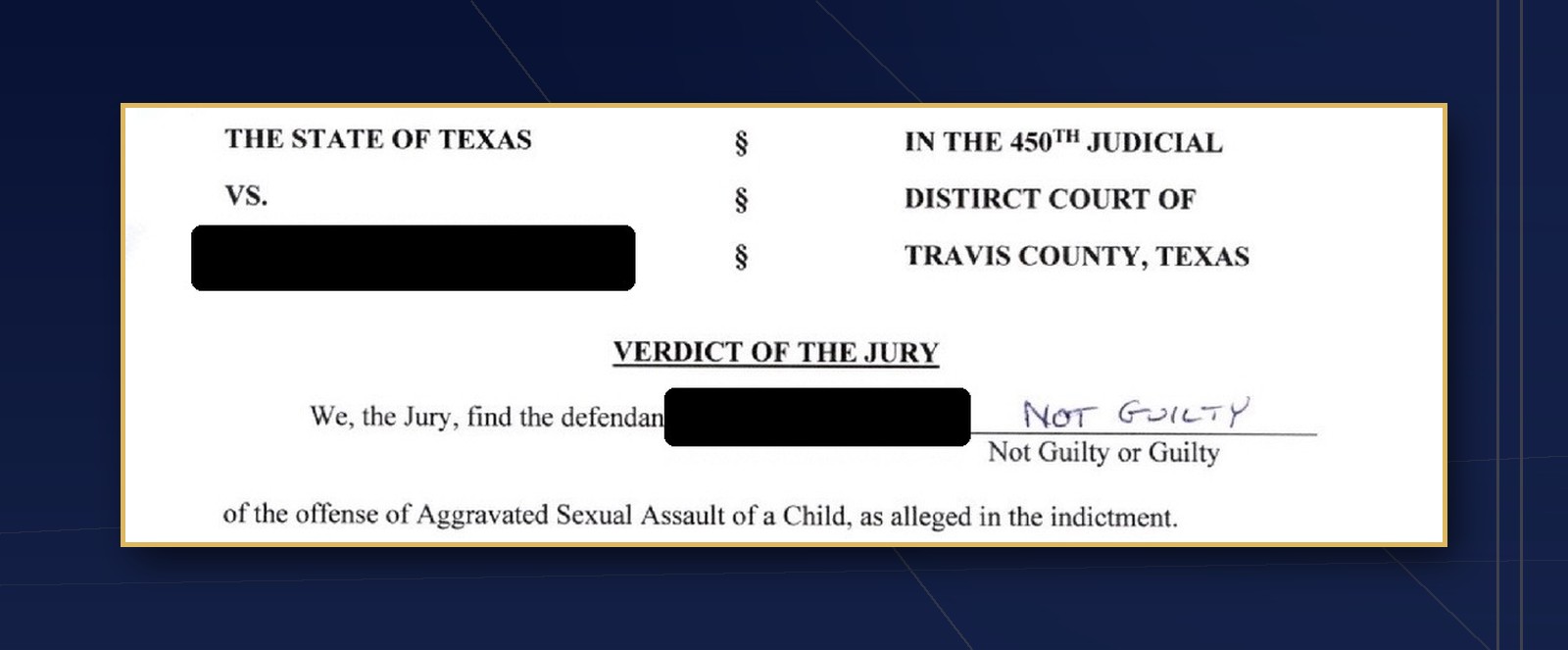
- Sexual assault of a child and aggravated sexual assault of a child, Travis County: not guilty. The complainant testified that she told a family member right after the alleged incident. We called that family member, who testified by video that she was in another country at the time, and we put her passport into evidence. Read the case study.
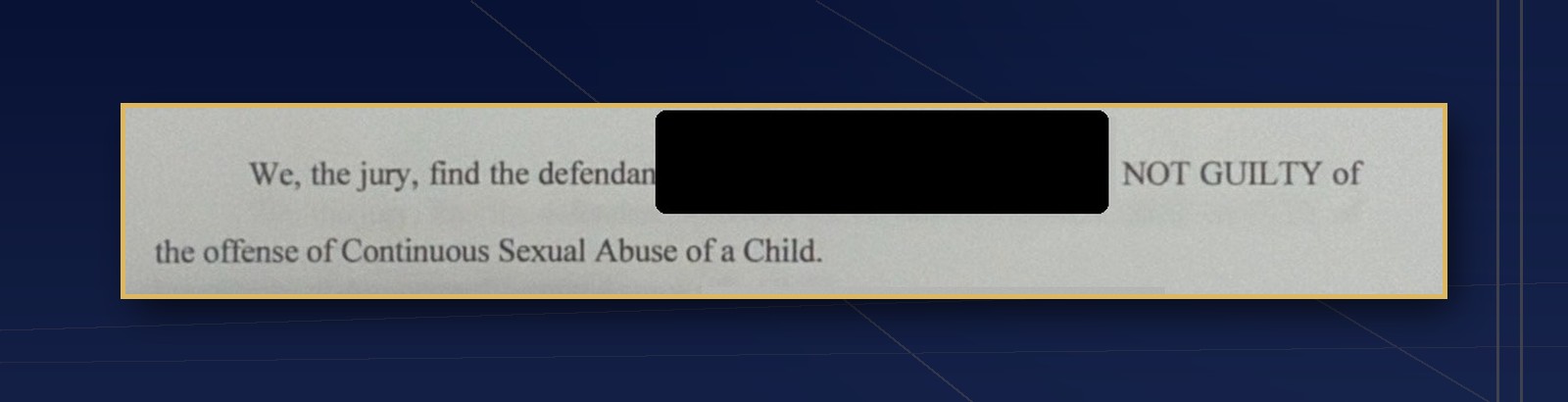
- Continuous sexual abuse of a child, Hays County: not guilty on all counts (July 2026). The accusation rested on one person’s account, and that account was inconsistent. Read the case study.
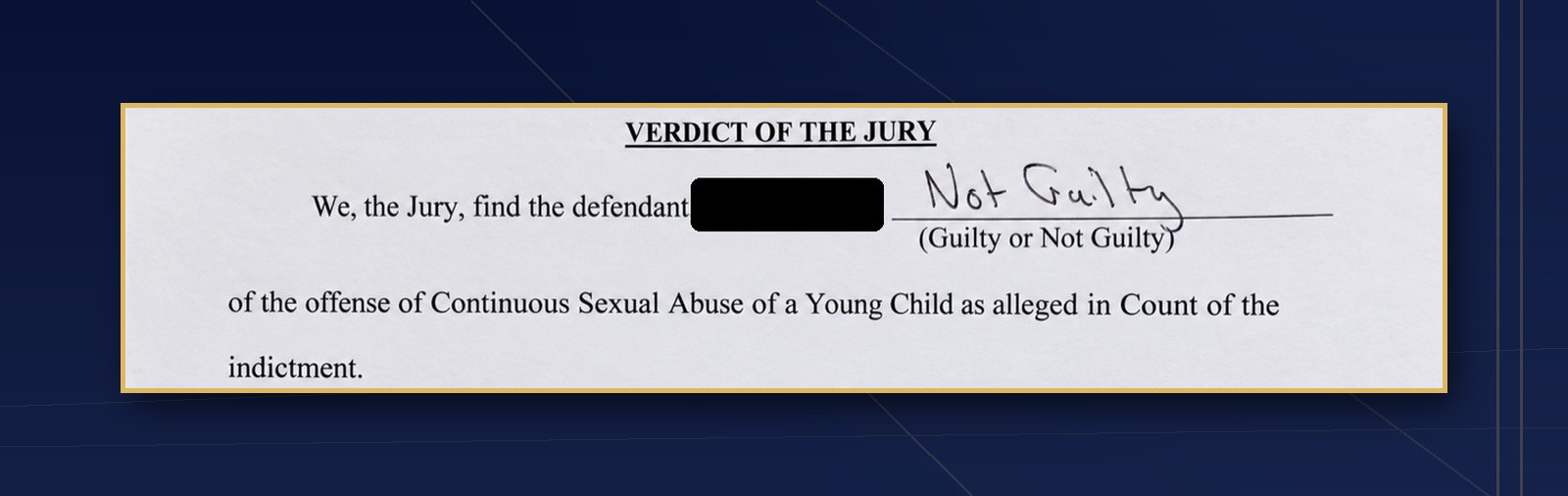
- Continuous sexual abuse of a young child, Travis County: not guilty. The accusation surfaced in a contested divorce and custody dispute and could not be squared with the timeline or the physical evidence. Read the case study.
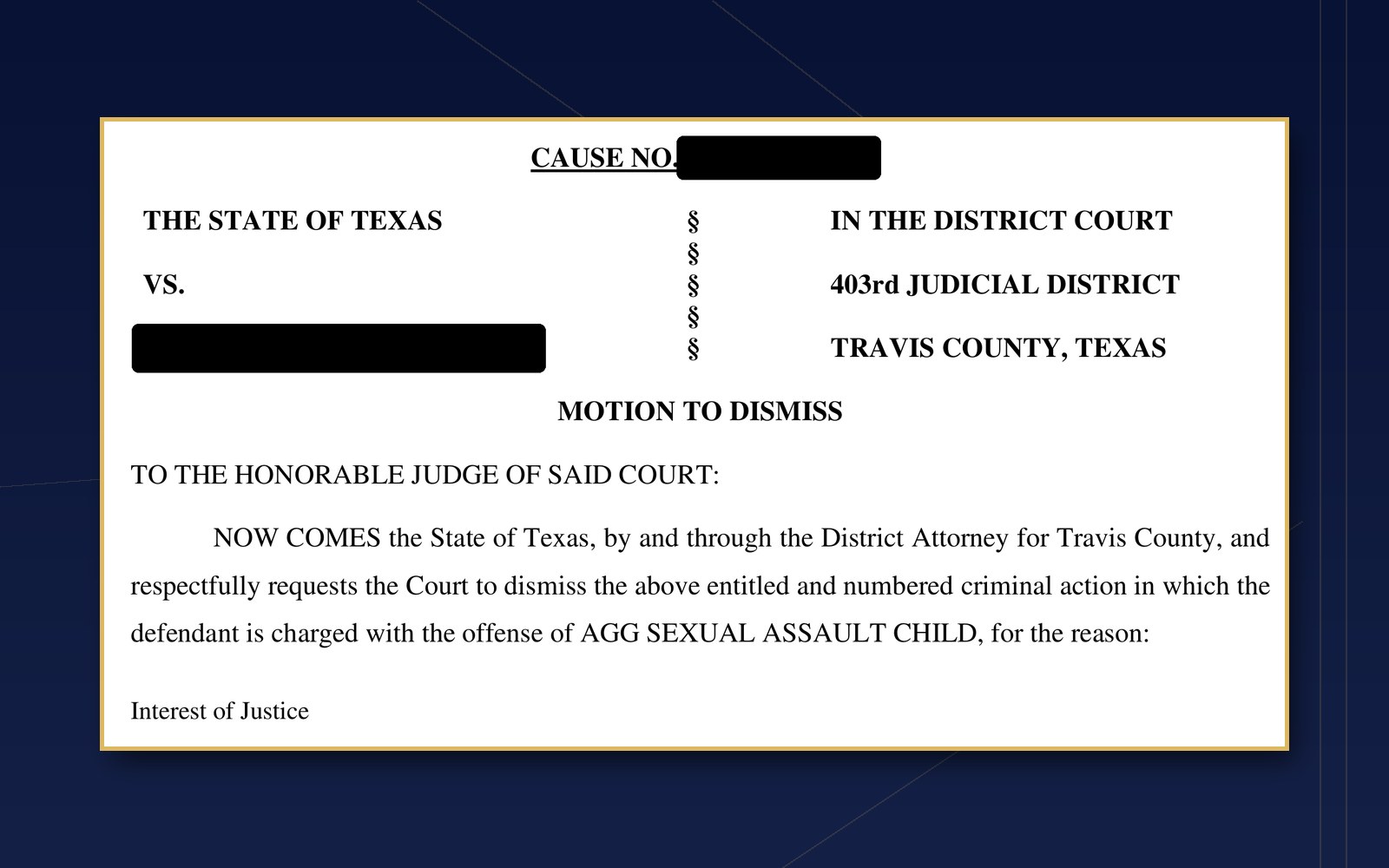
- Aggravated sexual assault of a child, Travis County: dismissed on the State’s motion in the interest of justice (June 2026).
Past results do not guarantee a similar outcome. More on our Case Studies page.
Outcry Witness FAQ for Texas Child Abuse Cases
Does the child still have to testify if there is an outcry witness?
Not necessarily on the stand, but the child must testify or be available to testify at the proceeding, in court or in another manner the law allows. Tex. Code Crim. Proc. art. 38.072, § 2(b)(3). The outcry witness adds to the child’s account rather than replacing it. If both testify, the jury may hear the account from both.
Is outcry testimony enough to convict someone in Texas?
It can be. Once admitted, outcry testimony is evidence the jury may consider for its truth, and the Court of Criminal Appeals has held it can support a conviction without independent corroboration. Rodriguez, 819 S.W.2d at 873–74. The State still has to prove every element of the charged offense beyond a reasonable doubt, and the outcry is a repetition of the child’s account, not independent confirmation of it.
The child waited years to tell anyone. Does that matter?
A delay by itself does not keep an outcry statement out. The timing of the statement is one of the things the judge weighs at the reliability hearing, along with what the child said and the circumstances. Buentello, 512 S.W.3d at 519–20. Age at disclosure matters too: a description first given at 18 or older is not a child’s outcry under this statute. Harvey, 123 S.W.3d at 629. Whether there is a time limit on the charge itself is a separate question.
Can a parent be the outcry witness?
Yes. A parent can qualify if they are the first adult, other than the person accused, to whom the child described the offense in some discernible manner. A parent who heard only a vague comment, with details coming out later to someone else, may not qualify. The trial judge decides which adult is the proper outcry witness.
Can a teacher or school counselor be the outcry witness?
Yes, if they were the first adult, other than the person accused, to hear the child describe the offense. In late-disclosure cases, a counselor or teacher is often the first adult to hear details, which can make them the outcry witness even if a family member heard something vaguer earlier. Their notes and any report they made are important records to compare with later accounts.
Does the outcry witness have to be the first person the child told?
No. They have to be the first adult, 18 or older and not the person accused, to whom the child described the offense. Earlier conversations with other children, or vague remarks to adults, do not count. Those earlier conversations can still help the defense understand how the account developed.
What if the child first told a friend or sibling who was under 18?
If the friend or sibling was under 18 when the child told them, that person cannot be the outcry witness, because the statute requires an adult. The first adult the child later described the offense to may be the outcry witness. It is still worth knowing what the child told the friend, because it is part of how the account developed.
Can there be more than one outcry witness in Texas?
Yes. Different adults can be outcry witnesses for different alleged acts if each was the first adult told about that act, and one adult can be the first adult told about more than one act. Two adults generally cannot both repeat the first description of the same act. For criminal proceedings that commence on or after September 1, 2025, a 2025 amendment requires the court to admit more than one qualifying outcry statement when the statements describe different conduct by the defendant.
What does the outcry witness actually have to say in court?
The outcry witness testifies about what the child told them in the qualifying conversation. The State’s notice must include a written summary of that statement, and a Texas appeals court has held that letting the witness testify to essential facts of the alleged offense that the summary left out was error. Gay, 981 S.W.2d at 866–67. Peripheral details outside the summary are not always excluded, so whether an objection works depends on what was left out.
What to Do Now
If you have learned that a child in your family has made an outcry, or that an outcry witness has been named in your case, the work that matters most starts early, before memories of ordinary conversations fade and before the account hardens into a single version.
- Do not try to explain your side to investigators alone. (See Do I Have to Talk to Police in Texas If I’m Not Under Arrest?)
- Follow every bond condition and protective order exactly, including any order not to contact the child or the family. (See What Happens at a Magistration Hearing in Texas?)
- Do not talk about the accusation on the phone, by text, or online. That includes calls from jail. (See Are Jail Phone Calls Recorded and Used Against You in Texas?)
- Keep the records. Messages, calendars, and school or family records can show who was where and when conversations happened. Do not delete anything.
- Get a defense lawyer involved early, so someone is reviewing the outcry notice and the earlier conversations before the reliability hearing.
Understanding what an outcry witness in a Texas child abuse case can and cannot say is the first step. The next is talking with a defense lawyer about your own facts. CMK Defense represents people accused of child sexual abuse in Austin and across Travis, Williamson, Hays, and Bastrop counties.
Call (512) 375-3303 or schedule a confidential consultation.