

By Deniz Kadirhan, CMK Defense, PLLC | Austin, Texas
Reviewed November 2, 2026
The short answer
Sex offender registration in Texas is usually triggered by a “reportable conviction or adjudication” for an offense on the list in Tex. Code Crim. Proc. art. 62.001(5), and deferred adjudication counts. An arrest or a pending charge does not, by itself, require registration. In an ordinary adult case, registration lasts for life for sexually violent offenses and certain other listed offenses. For the rest, it ends 10 years after the latest of release from prison or jail, discharge of community supervision, or dismissal and discharge of deferred adjudication. Juvenile adjudications and cases transferred from juvenile court follow separate 10-year rules. Tex. Code Crim. Proc. art. 62.101. The exact offense and subsection in the judgment, and certain findings the judge enters, decide which rule applies.
If you have just been charged with a sex offense in Texas, one question probably comes before all the others: will this put me on the sex offender registry, and for how long?
The statute answers it, and the answer turns on details most people are never told to look for. Sex offender registration in Texas does not depend on what you were arrested for. It usually depends on the exact offense you are convicted of or placed on deferred adjudication for, and sometimes on a finding the judge writes into the judgment. Those details get settled when the case is resolved, so the time to look at registration is while the charge is still open.
This guide covers what is on the list, how long registration lasts, what to check before a plea, and the narrow ways off the registry. It covers Texas law. Federal law has its own registration rules, noted below where they matter.
What Crimes Require Sex Offender Registration in Texas?
Texas registration law is in Chapter 62 of the Code of Criminal Procedure. The trigger is what the statute calls a “reportable conviction or adjudication.” In plain terms, that is a conviction or a deferred adjudication for an offense on a specific list. The definition starts like this:
“Reportable conviction or adjudication” means a conviction or adjudication, including an adjudication of delinquent conduct or a deferred adjudication, that, regardless of the pendency of an appeal, is a conviction for or an adjudication for or based on: . . .
Two things in that sentence matter right away:
- Deferred adjudication counts.
- An appeal does not pause the duty to register. Tex. Code Crim. Proc. art. 62.002(b).
The offenses on the list
Grouped in plain language, the list in article 62.001(5) covers:
- Sexual assault and abuse offenses: sexual assault, aggravated sexual assault, indecency with a child (both the touching and the exposure versions), continuous sexual abuse of a young child or disabled individual, the newer continuous sexual abuse offense in Penal Code § 21.03, invasive visual recording, prohibited sexual conduct (incest), and bestiality.
- Offenses involving images of children: sexual performance by a child and possession or promotion of child pornography.
- Online and grooming offenses: online solicitation of a minor and child grooming.
- Prostitution and trafficking offenses: aggravated promotion of prostitution, compelling prostitution, solicitation of prostitution only when it is punishable as a second-degree felony (for example, when the other person is, or is represented or believed to be, younger than 18), and the sex-trafficking forms of trafficking and continuous trafficking.
- Kidnapping, restraint, and burglary: aggravated kidnapping committed with intent to sexually abuse; unlawful restraint, kidnapping, or aggravated kidnapping when the judgment (or, for deferred adjudication, the papers in the case) contains a finding that the complainant was younger than 17; and burglary of a habitation punishable under Penal Code § 30.02(d), committed with intent to commit one of the sexual assault and abuse offenses above or aggravated kidnapping with intent to sexually abuse.
- Indecent exposure, the second time: a first indecent exposure violation is not on the list. A second violation is, unless the second case ends in deferred adjudication.
- Attempts: attempt, conspiracy, and criminal solicitation (Penal Code chapter 15) to commit most of the listed offenses. This is not solicitation of prostitution, and it does not reach online solicitation of a minor, child grooming, or a second indecent exposure.
- Other jurisdictions: out-of-state, federal, foreign, and military convictions whose elements are “substantially similar” to a Texas offense on the list. Separately, someone who already must register under federal or military law, a foreign country’s law, or the law of a state with a reciprocal agreement with Texas registers here for as long as that other law requires. Tex. Code Crim. Proc. arts. 62.001(10), 62.052(b).
- Civil commitment: any Texas offense for which the person has been civilly committed as a sexually violent predator.
The full list, with section numbers, is in Chapter 62 on the Texas Legislature’s statutes site. Read the text itself, not a summary.
What changed on September 1, 2025
The 2025 Legislature added four categories to the list: invasive visual recording, Penal Code § 21.15 (H.B. 1465); the new continuous sexual abuse offense, Penal Code § 21.03 (H.B. 1422); child grooming, Penal Code § 15.032 (H.B. 2000); and offenses for which a person has been civilly committed as a sexually violent predator (S.B. 1610).
The invasive visual recording and child grooming changes apply only to offenses committed on or after September 1, 2025. If any element of the alleged offense happened before that date, the old law applies, and under the old law neither offense required registration. In a recording or grooming case, when the conduct happened can decide whether registration is required.
What is not on the list
Many people assume every sex-related charge carries registration, and it does not. A first indecent exposure, voyeurism (Penal Code § 21.17), and public lewdness (Penal Code § 21.07) are not reportable offenses under article 62.001(5). Solicitation of prostitution is not reportable just because it is a felony: the ordinary offense is a state jail felony, and only the version punishable as a second-degree felony is on the list. Tex. Penal Code § 43.021(b).
Some of these still carry real consequences. But a charge that sounds sexual is not automatically a registration charge, and the difference between two closely related offenses can be the difference between registering and not registering.
Does Deferred Adjudication Still Mean Registering?
Yes, for nearly every offense on the list. This is the point most often misunderstood, because in most Texas cases deferred adjudication is how you avoid a conviction. For registration it does not work that way. The statute expressly includes “a deferred adjudication” in the definition of a reportable conviction or adjudication.
There are narrow exceptions. A second indecent exposure that ends in deferred adjudication does not trigger registration. Neither does deferred adjudication on the out-of-state, federal, foreign, or military categories of the list. Tex. Code Crim. Proc. art. 62.001(5)(F), (H), (I). Those exceptions only mean that particular disposition is not reportable. They do not erase a registration duty that comes from somewhere else, such as an earlier case or a condition of parole or probation.
Deferred adjudication on a registrable offense also closes two other doors. The judge cannot discharge the deferred term early. Tex. Code Crim. Proc. art. 42A.111(b). And the person is not eligible for an order of nondisclosure (sealing the record from most public view) for “an offense requiring registration as a sex offender under Chapter 62.” Tex. Gov’t Code § 411.074(b)(1)(A). Deferred adjudication can still be a better result than a conviction for other reasons, but it is not a way around the registry. Our guide to probation and deferred adjudication in Texas explains how deferred works in general.
How Long Does Sex Offender Registration Last in Texas?
For an adult, every reportable conviction or deferred adjudication falls into one of two periods: life, or 10 years after a release or discharge date. Article 62.101 decides which. You do not choose it, and the judge does not set it case by case.
| Period | Common examples | When it ends |
|---|---|---|
| Lifetime (adult) | Sexual assault, aggravated sexual assault, indecency with a child by contact, continuous sexual abuse, sexual performance by a child, child pornography | Generally at death, unless an exemption or early termination applies or the case was transferred from juvenile court (see below). Art. 62.101(a)–(b). |
| 10 years (adult) | Online solicitation of a minor, child grooming, invasive visual recording, indecency with a child by exposure (with no other reportable conviction or deferred adjudication), second indecent exposure | 10 years after the latest of release from prison or jail, discharge of community supervision, or dismissal and discharge of deferred adjudication. Art. 62.101(c)(2). |
| Juvenile | A listed offense adjudicated in juvenile court | 10 years after the disposition or after its terms are completed, whichever is later. The juvenile court can also excuse registration or keep it nonpublic. Arts. 62.101(c)(1), 62.351–.352. |
Cases transferred from juvenile court. If the registration duty comes from a conviction or deferred adjudication in a case transferred to adult court under Family Code § 54.02, the duty ends 10 years after the latest of release from civil commitment, release from prison or jail, discharge of community supervision, or dismissal and discharge, even for an offense that would otherwise require lifetime registration. Tex. Code Crim. Proc. art. 62.101(b).
Lifetime registration
Except in cases transferred from juvenile court, registration lasts until death for a conviction or deferred adjudication (but not a juvenile adjudication) for:
- a “sexually violent offense”: sexual assault, aggravated sexual assault, indecency with a child by contact, continuous sexual abuse under § 21.02 or § 21.03, sexual performance by a child, aggravated kidnapping with intent to sexually abuse, and burglary of a habitation punishable under § 30.02(d) with intent to commit one of the sexual assault and abuse offenses on the list or aggravated kidnapping with intent to sexually abuse, when committed by someone 17 or older;
- possession or promotion of child pornography, compelling prostitution under § 43.05(a)(2) or (3), prohibited sexual conduct, and the sex-trafficking forms of trafficking and continuous trafficking;
- indecency with a child by exposure, if the person has or later receives another reportable conviction or deferred adjudication (a juvenile adjudication does not count);
- unlawful restraint, kidnapping, or aggravated kidnapping, if the judgment (or, for deferred adjudication, the papers in the case) contains a finding that the complainant was younger than 17, and the person has or later receives another reportable conviction or deferred adjudication (a juvenile adjudication does not count);
- certain obscenity offenses involving children (Penal Code § 43.23(h)); and
- any offense for which the person has been civilly committed as a sexually violent predator.
Tex. Code Crim. Proc. arts. 62.001(6), 62.101(a).
Ten-year registration, and when the clock really starts
Every other reportable offense carries 10 years. That group includes online solicitation of a minor, child grooming, invasive visual recording, a single conviction for indecency by exposure, qualifying second-degree felony solicitation of prostitution, and a second indecent exposure.
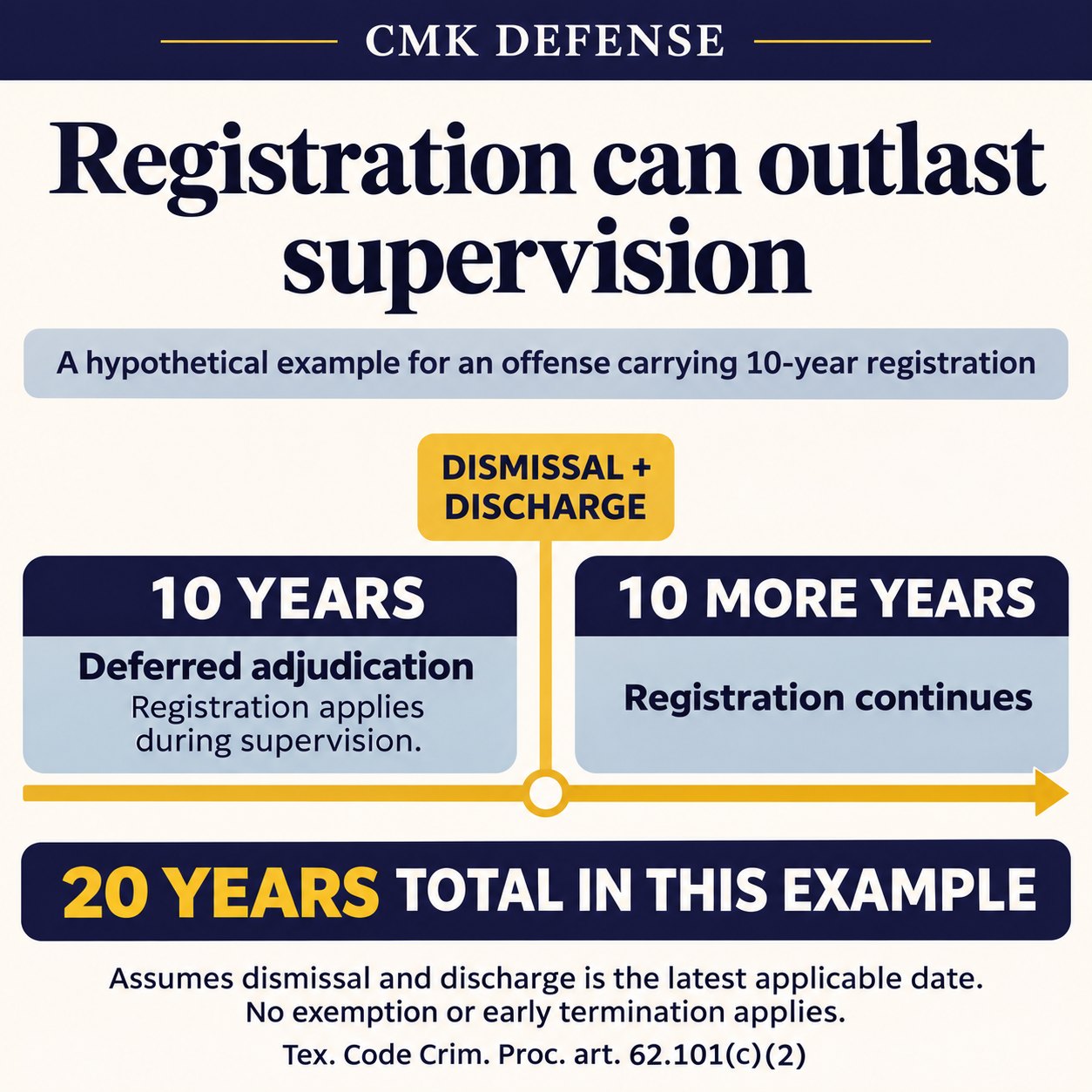
The key detail is when the 10 years begin. The clock does not start on the day you plead. For an adult, the duty ends 10 years after the latest of these dates: the day the court dismisses the case and discharges you from deferred adjudication, the day you are released from prison or jail, or the day you discharge community supervision. Tex. Code Crim. Proc. art. 62.101(c)(2).
In practice, that can mean registration lasts as long as the probation or deferred term, plus 10 more years. If someone completes a full 10-year deferred adjudication term on a 10-year registration offense, and no exemption or early termination applies, another 10 years of registration follows the dismissal and discharge: 20 years in all. Because the judge cannot discharge deferred early on a registrable offense, the deferred term does not get shorter for good behavior. Before anyone evaluates a plea offer, the length of supervision and the length of registration have to be read together.
Check-ins: every year or every 90 days
Most registrants verify their registration once a year, within 30 days before or after their birthday. Someone with two or more convictions or deferred adjudications for sexually violent offenses (and certain civilly committed people) must report at least once every 90 days. Tex. Code Crim. Proc. art. 62.058(a), (a-1).
What to Check Before Accepting a Plea Offer
For someone with a pending case, registration turns on three things, and all three should be checked before the case is resolved.
1. The exact offense, down to the subsection. In an ordinary adult case, indecency with a child by contact is a sexually violent offense and generally means lifetime registration. Indecency by exposure generally carries 10 years unless the person has or later receives another reportable conviction or deferred adjudication (a juvenile adjudication does not count). One subsection of the same Penal Code section separates a 10-year registrant from a lifetime one. Compare the indictment with the plea offer, then check the exact offense and subsection in the proposed judgment or deferred adjudication order, along with any required findings.
2. Findings the judge enters. Some registration consequences turn on a finding, not just the offense name.
- Unlawful restraint, kidnapping, and aggravated kidnapping become reportable with a finding in the judgment (or, for deferred adjudication, in the papers in the case) that the complainant was younger than 17. Aggravated kidnapping is also reportable, without that finding, when committed with intent to sexually abuse. Tex. Code Crim. Proc. arts. 42.015(a), 42A.105(b), 62.001(5)(C), (E).
- On the other side, in an indecency with a child (§ 21.11) or sexual assault (§ 22.011) case, the judge must enter an age-based finding when the defendant was no more than four years older than a complainant who was at least 15, and the conviction or plea is based solely on their ages. Tex. Code Crim. Proc. arts. 42.017, 42A.105(c). That finding is what later allows a petition for exemption under article 62.301 (see below). If it is not in the judgment or the papers, the exemption route may be closed, except for some cases resolved before September 1, 2011.
3. Whether the disposition is reportable at all. Resolving a case as an offense that is not on the article 62.001(5) list avoids the registration duty that would otherwise follow that case. Whether that is available depends on the evidence, the prosecutor, and the county, and it is often the most important subject of negotiation. But registration can also come from an earlier case, a condition of supervision, or another state’s law, so a proposed plea has to be checked against the person’s full history and the terms of the agreement.
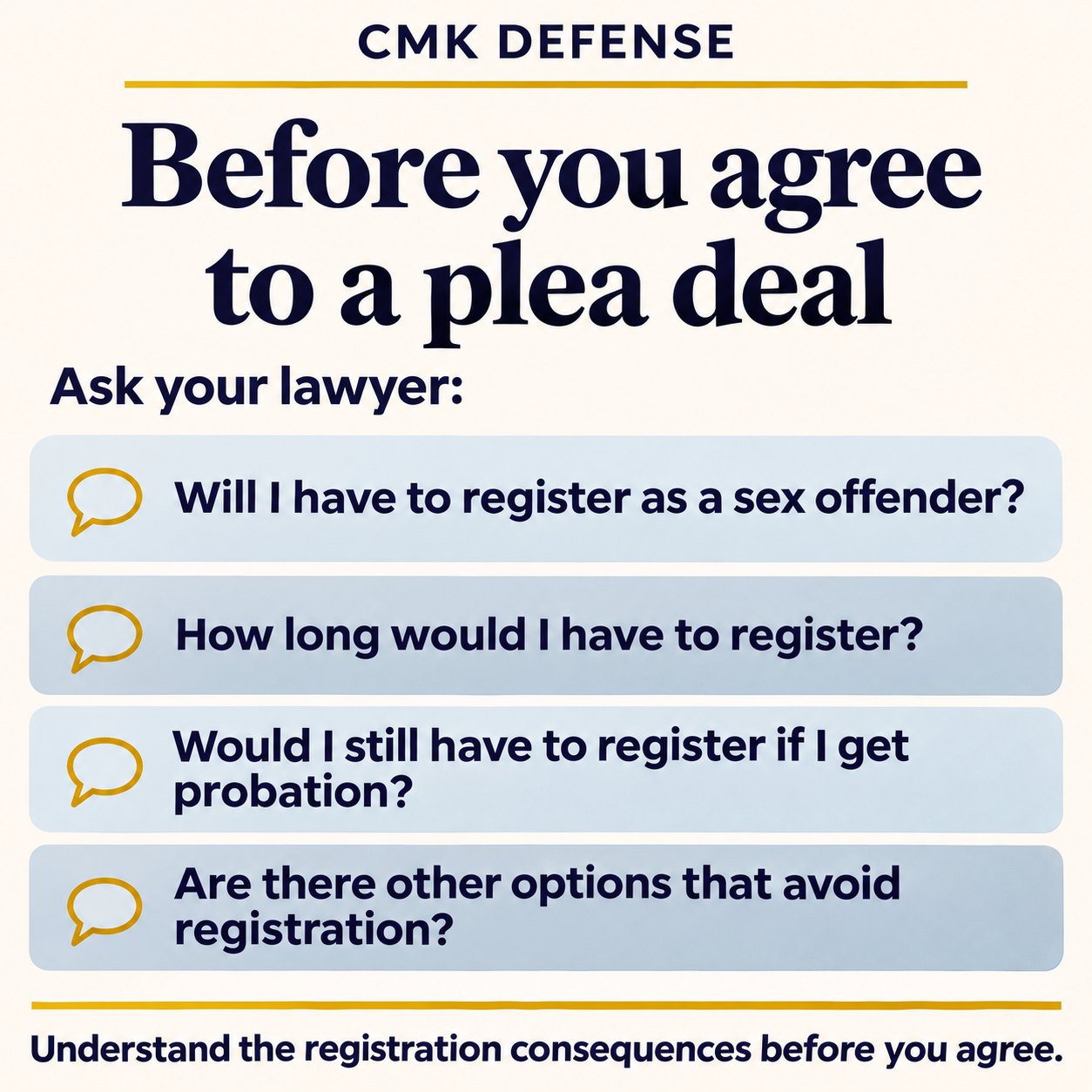
None of this is easy to repair after a plea. That is why the registration consequence of every offer should be laid out, offense by offense and subsection by subsection, before anything is signed.

Can You Get Off the Sex Offender Registry in Texas?
Sometimes, but the paths are narrow, and it is better to know that now than to plan around a remedy that may not apply.
Young-adult exemption. A person whose only registration comes from a single reportable conviction or deferred adjudication, and whose judgment or case papers include the age-based finding described above, can petition the court for an exemption at any time on or after sentencing or placement on deferred adjudication. After a hearing, the court can grant it if a preponderance of the evidence shows the exemption does not threaten public safety, the conduct was not without the complainant’s consent, and the exemption is in the best interest of the complainant and of justice. Some cases resolved before September 1, 2011, can qualify without the finding if the court finds the person would have been entitled to it. An exemption does not expire, but the court must withdraw it if the person later receives another reportable conviction or adjudication. Tex. Code Crim. Proc. art. 62.301.
Early termination. Some people with a single reportable conviction or adjudication from a Texas court may qualify to end their Texas registration duty early when the Texas period is longer than the minimum required under federal law. The Department of Public Safety publishes the list of Texas offenses and their federal tiers. The process requires an individual risk assessment through the Council on Sex Offender Treatment, then a motion in the court that sentenced the person. The court may deny the motion without a hearing. If the court grants it after notice and a hearing, the Texas registration duty ends on the later of the order date or the date the required costs are paid. Tex. Code Crim. Proc. arts. 62.401–.407. The council explains the steps on its deregistration page. Any separate federal or other-state obligation needs its own review.
Juvenile cases. In a juvenile case, the juvenile court can excuse registration, defer the decision until treatment is complete, or require registration but keep it off the public registry. Tex. Code Crim. Proc. arts. 62.351–.352. This works differently from the adult system and deserves its own conversation.
A reversal or an innocence pardon. If the conviction or adjudication behind the registration duty is set aside on appeal, or the person receives a pardon based on proof of innocence, the duty based on that case ends. Tex. Code Crim. Proc. art. 62.002(c).
What Happens If You Miss a Registration Requirement?
Failing to comply with any registration requirement is its own felony. The base classifications are a state jail felony for 10-year registrants, a third-degree felony for lifetime registrants who verify yearly, and a second-degree felony for lifetime registrants on 90-day verification. A prior failure-to-register conviction, or fraudulently using someone else’s identifying information while committing the offense, raises it one level. Tex. Code Crim. Proc. art. 62.102. The rules are detailed, including reporting a planned move in person at least seven days before it happens (art. 62.055(a)). Anyone who ends up registering needs a written list of their exact obligations from the start.
Results in Our Sex Offense Cases
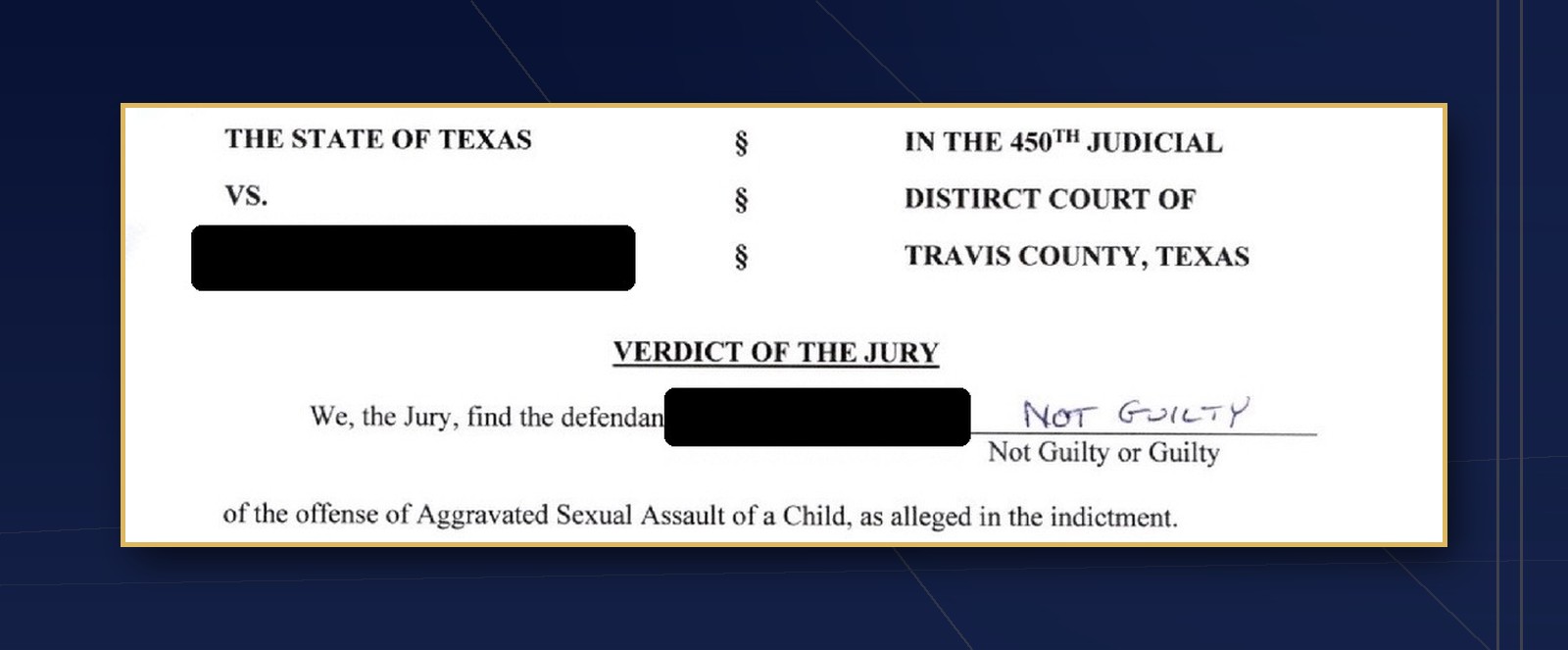
An acquittal is not a reportable conviction, so that charge creates no registration duty. Some of our results:
- Continuous sexual abuse of a young child, Travis County: not guilty, jury verdict. Read the Travis County continuous sexual abuse case study.
- Continuous sexual abuse of a child, Hays County: not guilty, jury verdict (July 2026). Read the Hays County continuous sexual abuse case study.
- Sexual assault of a child and aggravated sexual assault of a child, Travis County: not guilty, jury verdict. Read the Travis County sexual assault case study.
Past results do not guarantee a similar outcome. More on our Case Studies page.

Texas Sex Offender Registration: Common Questions
My son was just charged. Does he have to register while the case is pending?
Not because of the new charge alone. Registration under Chapter 62 starts with a reportable conviction or adjudication, not with an arrest or a pending charge, though a duty from an earlier case or a supervision condition can still apply. What happens to his case, and especially the exact offense it is resolved as, decides whether he registers later. His bond conditions may still limit contact, travel, or internet use while the case is open. Those are separate from registration; our guide to magistration and bond conditions explains how they are set in Travis, Williamson, Hays, and Bastrop counties.
Is the registry public? Would our home address show up?
Yes. The Department of Public Safety’s public sex offender registry shows the person’s name, photo, address, offense information, and numeric risk level, so a registrant’s residence address, including a family home, is public. By statute it leaves out Social Security and driver’s license numbers, phone numbers, employer information, and anything that identifies the complainant. Tex. Code Crim. Proc. art. 62.005(b). A juvenile court can order a registration kept off the public registry.
Does a “Romeo and Juliet” case require registration in Texas?
It can. Texas has close-in-age affirmative defenses, but the age gap alone does not establish one. For sexual assault of a child, one defense requires that the complainant was at least 14 and the accused was no more than three years older, along with other conditions. Tex. Penal Code § 22.011(e)(2). Indecency with a child has a similar defense with its own conditions. Tex. Penal Code § 21.11(b). A different rule, for cases where the complainant was at least 15 and the age gap was four years or less, can allow a petition to be exempted from registration, but only with the right court finding and a separate decision by the court. That petition generally requires a single reportable case, the court’s age-based finding, and an exemption order after a hearing. Tex. Code Crim. Proc. art. 62.301. Which rule applies depends on the facts and on what goes into the judgment.
Is online solicitation of a minor a registrable offense?
Yes. Online solicitation of a minor under Penal Code § 33.021 is on the registration list. In an adult case, it carries the 10-year period, which runs from the latest of release from confinement, discharge of community supervision, or dismissal and discharge of deferred adjudication. Many of these cases come from undercover operations, and how the conversation began and who steered it are often central to the defense. If police reach out before any charge, read whether you have to talk to police in Texas.
Do juveniles have to register in Texas?
Sometimes. A juvenile adjudication for a listed offense can carry registration, but juvenile courts have power that adult courts do not. They can excuse registration, defer the decision until treatment is finished, or keep the registration nonpublic. When juvenile registration does apply, it generally lasts 10 years from the disposition or the completion of its terms, whichever is later. A case transferred to adult court has its own 10-year rule. Tex. Code Crim. Proc. art. 62.101(b), (c)(1).
What happens to registration if I move to another state?
Texas generally requires an in-person report to the registration authority and the supervising officer at least seven days before an intended move. If the new state has a registration requirement, Texas law also requires registering there within 10 days after arrival. Tex. Code Crim. Proc. art. 62.055(a), (c). The new state’s deadline may be shorter, and federal law separately requires an in-person update within three business days after a change of residence. 34 U.S.C. § 20913(c). The Texas 10-day rule is not permission to wait 10 days everywhere, so confirm every deadline before moving.
Can a nondisclosure or expunction take someone off the registry?
Not usually. Texas law makes anyone whose offense requires registration ineligible for an order of nondisclosure, even after deferred adjudication. Tex. Gov’t Code § 411.074(b)(1)(A). Expunction is mainly for an acquittal, certain pardons, or an arrest that did not end in a conviction or court-ordered community supervision, and deferred adjudication is community supervision. Tex. Code Crim. Proc. arts. 55A.002–.004, 55A.051. So completing deferred adjudication on a registrable offense does not open the door to expunction or end registration. See our page on expunctions.
Can a plea deal be to something that doesn’t require registration?
Sometimes. A plea to an offense that is not on the Chapter 62 list avoids a registration duty from that case, though the lawyer still has to check the supervision terms, earlier cases, and any separate registration duty. For a registrable offense, the exact subsection can decide whether the period is 10 years or life. Whether that is realistic depends on the evidence and the prosecutor, so it is a question for a lawyer who has seen the file.

What to Do Now
Registration follows the exact offense of conviction or deferred adjudication, it lasts 10 years from a release or discharge date or for life, and the ways off the registry are narrow. The most useful thing you can do while a case is pending is make sure no offer is evaluated without its registration consequence spelled out:
- Get the charging papers (the complaint, and the indictment if there is one) to a defense lawyer, so the exact offense and subsection are clear.
- Ask what registration each possible outcome carries: the offense, the period, and any finding the judge would have to enter.
- Read the length of supervision and the length of registration together before weighing any offer.
- List any earlier case or other-state history, since registration can come from more than one source.
CMK Defense represents people facing sex crime charges in Austin and across Travis, Williamson, Hays, and Bastrop counties, including child sexual abuse and sexual assault cases. If you or someone in your family has been charged, we can review the charge and any offer, and tell you plainly what registration it would carry.
Call (512) 375-3303 or schedule a consultation.