
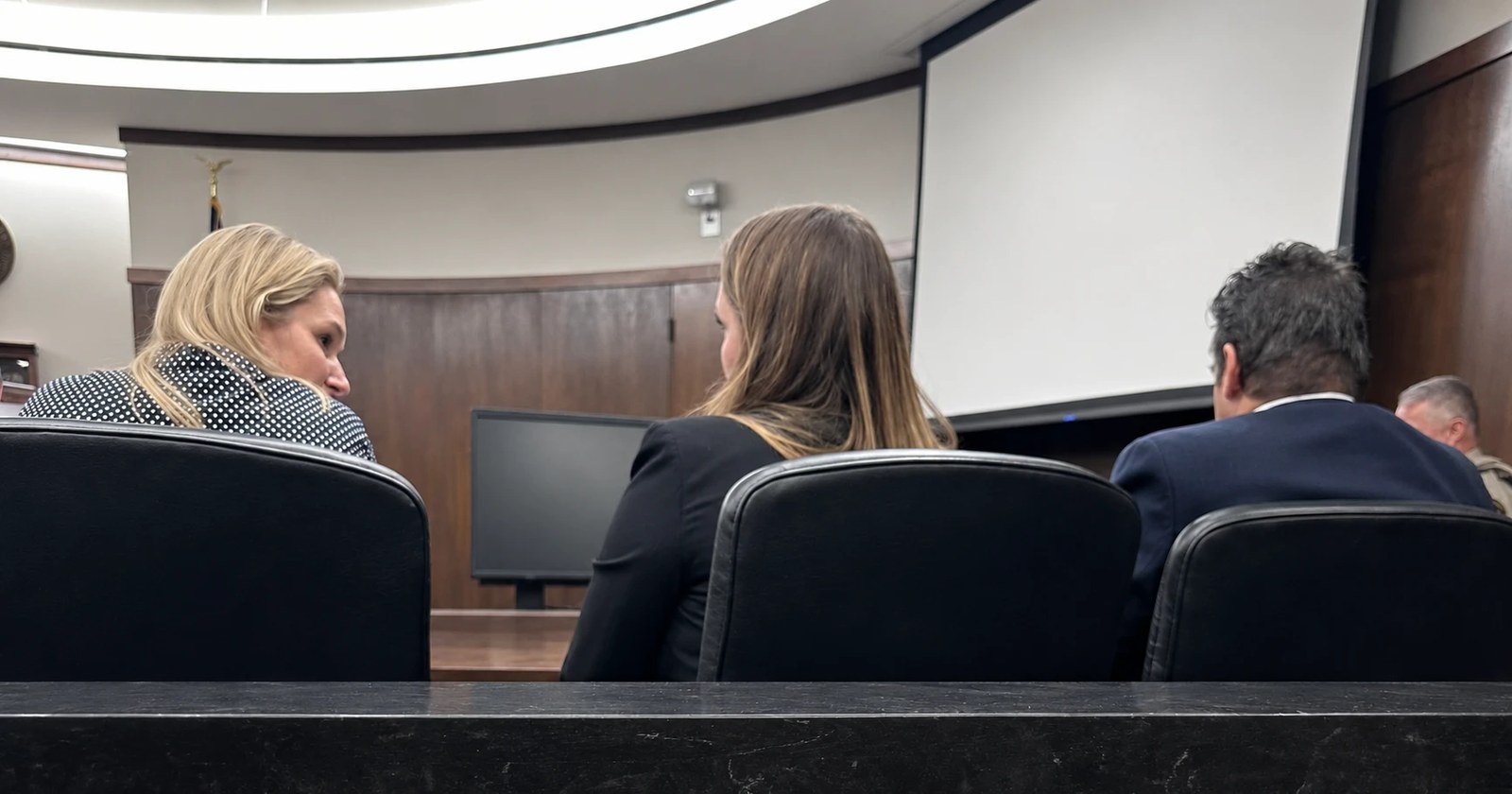
Angelica Cogliano with co-counsel Megan Roper at counsel table during a murder trial.
By Deniz Kadirhan, CMK Defense, PLLC | Austin, Texas
Reviewed November 11, 2026
The short answer
Yes. Under the law of parties in Texas, a driver, lookout, or passenger can be charged with murder even though someone else fired, and a conviction carries the penalties for murder. But a charge is not proof. The State has to prove beyond a reasonable doubt that the murder was committed and that you are responsible for it. Under the two routes covered here, that means proving either that you helped, encouraged, or tried to help commit that offense, and meant to; or that you joined an agreement to commit a felony, someone else in the agreement committed the killing while trying to carry out and further that plan, and the killing should have been anticipated. Tex. Penal Code §§ 7.02(a)(2), (b), 7.03. Being there is not enough. Gross v. State, 380 S.W.3d 181, 186 (Tex. Crim. App. 2012).
The police report says someone else fired. The charge still says murder. If you, or someone you love, was the driver, the friend in the passenger seat, or the person who stayed outside, you are probably asking how that is possible. The answer is the law of parties in Texas, and it works differently than most people expect.
Texas can charge a person who never touched the gun with murder. But before a jury can convict someone who did not fire, the State has to prove what that person intended or agreed to, not just where they were standing. The line between being there and being guilty is where these cases are fought.
This page walks through the two ways the State can hold one person responsible for what another person did (intentionally helping commit the offense, and the conspiracy rule), and the two charges that come up most when a robbery or another felony ends in a death: felony murder and capital murder.
This post covers Texas state law. Federal cases follow different rules.
The Law of Parties in Texas, Explained in Plain English
The law of parties is the set of rules that lets the State hold one person responsible for a crime another person physically committed. It is in Chapter 7 of the Texas Penal Code.
Why the charge says “murder” and not “helped with murder”
On TV, there is the person who did it and the “accomplice” or “accessory” who helped. Texas law dropped that distinction decades ago. The statute says:
“(a) A person is criminally responsible as a party to an offense if the offense is committed by his own conduct, by the conduct of another for which he is criminally responsible, or by both.
(b) Each party to an offense may be charged with commission of the offense.”
Subsection (c) abolishes the old line between principals and accomplices, and it lets the State charge and convict a party without saying which one the person was. Tex. Penal Code § 7.01(c).
In practice, that means the indictment for a driver often reads exactly like the indictment for the shooter. It does not have to say whether the State thinks you fired or helped. There is no separate, smaller crime of “being the driver.” That can be a shock to read. An indictment means a grand jury found probable cause, which is a low bar. It does not mean the State can prove the charge beyond a reasonable doubt.
Two ways the State can hold you responsible for what someone else did
Chapter 7 gives the State more than one route. Two of them come up again and again in these cases, and they ask very different questions.
| Helping on purpose | The conspiracy rule | |
|---|---|---|
| Where it is | § 7.02(a)(2) | § 7.02(b) |
| What the State must prove | You solicited, encouraged, directed, aided, or tried to aid the other person, and you did it with intent to promote or assist that offense. | You agreed with at least one other person to commit a felony. While trying to carry it out, one of you committed a different felony. That felony was committed in furtherance of the plan, and it should have been anticipated. |
| Must you have intended to help commit the crime you are charged with? | Yes. | No. The statute says “though having no intent to commit it.” |
| What the State might argue | You drove someone to a house knowing they were going there to shoot a person, and meaning to help. | You agreed to a robbery, and another person in the robbery killed someone. |
What “intent to promote or assist” actually means
The most common route to party liability is the first one:
“A person is criminally responsible for an offense committed by the conduct of another if: . . . (2) acting with intent to promote or assist the commission of the offense, he solicits, encourages, directs, aids, or attempts to aid the other person to commit the offense . . . .”
The State has to prove two things:
- An act. You solicited, encouraged, directed, aided, or tried to aid. Driving a car can be “aiding.” So can keeping watch, or handing someone a phone.
- A purpose. You did that act with intent to promote or assist the commission of the offense. Giving someone a ride is not enough. Giving someone a ride in order to help them commit the crime is.
That second part is the one people skip over when they first read a charge. It is also the one the State most often has to prove with circumstantial evidence, because almost nobody announces their intent out loud.
What the shooter’s case does, and does not, change
People often assume that if the shooter is acquitted, or takes a plea to something lesser, the case against everyone else falls apart. It does not. The statute says it is “no defense” that the person whose conduct is being attributed to you was acquitted, was never prosecuted or convicted, was convicted of a different offense, or is immune from prosecution. Tex. Penal Code § 7.03(2).
The flip side matters too. The State still has to prove that the offense was actually committed and that you were a party to it. Tex. Penal Code § 7.03. The shooter’s outcome does not decide your case in either direction. The evidence about you does.
Can You Be Charged With Murder If You Were Only the Driver in Texas?
Yes, you can be charged. Whether you can be convicted is a different question, and the answer turns on what the evidence shows you knew, intended, and did.
The driver, the lookout, and the person who waited outside
These three roles come up all the time, and each one gives the State a different problem.
- The driver. The State will argue the car was the plan: getting there, getting away. The defense question is what the driver knew and intended when they gave the ride, and as things unfolded. A ride to buy something, or a ride to see a friend, is not a ride to commit a robbery.
- The lookout. The State will argue that standing outside was keeping watch. The defense question is whether there is evidence of watching, as opposed to merely waiting, smoking, or being on a phone.
- The person who waited outside or stayed in the car. The State will argue that staying close was support. The defense question is whether staying close was anything more than just being there.
Being there is not enough
The Texas Court of Criminal Appeals has said this directly. In deciding whether someone was a party, a court may look at “events before, during, and after the commission of the offense,” and may rely on circumstantial evidence. Gross v. State, 380 S.W.3d 181, 186 (Tex. Crim. App. 2012). But there must be “sufficient evidence of an understanding and common design to commit the offense,” and “mere presence of a person at the scene of a crime, or even flight from the scene, without more, is insufficient to support a conviction as a party to the offense.” Id.
Two words in that sentence matter most: “without more.” Running away, by itself, is not proof of a plan. Panic can look a lot like guilt from the outside. A jury can weigh flight along with everything else, but flight alone does not make someone a party.
Gross was a driver’s case. By the driver’s account, he got into an argument with a stranger at a red light and pulled over, his passenger got out with a shotgun and killed the man, and he panicked and drove the shooter away. A jury convicted him of murder as a party. Id. at 183–84. The court of appeals threw that conviction out, and the Court of Criminal Appeals agreed: the evidence did not show he was part of a plan to shoot anyone, “either prior to or contemporaneously with the act.” Id. at 189. The court added that what he did afterward might support a different charge, hindering apprehension, but not murder. Id. at 186.
What evidence does the State use to prove intent?
Intent usually has to be pieced together from what people said and did before, during, and after the event. Expect the State to look at:
- Messages before the event. Texts, DMs, and group chats about the plan, the target, or a weapon.
- What was said in the car. Often reported by a co-defendant or a cooperating witness.
- Phone and location records. Where a phone was, and when. That is not always the same as who was holding it.
- Conduct afterward. Sharing money or property, helping hide a weapon, deleting messages, lying to police.
Some of that evidence can be damaging. Deleting a thread or splitting proceeds afterward is the kind of “after” evidence the State uses to argue you were in on it from the start. That does not end the case. What someone does after a shooting is relevant to what they knew or intended earlier, but it “cannot stand alone.” Gross, 380 S.W.3d at 188. The questions that matter are about timing. What did you know, and what did you do, before or while it happened? And if the State says there was an agreement to commit a felony, what evidence shows you actually joined it?
When the State’s main witness is a co-defendant
In many party cases, the clearest evidence of what was “agreed” comes from someone else who was charged. If that witness is an accomplice, Texas law requires more than their word:
“A conviction cannot be had upon the testimony of an accomplice unless corroborated by other evidence tending to connect the defendant with the offense committed; and the corroboration is not sufficient if it merely shows the commission of the offense.”
The Court of Criminal Appeals has explained the reason: accomplices “often have incentives to lie, such as to avoid punishment or shift blame to another person.” Zamora v. State, 411 S.W.3d 504, 509–10 (Tex. Crim. App. 2013) (quoting Blake v. State, 971 S.W.2d 451, 454 (Tex. Crim. App. 1998)). A witness charged with the same offense, or a lesser-included offense, is an accomplice as a matter of law. Id. at 510. For other witnesses who were involved, whether they count as accomplices can be a question for the jury. Id. So when a co-defendant takes a deal and points at you, the State still needs independent evidence tending to connect you to the crime. Evidence that only shows a crime happened is not enough.
The Conspiracy Rule: When One Person’s Act Becomes Everyone’s Charge
The second route is the conspiracy rule. It is how the State charges a person with a crime they never intended to happen:
“(b) If, in the attempt to carry out a conspiracy to commit one felony, another felony is committed by one of the conspirators, all conspirators are guilty of the felony actually committed, though having no intent to commit it, if the offense was committed in furtherance of the unlawful purpose and was one that should have been anticipated as a result of the carrying out of the conspiracy. In this subsection, ‘conspiracy’ means an agreement between two or more persons to commit a felony.”
Broken into parts, the State has to prove that (1) you were part of an agreement to commit a felony, and the group was trying to carry it out; (2) another person in that agreement committed a different felony; (3) that felony was committed in furtherance of the plan; and (4) it was one that should have been anticipated as a result of carrying out the plan. The Court of Criminal Appeals listed those four parts in the case of a getaway driver whose passenger shot at a game warden after a robbery. Hooper v. State, 214 S.W.3d 9, 11, 14 n.4 (Tex. Crim. App. 2007).
Each of those four parts is a separate thing the State has to prove, and each one can fail on its own.
What counts as an agreement to commit a felony?
The last sentence of § 7.02(b) defines “conspiracy” as “an agreement between two or more persons to commit a felony.” The Legislature added that sentence in 2023. It applies to offenses committed on or after September 1, 2023; if any element of the offense happened before that date, the earlier version of the statute applies. Act of May 24, 2023, 88th Leg., R.S., ch. 735, §§ 1–3 (H.B. 2961). The definition did not change the rest of the rule. It does say in plain words what the State has to show first: an actual agreement to commit a felony. Showing up together is not an agreement.
What does “should have been anticipated” mean?
The State does not have to prove you actually expected a death. The test is whether the killing should have been anticipated, which the Court of Criminal Appeals has described as whether it was “reasonably foreseeable” under the “totality of the circumstances.” George v. State, 634 S.W.3d 929, 939 (Tex. Crim. App. 2021). And the question is not limited to what was planned in advance. It covers what you should have anticipated at any point before or while the plan was being carried out. Id.
That is a judgment about the plan as you understood it, and it turns on evidence. In George, the court refused to adopt a blanket rule that anyone who agrees to a robbery should expect someone to be killed. The answer depends on the specific facts of each case. Id. at 932–33. Facts like these:
- Did you know anyone was armed?
- Was the plan a sale, a confrontation, or a robbery?
- Did the shooter do something sudden, personal, or outside anything discussed?
- Was the killing actually “in furtherance” of the felony, or was it a separate act driven by something else?
A plan to sell something is not necessarily a plan to rob someone. A plan to rob someone unarmed is not the same as a plan where everyone knew about the gun. These distinctions are the case.
What Is Felony Murder in Texas, and Who Can Be Charged With It?
Felony murder is a way of proving murder without proving anyone intended to kill. It is one of the ways the Penal Code defines murder. The law of parties is a separate question: it decides who, besides the person who did the act, can be held responsible.
Felony murder in one sentence
Under Texas law, a person commits murder if the person:
“(3) commits or attempts to commit a felony, other than manslaughter, and in the course of and in furtherance of the commission or attempt, or in immediate flight from the commission or attempt, the person commits or attempts to commit an act clearly dangerous to human life that causes the death of an individual . . . .”
Put plainly: if someone dies because of an act clearly dangerous to human life, and that act was committed in the course of and to further a felony (or in immediate flight from it), that can be murder even if no one wanted anyone to die. It is still a first-degree felony. Tex. Penal Code § 19.02(c). For how felony murder compares to the other homicide charges, see the four types of homicide in Texas.
Who can be held responsible for it? The person who committed the dangerous act, and anyone the State can prove was a party under either route above: by intentionally helping commit the offense, or under the conspiracy rule.
When Can a Killing During a Robbery Be Capital Murder?
A killing during a robbery can be charged as capital murder when the State says the killing was intentional. Many cases involving a driver or lookout are charged that way, not as murder. Capital murder includes a murder a person intentionally commits “in the course of committing or attempting to commit kidnapping, burglary, robbery, aggravated sexual assault, arson, obstruction or retaliation,” or certain terroristic threats. Tex. Penal Code § 19.03(a)(2).
Someone has to have killed intentionally. A person who did not fire can still be convicted of that capital murder as a party, in either of two ways. The State can prove the person intentionally helped commit it. Tex. Penal Code § 7.02(a)(2). Or the State can use the conspiracy rule, by proving the person agreed to the robbery and that (1) someone else in the agreement committed the murder, (2) the murder was committed in furtherance of the robbery, and (3) the murder should have been anticipated as a result of carrying out the plan. George, 634 S.W.3d at 938.
Does a Party Face the Same Punishment as the Shooter?
A party is convicted of the offense itself, so a party faces the penalties for that offense. That is the same starting point as the shooter. It does not mean the same range in every case, and it never means the same sentence automatically.
Murder
Murder is a first-degree felony. Tex. Penal Code § 19.02(c). That ordinarily means five to 99 years or life in prison, plus a possible fine of up to $10,000. Tex. Penal Code § 12.32. Where a sentence falls in that range can depend on what each person actually did. A person’s own prior felony convictions can also raise the minimum, so two people convicted of the same murder can face different ranges. Tex. Penal Code § 12.42(c)(1), (d). Our guide to felony punishment ranges in Texas explains how ranges work.
A range is not a prediction, and it says nothing about how the evidence on intent will hold up.
Capital murder
Capital murder is a capital felony. Tex. Penal Code § 19.03(b). In a capital murder case in adult court where the State does not seek the death penalty, the sentence is life without parole for a person who was 18 or older at the time of the offense, and life for a person who was younger than 18. Tex. Penal Code § 12.31(a).
If the State does seek death, and the jury was allowed to convict on a party theory, the law adds a step at sentencing. The State must prove beyond a reasonable doubt that the defendant actually caused the death, or intended to kill the person who died or someone else, or “anticipated that a human life would be taken.” Tex. Code Crim. Proc. art. 37.071, § 2(b)(2), (c). That is a higher bar than the one at the guilt stage. A person can be convicted under the conspiracy rule because a death should have been anticipated. A death sentence requires proof that the person actually anticipated it, intended it, or caused it. Valle v. State, 109 S.W.3d 500, 503–04 (Tex. Crim. App. 2003). That finding is one of several the law requires before a death sentence.
What Happens Next, and Why Timing Matters
A murder or capital murder case usually goes to a grand jury before trial. Before an indictment, a defense lawyer may be able to give the prosecutor information about what happened and what role the accused actually played. Whether the case is still being investigated or has already been charged, a few things matter right away.
- Do not try to explain your side to investigators alone. In a party case, the detective is looking for exactly the details that prove or disprove intent. (See Do I Have to Talk to Police in Texas If I’m Not Under Arrest?)
- Do not talk about it on the phone, by text, or online. That includes calls from jail. (See Are Jail Phone Calls Recorded and Used Against You in Texas?)
- Keep the evidence about intent. Phone records, messages, and location data are easiest to preserve early. Do not delete anything.
- If the person charged is in custody, release comes first. (See What Happens at a Magistration Hearing in Texas? and How a Bond Reduction Hearing Works in Travis County.)
- Get a defense lawyer involved as early as you can. If the case has not been indicted yet, that means before the grand jury acts, while the charge is still being decided.
Law of Parties in Texas: Common Questions
Can you go to jail for murder in Texas if you didn’t kill anyone?
Yes. You can be charged with murder and, if the State proves its case, convicted, even if someone else did the killing. Under the two routes covered here, the State has to prove either that you helped, encouraged, or tried to help commit the offense, and meant to; or that you joined an agreement to commit a felony, someone else in the agreement committed the killing while trying to carry out and further that plan, and the killing should have been anticipated. Tex. Penal Code § 7.02(a)(2), (b). Being present is not enough. Gross, 380 S.W.3d at 186.
Does a party get the same sentence as the shooter in Texas?
Not necessarily. A party faces the penalties for the offense of conviction, which is the shooter’s starting point too. For murder, the range is ordinarily five to 99 years or life, and a person’s own prior felony convictions can raise the minimum. Tex. Penal Code §§ 12.32(a), 12.42(c)(1), 19.02(c). Where a sentence falls in that range depends on the facts, including what each person actually did. Capital murder has its own rules, including life without parole for an adult when the State does not seek death. Tex. Penal Code § 12.31(a).
What if I didn’t know he had a gun?
What you knew about a gun can matter under both routes. If the State says you intentionally helped commit the offense, it bears on whether you intended to help commit the offense charged. If the State relies on the conspiracy rule, it bears on whether the killing should have been anticipated. A jury looks at all the circumstances of the plan and how it was carried out, not at one fact alone. Tex. Penal Code § 7.02(a)(2), (b); George, 634 S.W.3d at 939.
What happens to my case if the shooter is acquitted or takes a plea deal?
Your case can continue either way. Texas law says the shooter’s acquittal, conviction of a different offense, or lack of prosecution is not a defense for a party. Tex. Penal Code § 7.03(2). It also does not prove anything against you. The State still has to prove that the offense was committed and that you were a party to it, with evidence about you.
Is a getaway driver an accessory or a principal in Texas?
Texas does not use those labels anymore. A driver who acted with intent to help commit the crime can be charged as a party with the crime itself. Tex. Penal Code § 7.01(b)–(c). A person who only helps someone after the fact, without being part of the crime, may instead face a separate charge such as hindering apprehension. Tex. Penal Code § 38.05.
Can the State use my texts to prove I was part of a plan?
Yes. Courts can look at events before, during, and after the offense, and circumstantial evidence counts. Gross, 380 S.W.3d at 186. That cuts both ways: messages that show a different plan, or no plan, are just as much a part of the picture.
Is the law of parties the same as a criminal conspiracy charge?
No. The law of parties is not a separate crime. It is a way of holding a person responsible for an offense someone else committed, either because the person intentionally helped commit it or under the conspiracy rule in § 7.02(b), where “conspiracy” means an agreement between two or more people to commit a felony. Criminal conspiracy is its own offense with its own elements: agreeing with someone, with intent that a felony be committed, plus an overt act by one of the people in the agreement. Tex. Penal Code § 15.02(a).
Can a co-defendant’s testimony alone convict me in Texas?
Not if the co-defendant is an accomplice witness. Texas law then requires other evidence tending to connect you to the offense, and evidence that only shows a crime happened is not enough. Tex. Code Crim. Proc. art. 38.14. A witness charged with the same offense, or a lesser-included offense, is an accomplice as a matter of law. Zamora, 411 S.W.3d at 510.
Does running from the scene make me a party to the crime?
Not by itself. The Court of Criminal Appeals has said that presence at the scene, “or even flight from the scene, without more,” does not prove someone was a party. Gross, 380 S.W.3d at 186. A jury can consider flight along with the rest of the evidence, but the State still needs other evidence that you took part.
My son was only in the car. Can he really be charged with murder?
Yes, he can be charged, and that is often the first thing families hear. The charge is where the case starts, not where it ends. To convict him, the State must prove he intentionally helped or tried to help commit the offense he is charged with, or that he joined an agreement to commit a felony, someone else in that agreement committed the killing while trying to carry out and further that plan, and the killing should have been anticipated. His presence in the car does not prove either one. A defense lawyer can explain how that applies to his specific facts.
Can we get our son out on bond if he is charged with murder or capital murder?
It may be possible, but it is not guaranteed. Since November 2025, the Texas Constitution requires a judge to deny bail on a murder or capital murder charge if, after a hearing, the State shows by a preponderance of the evidence that bail will not reasonably prevent him from willfully missing court, or shows by clear and convincing evidence that bail will not reasonably ensure the safety of the community, law enforcement, and the complainant. Tex. Const. art. I, § 11d(a)–(b). He has the right to a lawyer at that hearing. Tex. Const. art. I, § 11d(f). Bail can also be denied in a capital case when the proof is evident. Tex. Const. art. I, § 11. If bond is set, our guide to bond reduction hearings in Travis County explains what affects the amount.
Should he talk to the detective to explain he wasn’t involved?
Not without a lawyer. In a party case, the investigator is looking for exactly the details that prove or disprove intent, and an explanation given without counsel can supply the State’s missing piece. See Do I Have to Talk to Police in Texas If I’m Not Under Arrest?
The Bottom Line on Party Liability in Texas
The law of parties in Texas lets the State charge someone who did not fire the gun with murder, or with capital murder. It does not let the State skip the hard part. To convict, the State has to prove you intentionally helped or tried to help commit the offense charged, or prove an actual agreement to commit a felony, a killing committed by someone in that agreement while trying to carry out and further the plan, and a death that should have been anticipated. Presence, flight, and an accomplice’s word, standing alone, do not get it there.
CMK Defense represents people facing murder and capital murder charges in Austin and across Travis, Williamson, Hays, and Bastrop counties. If you or someone in your family is under investigation or has been charged, call (512) 375-3303 or schedule a consultation to talk through the evidence, the State’s theory, and the next court date.