

By Deniz Kadirhan, CMK Defense, PLLC | Austin, Texas
Reviewed October 30, 2026
It usually starts politely. An officer at a traffic stop, or a detective in a room you were told you could leave, asks, “Mind if I take a look at your phone?” It sounds like a formality. It is not.
So, can police search your phone without a warrant in Texas? As a general rule, no. Police need a warrant to go through the contents of your phone, and that rule holds even after an arrest. There are exceptions, and the one that turns on a decision you make in the moment is consent. If you say yes, and the yes is voluntary, police do not need a warrant for whatever your yes covered.
Where you start depends on where you are:
- If police are asking to search your phone: you can say no. See what to do if police ask for your phone.
- If police already took your phone: taking it and searching it are different things. See taking a phone vs. searching it.
- If you already said yes: you may still be able to challenge the search. The State has to prove you agreed voluntarily, and police could search only what you agreed to. See I already said yes.
Can police search my phone without a warrant in Texas?
The rule after an arrest
In 2014 the U.S. Supreme Court decided that a phone is not like a wallet or a pack of cigarettes in your pocket. Officers can take it when they arrest you, but to search what is on it, the Court’s instruction was short: “get a warrant.” Riley v. California, 573 U.S. 373, 403 (2014). The Court was clear that phone data is not off-limits to police; a warrant is generally required before they search it. Id. at 401. The Court also left room for case-specific exceptions, such as a genuine emergency. Id. at 401–02.
The same year, Texas’s highest criminal court reached the same conclusion in a Texas case. A high school student’s phone was sitting in a jail property room after his arrest, and an officer went in, turned it on, and looked through it. The court held that the student still had a reasonable expectation of privacy in his phone’s contents, and that the officer could have held the phone while he got a warrant but could not search it without one. State v. Granville, 423 S.W.3d 399, 417 (Tex. Crim. App. 2014).
Texas put it in a statute
The Legislature then wrote the rule into the Code of Criminal Procedure:
A peace officer may not search a person’s cellular telephone or other wireless communications device, pursuant to a lawful arrest of the person without obtaining a warrant under this article.
Tex. Code Crim. Proc. art. 18.0215(a).
The statute also says what a warrant application has to contain: a sworn, written application from an officer that identifies the device and lays out probable cause that a search will turn up evidence of a crime. Id. art. 18.0215(c).
The exceptions, and why consent is the one that matters
The same statute lists the situations where an officer can search a phone without a warrant:
Notwithstanding any other law, a peace officer may search a cellular telephone or other wireless communications device without a warrant if:
(1) the owner or possessor of the telephone or device consents to the search;
(2) the telephone or device is reported stolen by the owner or possessor; or
(3) the officer reasonably believes that:
(A) the telephone or device is in the possession of a fugitive from justice for whom an arrest warrant has been issued for committing a felony offense; or
(B) there exists an immediate life-threatening situation, as defined by Article 18A.201.
Tex. Code Crim. Proc. art. 18.0215(d).
Look at that list. A stolen phone, a felony fugitive, a life-threatening emergency: those are narrow situations, and the last two come with a judge built in. When an officer searches because he believes the phone is in a felony fugitive’s possession, or because of an immediate life-threatening situation, he has to apply for a warrant as soon as practicable afterward. If the judge finds that the situation did not occur and declines to issue the warrant, the evidence is not admissible. Id. art. 18.0215(e).
Consent gets no automatic review. A judge looks at whether it was valid only if your defense lawyer challenges it. It is the first item on the list, and it is the one that depends on what you say when the officer asks.
Taking your phone and searching it are two different things
Many people say yes because they assume the phone is going to get searched either way. That assumption is wrong, and it starts with a distinction most people never hear.
Seizing a phone means taking it and holding it. Searching it means opening it and looking at what is inside. Granville drew exactly this line: police may be able to take a phone and keep it while they go get a warrant, but taking it does not give them permission to look. 423 S.W.3d at 417.
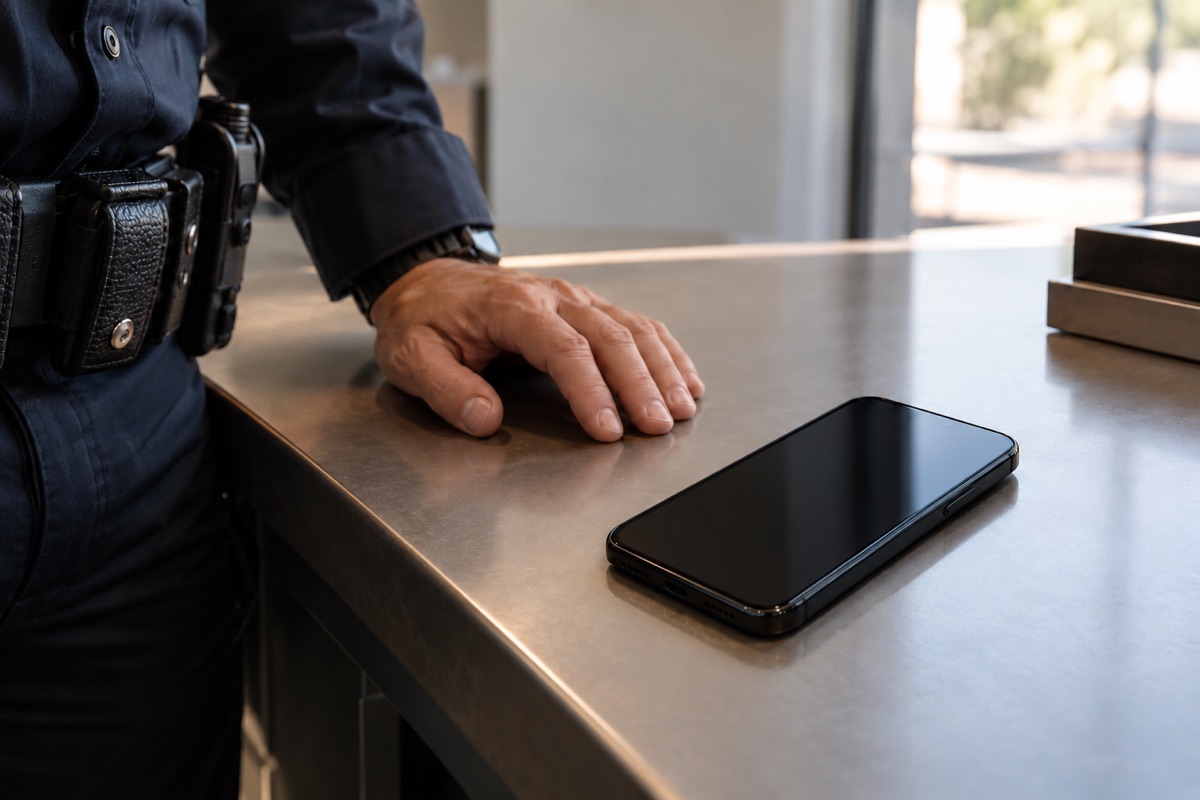
So saying no may not keep the phone in your hand. What it does is take consent off the table. If police still want to look, they generally need a warrant, which means an officer has to write down, under oath, why he believes this phone holds evidence of this crime, and a judge has to agree.
What does consent actually cost you?
You give up the warrant, and every fight that comes with it
A warrant is a paper trail, and a defense lawyer can challenge what is on that paper. In 2022 the Texas Court of Criminal Appeals held that a phone warrant cannot rely only on boilerplate about how criminals commonly use phones. The affidavit has to connect this device to this offense with real facts. State v. Baldwin, 664 S.W.3d 122, 134–35 (Tex. Crim. App. 2022).
That is a meaningful protection. Affidavits get challenged for exactly this kind of gap: a generic paragraph about phones, stapled to facts that never explain why the phone matters. When police search on valid consent, there is no affidavit. The probable cause question that a judge would have had to answer, and that your lawyer could have attacked later, never gets asked.
That challenge can change the outcome of a case. In a Travis County murder case, we challenged the warrant used to search our client’s phone, and the court kept that evidence out, so the jury never heard what was on the phone. Before trial, the State’s offer had been 40 years. While the jury was deliberating, the prosecutor offered three years on a lesser charge of manslaughter, and our client accepted. Read the case study.
Consent takes that fight off the table before it starts.
“Just a quick look” can turn into the whole phone
The law measures what you agreed to by what a reasonable person would have understood from the conversation between you and the officer. Florida v. Jimeno, 500 U.S. 248, 251 (1991). You have the right to limit it. Id. at 252.
That is easy to miss in the moment. “Can I take a look?” is a vague question, and “sure” is a vague answer. You may have meant one conversation. The officer may say you meant everything. And everything is a lot: forensic software can copy a phone’s messages, photos, location history, and app data in a single extraction.

Whether “sure, look at my texts with her” covered a full download of your phone then becomes a dispute over exactly who said what.
Saying no is not an admission
Officers ask for consent because consent is easier than a warrant. Saying no is not obstruction, and it is not an admission of anything. It means police need some other legal basis to search, usually a warrant, and a warrant means a sworn explanation in front of a judge.
Saying yes, on the other hand, gets treated as an invitation. And phones hold context-free fragments: a text that reads one way alone and another way inside the full thread, a search history, a photo with a date stamp. Once it has been extracted, that material is in the file, and arguments about what it means come later. An apology text is a common example.
I already said yes. Now what?
That is not the end of the analysis. It is the beginning of a different one.
In Texas, the State has to prove your consent was voluntary
Consent only counts if it was given freely. When a search is challenged, Texas requires the State to prove the consent was voluntary by clear and convincing evidence. State v. Ibarra, 953 S.W.2d 242, 245 (Tex. Crim. App. 1997); see also Meekins v. State, 340 S.W.3d 454, 459 (Tex. Crim. App. 2011). That is a demanding standard, well above “more likely than not,” and the burden sits on the prosecution, not on you.
Courts look at the totality of the circumstances. Meekins, 340 S.W.3d at 459–60. The question is not just whether you said a word that sounded like yes. It is whether, given everything going on around you, that yes was your free choice.
What makes consent involuntary
Consent cannot be coerced, openly or by implication. Schneckloth v. Bustamonte, 412 U.S. 218, 228 (1973). And a yes given only in submission to a claim of lawful authority does not count as consent at all. Id. at 233.
In practice, the facts that matter tend to be things like:
- What the officer said. Was the request phrased as a question or as an instruction? Was there a suggestion that refusing would make things worse, or that the search was going to happen regardless?
- The setting. How many officers, where, for how long, whether you had been told you were free to leave, and whether you were in handcuffs.
- Your own situation. Your age, whether you understood what was being asked, and what state you were in at the time.
- Whether you knew you could say no. Not knowing does not automatically make consent invalid, but it is one of the circumstances a court weighs. Schneckloth, 412 U.S. at 227.
None of these is a magic word. The point is that “he said yes” is the State’s starting position, and every circumstance around that yes is open to challenge.
Did police stay inside what you agreed to?
Even valid consent has limits. If you agreed to let an officer look at one conversation and the State is holding a full forensic extraction of your phone, the gap between those two things is a real issue. Jimeno, 500 U.S. at 251–52. What did you actually say? What did the officer say? Was there a written consent form, and what did it describe?
Can you take back a yes?
Yes. A person who consents to a search can limit that consent or revoke it. Valtierra v. State, 310 S.W.3d 442, 450 (Tex. Crim. App. 2010). Say it plainly: “I’m withdrawing my consent to search my phone.” Do not grab the phone back. What police saw before you withdrew is a separate question from what they did after, so the exact moment you said it matters, and a recording is the best proof of when that was.
What a defense lawyer looks at first
Memories of a roadside conversation fade and shift. The records usually do not. In a consent case, these are the first things to get:
- The recording. Body-worn camera, dash camera, or interview-room video often captures the exact words of the request and the answer, how many officers were there, and whether anyone mentioned a warrant.
- The consent form, if there is one. What it describes (one app, one conversation, or the whole device), when it was signed, and whether it was signed before or after the search started.
- The extraction report. Forensic tools generate a report of the extraction itself, which typically shows what kind of extraction was run, when, and what categories of data were pulled. That is where a “quick look” that became a full download shows up.
- The timeline. When the phone was taken, when consent was given, when the search or extraction happened, and whether anyone applied for a warrant along the way. Gaps and out-of-order steps matter.
Some of these records are kept only for a limited time, which is one reason to have a lawyer request them early.
What happens to evidence from a bad search
Texas has its own statutory exclusionary rule, and it is broader than the federal one:
No evidence obtained by an officer or other person in violation of any provisions of the Constitution or laws of the State of Texas, or of the Constitution or laws of the United States of America, shall be admitted in evidence against the accused on the trial of any criminal case.
Tex. Code Crim. Proc. art. 38.23(a).
If the consent was not voluntary, or police searched past what you agreed to, the question becomes what has to be kept out. That is decided through a motion to suppress, which is a request that the judge exclude the evidence, either before trial or during it. Whether one is worth filing depends on facts specific to your case, and that is a conversation to have with a lawyer who has seen the recordings.
What to do if police ask for your phone
- You can say no, calmly and clearly. “I don’t consent to a search of my phone” is enough. You do not have to explain why.
- Do not physically resist if an officer takes the phone anyway. Seizure and search are separate questions, and the search question can be fought later. A struggle cannot be undone, and it could lead to more charges.
- If you have already agreed, do not try to fix it on your own by deleting anything or contacting anyone involved in the case. Both create new problems and could lead to more charges.
- Write down what you remember about the conversation as soon as you can: what was asked, what you said, who was there, and whether anything was recorded or signed.
- Talk to a defense lawyer before any further conversation with police. If you have not been arrested, our guide to talking with police before an arrest covers the rest of that conversation.
FAQ: Police phone searches without a warrant in Texas
Can police go through my phone at a traffic stop in Texas?
Not without a warrant or an exception. When an officer at a traffic stop asks to look at your phone, he is asking for your consent, and you are allowed to refuse. A warrant is generally required before police search a phone’s contents. Riley, 573 U.S. at 401.
If I show an officer one text, can they look through the rest of my phone?
Not automatically. The scope of consent is measured by what a reasonable person would have understood from the exchange, and you can limit it. Jimeno, 500 U.S. at 251–52. If you handed the phone over to show one message and the officer kept scrolling, that difference is something your lawyer will want to examine.
Can I change my mind after I agree to a phone search?
Yes. In Texas, a person who consents to a search can limit or revoke that consent. Valtierra, 310 S.W.3d at 450. Say it clearly, do not physically take the phone back, and tell your lawyer exactly when you said it. What police saw before you withdrew consent is a separate question from anything they looked at after.
Can police keep my phone? How do I get it back?
Police can sometimes hold a phone while they apply for a warrant, even when they cannot search it yet. Granville, 423 S.W.3d at 417. Getting it back depends on whether it is being held as evidence and on the status of your case, so ask your lawyer to raise it early rather than calling the department yourself.
Does saying no to a phone search make me look guilty?
Saying no is a choice the law gives you, and officers hear it every day. It does not stop the investigation. It means police need a warrant or another legal basis before they search, and a warrant requires a judge to agree there is a real reason to look. An officer may read your no as a sign you are hiding something, but his suspicion alone does not get him into your phone.
Can police search my phone if I’m not under arrest?
They still need a warrant or an exception. If an officer is asking for your permission, the exception he is relying on is your consent. If police want to talk with you and you have not been arrested, read our guide to non-custodial police interviews in Texas before you agree to anything, including handing over your phone.
What if the officer said they would just get a warrant anyway?
It depends on exactly what was said and whether it was true. Consent given only in submission to a claim of lawful authority is not valid consent, Schneckloth, 412 U.S. at 233, and a statement like this is one of the circumstances a court weighs in deciding whether a yes was voluntary. Get the recording if one exists; the precise words matter.
Police took my son’s phone when they arrested him. Can they search it?
Not without a warrant, unless an exception applies, such as his consent. Texas law bars searching a phone incident to an arrest without a warrant. Tex. Code Crim. Proc. art. 18.0215(a). If he was asked for consent while in custody, the circumstances of that request are something his lawyer will look at closely. For what happens in the first hours after an arrest, see our guide to magistration in Texas. If he is still in jail, keep the case off the phone there too: jail phone calls are recorded and can be used against him.
My husband let detectives copy his phone. Can a lawyer still challenge that?
Often, yes. In Texas the State must prove the consent was voluntary by clear and convincing evidence, Ibarra, 953 S.W.2d at 245, and even voluntary consent has limits on what it covers. Whether a challenge is worth bringing depends on what was said, what was signed, and what was actually taken, which is exactly what a defense lawyer reviews first.
If police have your phone, or want it
Here is where that leaves you. Police generally need a warrant to search your phone in Texas, and consent is the exception that turns on what you say. If you have not been asked yet, you can say no; if police still want to search, they generally need a warrant or another exception. If you already said yes, the search is not beyond question: the State has to prove your consent was voluntary, and police could search only what you agreed to. The best evidence on both points, the recordings, any signed forms, and the extraction report, is worth having your lawyer request now.
If police have your phone or have asked for it, call CMK Defense at 512-375-3303 to talk through what happened.